It is 9:30 on the morning of September 22, 1776. Morning light makes its way through a nearby window, falling across a wooden ladder-back chair in a home somewhere near the British artillery park in Manhattan. On any other morning, it might feel ordinary, but this is not an ordinary morning.
Beyond the home’s front door, British soldiers occupy the city, their artillery positioned nearby. Voices can be heard carrying through the streets as troops move about. A restless feeling hangs in the air, something difficult to ignore even from inside the comfort of home.
New York was at war, and on that morning, the city bore the signs of having been shaken by the Great Fire of New York, which swept through the streets the night before. Nearly a third of the city had been destroyed, including Trinity Church, one of New York’s most important and recognizable landmarks. Homes, businesses, and other buildings had been reduced to ruins, leaving behind the unmistakable smell of a place that had been through something terrible.
Families begin to take stock of what remains, while rumors and questions move from one home to another. The British army controls New York, and its presence is impossible to miss. But this morning, there is another story unfolding.
Somewhere in British custody is a newly captured 21-year-old American officer. Declared a spy, he has been ordered by General William Howe to be hanged at 11 o’clock.

Nathan Hale had gone behind British lines posing as an out-of-work schoolteacher, but his cover failed, and the British discovered his true identity. His death would become one of the Revolution’s most familiar stories. Washington needed information from behind British lines, yet sending a lone officer into enemy territory with a disguise and a dangerous assignment was only one approach. Hale had been a captain in Knowlton’s Rangers, a specialized American unit used for reconnaissance and gathering intelligence, but the Continental Army was still learning what an effective intelligence network actually required.
And there was another connection that would matter later.
Hale had gone to Yale with Benjamin Tallmadge. They had been classmates, part of the same generation of young men whose lives would be changed by the war. But the lessons of 1776 would not be learned all at once. Washington would try different approaches. Some would depend on individual spies; others on temporary channels and people already moving through enemy territory.
By 1777, with the British occupying Philadelphia, Washington already understood how dangerous it was to fight an enemy whose movements could not be seen. How many British soldiers were there? Where were they stationed? What supplies were arriving? And what was General William Howe planning next?

photo courtesy Library of Congress
The answers mattered. Washington needed people who could gather information, move it safely, and report what they saw. Someone had to find out. And that responsibility fell in part to Major John Clark Jr., a young Pennsylvania officer whose life had taken a very different turn from the one he had expected.
Born in Lancaster County and raised in York, Clark studied law before the Revolution pulled him into military service. He marched with the Pennsylvania Rifle Corps, fought at Long Island, and served as an aide to General Nathanael Greene. Now, with Philadelphia in British hands, he had another kind of battlefield.
Clark worked from the countryside west of the city, gathering information through people who could move in and out of Philadelphia without attracting immediate suspicion. Farmers brought produce to market. Merchants conducted business. Others had friends, family, customers, or business inside the city. Their ordinary lives gave them legitimate reasons to travel, and Clark understood that an ordinary reason to be on a road could be more useful than any disguise.
His letters place him around Uwchlan Township, Goshen, Newtown Square, Whiteland, Chester, and Darby. The places mattered because the roads between them mattered. Information had to leave Philadelphia, cross the countryside, and reach Clark before continuing toward Washington.

photo courtesy The Lower Merion Historical Society
On October 6, 1777, Clark was at the Red Lion in Uwchlan Township when Cadwalader Jones returned from Philadelphia. Jones was a Quaker farmer, and Clark described him as a man “on whom I can rely.” Five hours later, another informant arrived from Philadelphia, carrying information gathered in and around the city and from the aftermath of Germantown.
Clark listened, collected what he could, and prepared to send the information onward. He would later suggest recruiting more Quaker farmers. They could continue taking produce into Philadelphia, where their business gave them a natural reason to be there while quietly gathering information.
Many of those people never appeared by name in Clark’s letters. He referred to them as “my Spy,” “my Friends,” “a Gentleman,” “a person,” “a young fellow” and “several of them.” The fewer names committed to paper, the fewer the British could learn if a letter—or the person carrying it—fell into their hands.
One young man was already living in Philadelphia and knew several British officers personally. Clark planned to have him mingle with them and gather information, while money could be passed to him through a woman who believed she was simply boarding him. Clark created a false identity for him as a disgruntled Pennsylvanian who might be sympathetic to the British. Through that identity, he could learn what British officers were saying and even feed false information toward Howe.
Another informant, John Fawkes, was a Chester County man carrying a British pass. It gave him a legitimate reason to move through the countryside. People like Fawkes were essential to the network because they did not have to look like spies. They simply had to look like themselves.
But the roads were dangerous. British patrols, checkpoints, and suspicion could turn an ordinary journey into a serious risk. American volunteers sometimes stopped and robbed the very people Clark depended upon to carry intelligence. A British pass could allow a man to travel, but it could not guarantee that everyone along the road would believe his story.

On October 27, Clark was at Goshen after riding almost to Chester during the night to check reports. In November, he moved through the country below Marcus Hook and around Chichester Meeting House, Derby, and the Delaware ferries. At one point, a ruse involving a local loyalist and a story about obtaining fresh beef brought five British soldiers ashore, giving the Americans an opportunity to learn more about British movements.
The information itself was not always certain. Rumors could be incomplete, misunderstood, or simply wrong, including one report that Cornwallis had been captured. The network also failed to warn Washington in time about Cornwallis’s movement to forage in the countryside. The work was valuable, but it was never infallible.
The work was taking a physical toll. Clark was riding twenty to sixty miles a day. He wrote that he had worn out three horses and was dealing with a shoulder injury. He had become part of the machinery he was trying to keep moving.
Then, before dawn on December 19, one of Clark’s informants came back from Philadelphia. Clark was at Newtown Square at four o’clock in the morning when the man arrived. He had left Philadelphia at three the previous afternoon and traveled through the night, carrying information about British fortifications and troop activity. Now it had to continue toward Washington.
That was the network in practice: people moving between farms, towns, taverns, private homes, and ferries, each carrying a small piece of what Washington needed to know. There was no single headquarters and no formal roster. And sometimes those pieces never arrived.
A few days later, one of Clark’s spies, carrying information from the British headquarters near Derby, was caught by the British and brought before their generals. Clark could send men into Philadelphia, but once they left his sight, he could do little more than trust them to return.
By the end of December, Clark was receiving information through the night and worrying about American volunteers interfering with his couriers. Exhausted and injured, he continued to meet informants and send what he believed Washington needed.
And somewhere beyond the roads and meetings was another life.

In 1777, Clark had married Margaret Bittinger of York County. On December 30, even as he managed his intelligence work, he was thinking about returning to York to see her. He was a husband, a lawyer, and a soldier, trying to carry on a private life while the Revolution pulled him deeper into its machinery.
York itself had become part of that machinery. Congress had moved there in September 1777 and would remain until the following June, turning the town into a temporary center of revolutionary government. A printing press was established in Clark’s home while Congress was meeting there, making the house of a young Pennsylvania lawyer part of a much larger effort to keep the new government functioning.
Most of the people who made Clark’s network work would never become famous. Some would barely leave a name behind. Clark knew who they were; Washington often did not.
The work in Pennsylvania was part of a larger evolution in the way Washington gathered intelligence. Earlier efforts had shown both the possibilities and the weaknesses of relying on individual agents. Washington eventually ended the arrangement after deciding that the intelligence was not coming quickly or reliably enough.
Major Benjamin Tallmadge, the Yale classmate who had known Nathan Hale, would help build something more permanent. By the end of 1776, Washington had assigned Tallmadge to the 2nd Regiment of Light Dragoons, with responsibility for reconnaissance and intelligence collection around British-occupied Philadelphia. In 1777, Tallmadge was already recruiting and managing informants, gathering reports from several people and moving them toward Washington. And the people he brought into that network did not look like spies.

Abraham Woodhull was a farmer from Setauket on Long Island. Robert Townsend was a businessman in New York City with access to British officers and Loyalist society. They became known by names Washington assigned them: Samuel Culper Sr. and Samuel Culper Jr. Tallmadge became John Bolton.
And the information no longer traveled simply from one person to another. Woodhull gathered intelligence and passed it to couriers moving between New York and Setauket. Caleb Brewster and his whaleboat crews carried messages across Long Island Sound to Tallmadge in Connecticut, who sent them onward toward Washington. The information could travel from New York City to Setauket, across the Sound, and then south toward Washington’s headquarters. Later, express riders made the final journey.
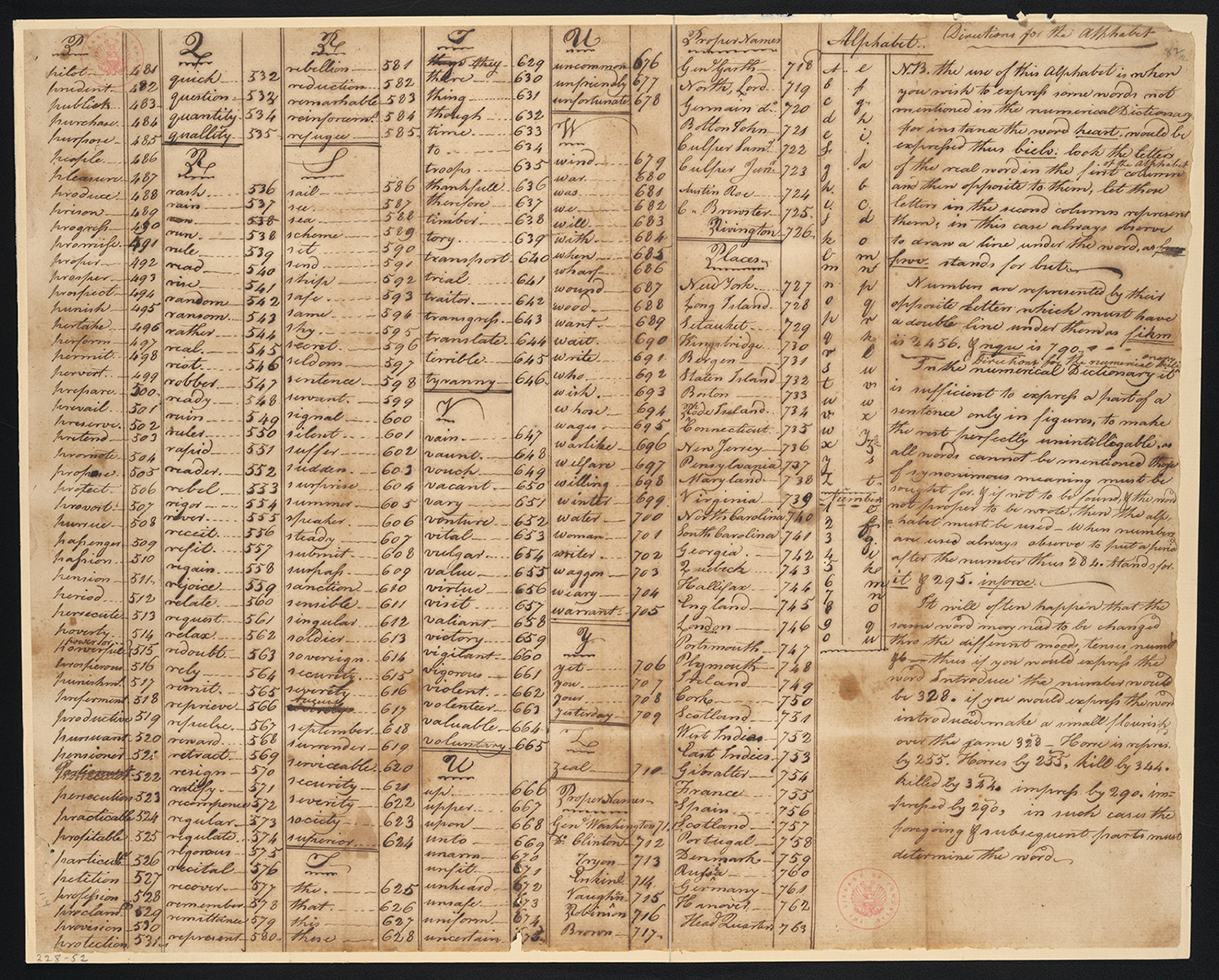
The principle was familiar. The system was not. Clark’s network had depended heavily on trust and secrecy. The new network took that secrecy further. Names became numbers. Messages could be concealed with invisible ink or written in code. Tallmadge developed numbered codebooks assigning numbers to people, places, and actions. Washington himself became 711.

The famous Culper Ring had begun to take shape. It would become one of the best-known intelligence networks of the American Revolution, operating for years behind British lines in New York. In 1780, the ring warned Washington of a planned British attack on the French forces at Newport, Rhode Island. Its intelligence also helped expose Benedict Arnold’s treason, after the capture of British spy Major John André revealed Arnold’s role in the plot.
It is September 29, 2026, and nearly 250 years have passed since that September morning in Manhattan. The place where Nathan Hale spent his final hours is gone. The war that surrounded him has been gone for generations, and the men who hunted spies, carried messages, and waited for information have become names in books.
History tends to remember the names that became famous: Nathan Hale. Benjamin Tallmadge. The Culper spies. But before the secret codes and invisible ink, there were people simply moving along Pennsylvania roads. And today, the words traditionally attributed to Nathan Hale remain among the most remembered words of the Revolution:
“I only regret that I have but one life to lose for my country.”
On the night of September 21, 1776, fire swept through British-occupied New York, consuming hundreds of buildings and leaving much of the city in ruins. Its cause was never determined. Some suspected American patriots had deliberately set the fire rather than allow the British to use the city, while others believed it may have begun accidentally; neither explanation was ever proven. By morning, the flames had largely burned themselves out, but smoke and destruction remained. Homes, businesses, churches, and other buildings were gone, leaving thousands of residents to face the aftermath in a city already unsettled by war.


Leave a Reply