A few weeks ago, news broke that historic Saint Peter’s Village was going up for sale. While the announcement naturally sparked conversation about the property’s future, it also raised a question few people stop to ask: Why is there a village here at all?
Tucked into a narrow ravine along French Creek, Saint Peter’s Village feels less like a place that was built than one that simply appeared. Thousands of visitors come each year to browse the shops, climb the giant boulders, and pause beside the rushing water. But the story of this landscape began long before the village took shape.
Molten rock forced its way toward the surface and slowly cooled into the dark, exceptionally hard stone known as diabase. Over countless centuries, French Creek carved its way through that ancient bedrock, exposing rich deposits of iron ore beneath the surrounding hills.
Without that geology, there would have been no iron mines. Without the mines, no black granite quarries. Without the quarries, no railroad. Without the railroad, no Saint Peter’s Village.

The first settlers weren’t drawn to this valley by its scenery. They came for the iron.
In 1845, local farmers Samuel Keim and Samuel Crosley discovered rich iron ore deposits near the falls of French Creek. Their discovery drew miners into the narrow valley, and a settlement took shape.
Hundreds of men worked beneath the hills in shafts known as Elizabeth, Suzie, and Calamity. Above ground, teams of horses hauled wagonloads to nearby furnaces before the railroad reached the valley. By the time the mines closed, an estimated one million tons of iron ore had been removed from beneath the hills.
But iron wasn’t the valley’s only gift.
The same rugged landscape that concealed iron also held vast deposits of diabase, a stone that came to be known as “black granite.” As demand grew for paving blocks, curbstones, and cut stone, the valley entered a new chapter.
Saint Peter’s “black granite” left its mark far beyond the valley. It paved Philadelphia streets, lined curbs, and found its way into buildings across the country. Decades later, the same stone would be chosen for the Franklin D. Roosevelt Presidential Library. It would even play a role in the Space Age, used to create precision granite surface plates that helped manufacturers build and inspect highly accurate aerospace components.
No single person shaped Saint Peter’s Village more than Davis Knauer.
Born in nearby Knauertown in 1826, Davis was the great-grandson of an early area settler. Driven by uncommon ambition, he became one of the region’s largest landowners, controlling nearly 4,000 acres across northern Chester County. Local residents came to call him “The Laird of Warwick.” Others knew him as “the Charcoal King,” supplying nearly 7,000 cords of charcoal each year to Pennsylvania’s iron furnaces.

Yet charcoal was only one chapter of his story.
In 1868, Knauer purchased the rugged land surrounding the mining settlement on French Creek. Working with Jonathan Keirn, he spent the next two years carving a road along the steep eastern hillside using nothing more than horses, mules, axes, saws, picks, shovels, and dynamite. Before the granite could leave the valley, there had to be a road.
In 1872, he and Keirn dismantled the machinery from the old Coventry Forge, hauled it to French Creek, and rebuilt the operation beside the falls, converting it from water power to steam. There they manufactured farm implements and iron goods.
When the quarry opened in 1880, the only homes in the valley were four modest frame houses built years earlier for iron miners. Everything people now associate with Saint Peter’s Village was still waiting to be imagined.

Workers’ homes rose along the narrow road. A general store, bakery, boarding house, creamery, blacksmith shop, and other businesses soon followed. Tradesmen—a cobbler, barber, butcher, and baker—served the growing community year-round. The black granite quarry was creating more than an industry. It was creating a community.
Knauer believed the valley could offer something more. For nearly eight years, he built roads, footbridges, and pathways that encouraged people to explore both sides of French Creek and the towering boulder fields surrounding the falls. He was convinced others would one day appreciate the valley’s beauty as much as he did.
He eventually opened the Excursion House—today’s Inn at Saint Peter’s Village. The same railroad that carried granite out of the valley also brought travelers in. Before long, people were arriving for weekends and summer vacations, many with no connection to the quarry at all.

By the late nineteenth century, Saint Peter’s Village had become two places at once. During the week, quarrymen split enormous blocks of black granite destined for Philadelphia streets and buildings across the nation. On weekends, excursion trains delivered families who climbed those very same boulders, picnicked beside French Creek, listened to German bands in “The Park,” enjoyed sleigh rides during the winter, and wandered a village unlike any other in Pennsylvania.
After Knauer’s death in 1907, his sons and grandsons carried the business forward for decades, preserving the vision he had set in motion. For nearly a century, the Knauer family owned not only the quarry, but the village itself. Rather than evolving through generations of unrelated owners, Saint Peter’s Village grew under a single guiding vision.
When the quarry finally fell silent in the 1970s, Saint Peter’s Village could easily have become another forgotten company town. Instead, it found a new purpose. Rather than sweeping away the past, later owners built upon what was already there. The Inn remained at the heart of the community, while the General Store, creamery, polishing shed, workers’ homes, and other historic buildings found new life without losing the character that had defined the village for generations.

The same geography that gave birth to Saint Peter’s Village also helped protect it. Hemmed in by French Creek on one side and steep wooded hillsides on the other, the village never expanded the way so many historic communities did. Modern development simply had nowhere to go. As a result, much of the village retained the scale and character established during the nineteenth century.
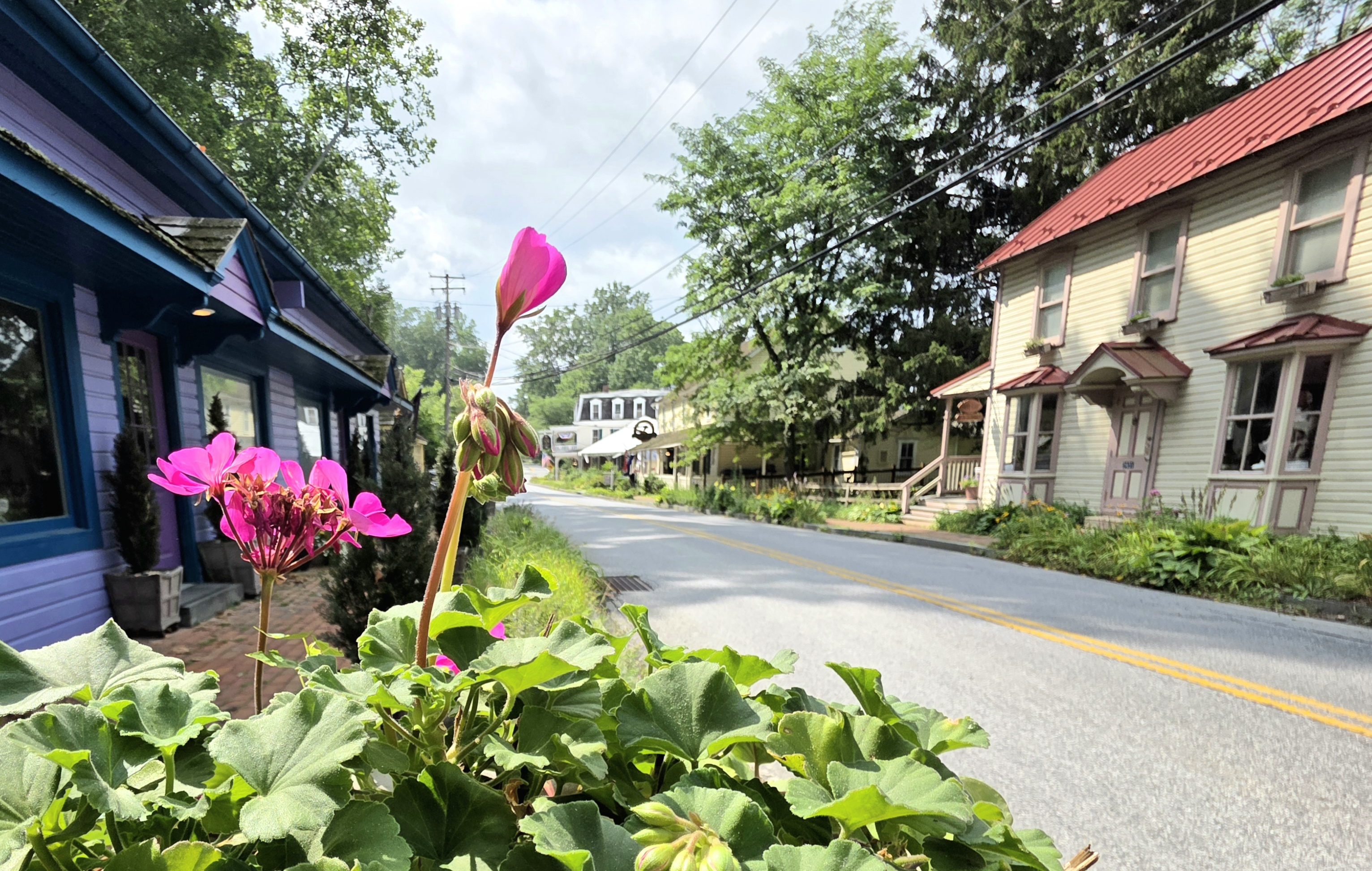
Listed on the National Register of Historic Places in 2003, Saint Peter’s Village remains one of Pennsylvania’s best-preserved nineteenth-century company villages. Walk its single street today and you’ll find more than historic buildings. The same narrow road still follows French Creek through the ravine. Historic homes and businesses continue to line the village, while the giant boulders still dominate the landscape.
Now, nearly a century and a half after Davis Knauer first looked at a rugged ravine and saw possibility, Saint Peter’s Village stands on the threshold of its next chapter.


On September 30, 2026, the entire historic village is scheduled to be sold at absolute auction. Unlike most real estate offerings, it will be sold as a single unit, placing its future in the hands of one new owner.
The offering includes approximately 83 acres, the Inn at Saint Peter’s Village, thirteen historic and commercial buildings, and approved residential home sites. Remarkably, the sale also includes the subterranean mineral rights beneath the property. Their inclusion is a fitting reminder that the same iron ore and black granite that first drew people to this narrow valley nearly two centuries ago continue to shape its story.
In many ways, the upcoming auction echoes earlier chapters in the village’s history. Ownership has changed. Industries have risen and faded. Iron mining gave way to granite quarrying. Quarrying gradually gave way to tourism.
Whoever places the winning bid won’t simply purchase a historic piece of Chester County real estate. They’ll become the next steward of a story first shaped by geology and carried forward by generations of miners, quarrymen, shopkeepers, innkeepers, and families.
Saint Peter’s Village isn’t remarkable simply because it’s old. It’s remarkable because so much of its history still stands where it happened. Most people come for the scenery. Few realize the landscape has been telling that story all along.

Leave a Reply