There are moments in each of our lives that stand out—memories that echo. Not because they are the most important things that ever happened, but because something about them stays with you longer than you expect.
I mentioned my family home on Avon Court last week. My dad was quick to remind me that it wasn’t actually the first. There had been an apartment on Walnut Street, though I have no memory of it. I was only a few days old when I arrived there from the hospital, in a brace. We moved to Avon Court when I was one. That’s where our dog Toby, a chocolate lab, peed in one of my sneakers. It’s a small thing, but it shows how quickly a moment can settle—and stay.
I think, too, of the Christmas when Santa brought me the top item on my wish list—the Charlie’s Angels Hideaway House. I remember the box—colorful wrapping, larger than I expected. I stood there for a moment, certain, in that way only a child can, that wanting something badly enough could make it real. It was my dad who made it real, though I didn’t understand it at the time.
Then there is the car accident that totaled my bright orange hatchback and left me with stitches and a concussion. What stayed with me was not the impact, but the stillness afterward. I expected something to feel different, to mark what had happened—but nothing did. The world had not shifted to match the moment. Only I had.

Over time, you begin to see how memory changes. In that change, people don’t just stay remembered; they stay active. At first, things are only what they were, but they don’t remain fixed. They gather meaning like dust settling on surfaces you don’t notice at first. You remember them differently than you lived them—and in that difference, they begin to belong to you.
There are also moments when something in you answers before you do. A pause before you speak. A quiet correction mid-thought—no, not like that, try again. It doesn’t always sound like a voice. Sometimes it’s just a sense of being slightly ahead of yourself, moving carefully without quite knowing why. It’s as if something in you learned, long before you remember learning, what words can do.

My mother is Helen, and she was part of that long before I understood it as anything at all.
She didn’t arrive as a lesson or a philosophy. She was just there—morning light in the kitchen, the sound of her moving through a room, the way she could say your name and make it feel like both warning and comfort at once. If I said something carelessly, she didn’t always correct me right away—but later, sometimes much later, she would come back to it. Not to scold, but to refine it. To show me how it could have been said differently, and why that difference mattered.
Something in me began to carry her. Not as memory exactly, but as instinct—in the way I speak, in the way I hold my ground, in the way I start over when I would rather walk away. I don’t always hear her voice clearly, but I hear its shape in mine.
That quiet inheritance—the way someone stays with you without being seen—is part of what Mother’s Day has always tried to name. Long before it became a date on a calendar or a reason to make a reservation, it began as something personal, carried through memory, ritual, and return.

In 1908, forty-four-year-old Anna Jarvis held memorial services in Grafton, West Virginia, and in Philadelphia to honor her mother. She sent 500 white carnations—her mother’s favorite flower—to be placed in the church. They weren’t just decoration. They stood in for something harder to name: a kind of care that doesn’t disappear when a person does.
Her mother had spent years organizing Mothers’ Day Work Clubs—practical efforts to improve sanitation, reduce infant mortality, and care for families during and after the Civil War. But beneath that work was a larger idea: that motherhood wasn’t private. It had public weight.
The observance spread, and by 1914 it became official in the United States. Almost immediately, it began to shift into something more commercial—cards, flowers, reservations. Anna Jarvis pushed back, arguing that the day had drifted from its original meaning. For her, it was supposed to be simple: a handwritten note instead of a printed card, a single flower instead of a bouquet. She even protested its commercialization, at one point being arrested for it.

But the idea itself didn’t come from nowhere. In the 1870s, Julia Ward Howe wrote what she called a “Mother’s Day Proclamation,” calling for mothers to unite in peace after the Civil War and the Franco-Prussian War. In England, Mothering Sunday marked a return to one’s “mother church” during Lent, often with small gifts or a journey home. Long before Jarvis, Ann Reeves Jarvis’s work clubs were already doing something similar in a different form—organizing care not as sentiment, but as civic work.
As the idea moved, it changed shape. In some places it became tied to religion, in others to national tradition. The forms shift, but the gesture remains familiar: a day built around noticing what is usually left unspoken. In the United States now, it is one of the busiest days of the year for restaurants and phone calls—a modern expression of the same impulse to reach back toward the people who made you.
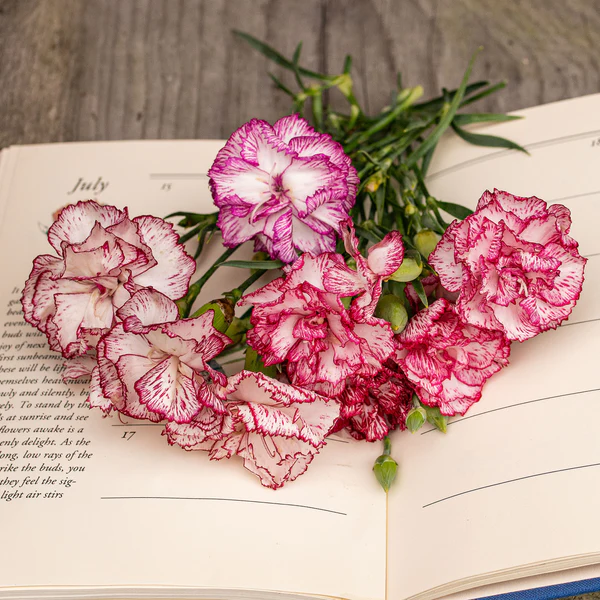
The carnation carried through all of it. Known in ancient times as dianthus—the “flower of the gods”—it became a symbol not because it is rare, but because it endures. Carnations hold their shape as they fade; they remain gathered even as they change.
When Anna Jarvis chose the white carnation, she chose it for that quality. White for remembrance. Pink for presence. Red for love. A simple language, repeated until it no longer needs explanation—not because it is precise, but because it is understood.
Maybe that is why the day has endured. It does not try to say everything. It makes space instead—for something to be noticed. Not to define what cannot be held, but to pause long enough to recognize the ways we are shaped, and what we carry without realizing.
So to the mothers who are here and the mothers who live on in the quiet ways we move through the world because of them—Happy Mother’s Day.
And Mom, if you’re reading this, I hope there is at least one small moment today that stays with you—longer than expected. Maybe even one that shapes what you say next.
All my love.


Leave a Reply