As a teenager, I played for the Rangers, a scrappy Little League baseball team in my hometown. My heart was set on third base—the hot corner—but being a lefty made it a tough fit. Left-handed players at third are rare, awkwardly scrambling to throw to first, like a giraffe on roller skates trying to nail a new dance move. So, they stuck me with pitching for a team mostly made up of boys. But I made it work, earning a spot on the All-Star team in my first season. I’ll never forget the moment that sealed my place: it was my turn at bat, and I smacked a line drive past the infield, bringing two teammates home. As the final run crossed the plate, my coach turned to me and said, “You’re in.”
While my personal tale may be just a small moment in the grand history of baseball, the sport itself has evolved over centuries, becoming a defining part of American culture. Once regarded as America’s pastime, baseball didn’t appear overnight. By the 1850s and 1860s, it had firmly embedded itself in the fabric of American life, eventually surpassing cricket in popularity due to its faster pace and accessibility. The formation of the National League in 1876 turned Major League Baseball into a professional powerhouse. While no one person can claim the invention of the game, Alexander Cartwright and the New York Knickerbocker Base Ball Club helped shape the version of the sport we recognize today.
A pivotal moment in baseball’s history came during World War II. In 1943, with many male players off to war, Philip K. Wrigley founded the All-American Girls Professional Baseball League (AAGPBL). Over its twelve-year run, more than six hundred women played across fifteen teams, with forty-six players hailing from Pennsylvania. While both the 1992 film A League of Their Own and its 2022 series adaptation were inspired by these events, they took significant creative liberties in telling the story of the league and the remarkable women who played in it.

One of those women was Ruth “Rocky” Kramer Hartman. Born in 1926 in the rural town of Limekiln, near Reading, Ruth’s journey to baseball began in the most unexpected place—her father’s cow pasture. With no proper field to practice on, she rigged up a makeshift strike zone by nailing an old mattress to a tree. By the age of 13, Ruth was already holding her own in games against boys much older than her. In high school, her pitching had earned her a reputation as a formidable force.
After graduating from Reading High School in 1942, Ruth went on to East Stroudsburg State Teachers College, where her undeniable talent in softball quickly made her a campus legend. Standing just 5’1″ and weighing only 110 pounds, she didn’t exactly look like a powerhouse. But when she took the mound, the ball flew with almost supernatural speed and precision. No one on her intramural team could handle the heat of her pitches, resulting in the men’s team lending her a catcher. It wasn’t long before her talent caught the eye of former Pittsburgh Pirate Max Carey, who was scouting for the Fort Wayne Daisies.
Ruth’s transition into the league wasn’t without its challenges. The eleven-inch AAGPBL ball was much smaller than the twelve-inch softball she had mastered. It was quicker, more unpredictable, and at first, it seemed like her shot at professional baseball might slip away. But Bill Wambsganss, the Daisies’ manager and former hero of the only unassisted triple play in World Series history, saw something others didn’t. He understood that Ruth’s problem wasn’t a lack of talent, but rather her struggle to adapt. After a brief workout, he recognized that Ruth wasn’t just a pitcher—she was a versatile player with skills that extended beyond the mound. Seeing potential in her at second base, he gave her a shot.


Ruth would only play two seasons before prioritizing her education at East Stroudsburg. She chose not to return for the 1948 season, leaving the league just before its most memorable year. But her love for the game never waned. After graduating, Ruth embarked on a distinguished 36-year teaching career in the Reading School District. Along with teaching, she coached volleyball, track, and swimming, seamlessly integrating her love of sports into her role as an educator. Ruth’s passion for athletics didn’t stop there—she continued playing fast-pitch softball across Pennsylvania, showcasing her competitive spirit well beyond her professional career.
In 1976, Ruth took a significant step by founding a girls’ softball program at Reading High School. Over the next eighteen seasons, she led her teams to an impressive 217-73 record, clinching two Berks County Championships and three District Titles. Her dedication to the sport didn’t just shape athletes; it created a lasting legacy of success and inspiration for generations of female athletes in the region.
Upon her retirement from education, Ruth channeled her energy into raising and breeding Corriedale sheep on her farm in Limekiln. True to her nature, she blended her passions—cleverly naming her sheep after Phillies baseball players, including Ryan Howard and Shane Victorino. Breaking with tradition, Ruth said her greatest sheep of all time was Mutombo, named after the former Philadelphia 76ers great.
Sadly, Ruth Kramer Hartman passed away on November 9, 2015, due to injuries sustained in an automobile accident. State police reported that Hartman was driving in Oley Township when she struck a deer. After stopping to check on the animal, her SUV rolled forward and pinned her underneath.

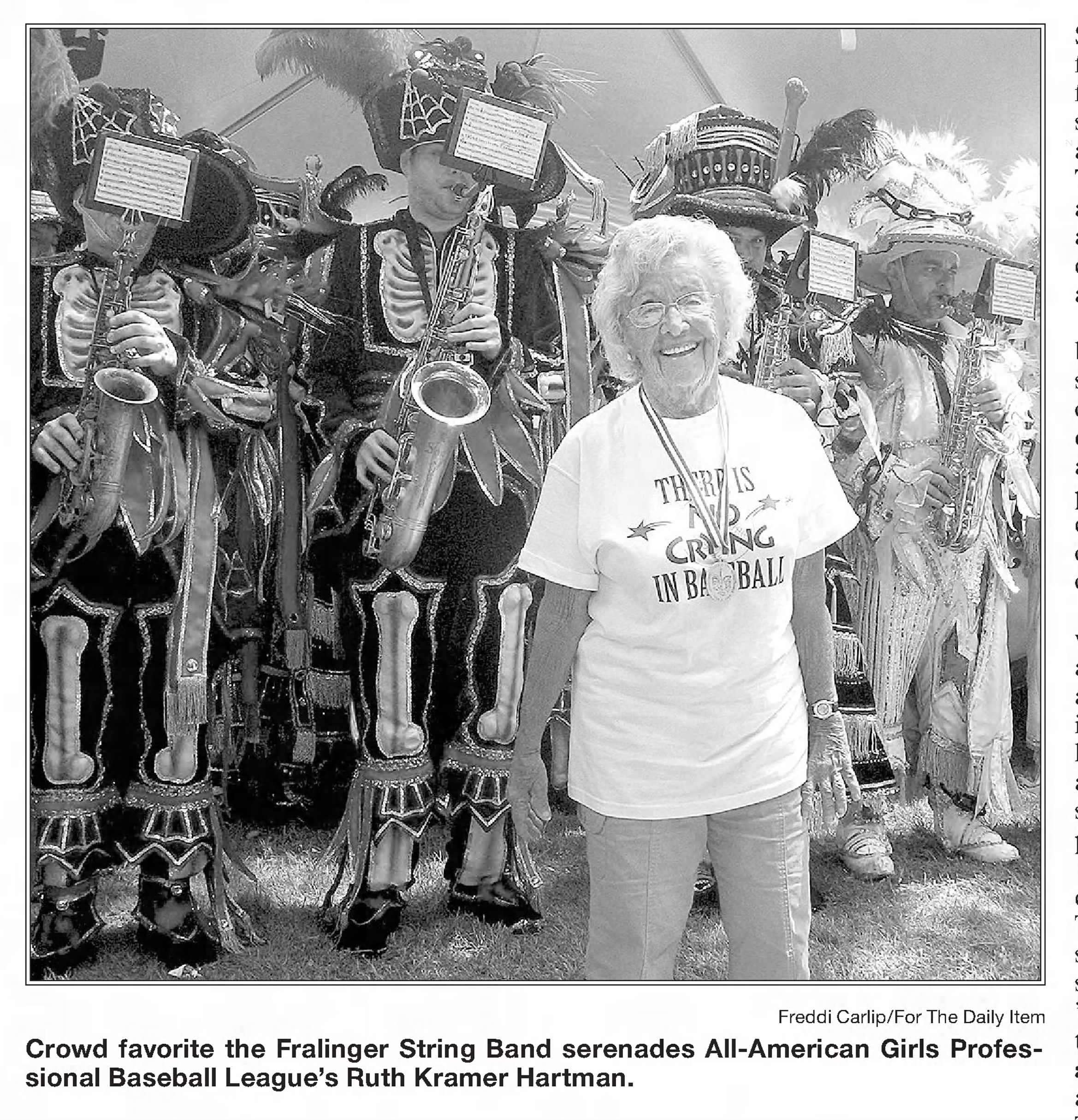
Ruth Kramer Hartman’s remarkable legacy lives on through her induction into several prestigious halls of fame, including the Fort Wayne Athletic Hall of Fame, the Berks County Division of the Pennsylvania Sports Hall of Fame, and the Reading High School Sports Hall of Fame. In 2016, she was honored with a spot in the Reading Baseball Hall of Fame, a testament to the lasting impact she made on the world of sports. As I reflect on my own love for playing and watching sports, Ruth’s story reminds us that the game is about more than just the sport—it’s about the people who shape it and the history they leave behind.
The Philadelphia Phillies will face the Washington Nationals in the season opener on March 27, with the first pitch scheduled for 4:05 p.m.
Other Notable Pennsylvania-born All-American Girl Players
Known for her skill at first base, Kulpsville native Gertrude “Gertie” Alderfer Benner (1931-2018) was part of a pioneering generation of female athletes who broke barriers in sports at a time when opportunities for women were limited. During her career, she played for the Chicago Colleens, Springfield Sallies and Muskegon Lassies. In 1951, she gave up her professional career to care for her ailing mother. While she may not be as widely remembered as some of her peers, her contributions were crucial in paving the way for future generations of women in sports.
Allentown’s Jeanette “Jan” Bottazzi (1927-2023) joined the AAGPBL at age 19 to play for the Kenosha Comets in 1946. Though she only played three games without recording any hits, Bottazzi’s brief career remains a part of the league’s legacy. Her contributions are honored in the Baseball Hall of Fame, acknowledging the significance of women’s baseball during its formative years. After baseball, Bottazzi had a fulfilling life, including 58 years of marriage.
Jean Faut (1925-2023), a trailblazing pitcher from East Greenville earned recognition for her exceptional skills with the South Bend Blue Sox. Faut’s standout achievements include two perfect games, making her the only professional baseball pitcher—male or female—to accomplish such a feat. Her career also boasts two Player of the Year awards and four All-Star selections. She led the Blue Sox to consecutive championships in 1951 and 1952. Faut was among the married ballplayers in the AAGPBL. Her husband and Blue Sox Team Manager, Karl Winsch, pitched for the Philadelphia Phillies from 1942 to 1944.
Beatrice “Beatty” Kemmerer (1930-2013), from Friendsville near the New York state border, played with the Fort Wayne Daisies and South Bend Blue Sox. As a catcher and shortstop, she helped the Blue Sox win the 1951 championship. After her baseball career, Kemmerer worked at Uniroyal Tires and remained active in sports, including bowling. She was inducted into the Women’s Baseball Hall of Fame and had a cameo in A League of Their Own.
Erma Keyes (1926-1999) played as an outfielder during the 1951 season. A native of Frazer, she started with the South Bend Blue Sox before joining the Battle Creek Belles and the Peoria Redwings. Over the course of 89 games, she hit .212 with 67 hits and 23 RBIs. A graduate of Ursinus College, where she earned nine varsity letters, Keyes went on to become an educator and an amateur golf champion.
Jean Malanowski (1929-2007), known as Jean Marlowe, played from 1948 to 1954, primarily as a pitcher. Born in Scranton, she began her career with the Springfield Sallies. Alongside her 56–79 pitching record and 3.18 ERA, she also played as an infielder and outfielder. Malanowski was inducted into the Pennsylvania Sports Hall of Fame in 2002 and is part of the “Women in Baseball” exhibit at the Baseball Hall of Fame.
Philadelphia-born Audrey Seitzinger (1933-1975), originally Audrey Bleiler, played as a shortstop and third baseman for the South Bend Blue Sox. She helped the team win back-to-back championships in 1951 and 1952. After marrying in 1951, she played under the name Audrey Seitzinger for her final season. Seitzinger retired to raise her family in Camden, New Jersey.
Delores Siegfried (1926-2009), a second baseman from Allentown, played for the Muskegon Lassies during the 1947 season. The team finished first in the league that year with a 69-43 record. After the league’s closure in 1954, she transitioned to life outside of baseball, working as an assembly line worker at B. Braun Medical in Bethlehem. Siegfried was inducted into the Women’s Softball Hall of Fame in 1989.


 Keystone Wayfarer
Leave your thoughts