
The opening line of Edgar Allan Poe’s final poem, Annabel Lee, beckons readers into a poignant exploration of love and loss. First published in the New York Tribune, the poem beautifully captures the enduring bond between the speaker and his beloved—a theme intricately woven throughout Poe’s works and the tumultuous experiences of his life. Today, October 7, marks the 175th anniversary of Poe’s puzzling death—an occasion that prompts reflection not only on his profound literary legacy but also on the enduring mysteries surrounding his untimely demise.
As I contemplate the themes of love and loss in Annabel Lee, I’m reminded of my visit years ago to the Poe House in Philadelphia, a moment that solidified my connection to his work. There, I purchased a poster featuring an image of Poe with his piercing gaze—an artistic invitation into his world that now occupies a prominent spot in my home, welcoming visitors as they enter.
I vividly recall that sunny day at the federal-style house on North Seventh Street. The air felt heavy with the weight of history, as though the walls whispered stories from the past. This atmosphere enveloped me, drawing me deeper into Poe’s world. Walking through the red-brick, three-story home where he briefly lived with his wife, Virginia, and mother-in-law, Maria Clemm, I imagined their lives—how love and loss intertwined in their daily existence. It was here that he penned The Black Cat, one of my favorite stories, reminding me of the complex emotions reflected in his writing.
It was Election Day in Baltimore, Wednesday, October 3, 1849, when Joseph W. Walker, a pressman for the Baltimore Sun, discovered a man lying in the gutter, delirious and dressed in shabby, tattered clothes. As Walker approached, a sinking realization washed over him: the semi-conscious figure before him was none other than Edgar Allan Poe. Concerned for the dazed poet, Walker asked if he needed help. This moment marked a fateful intersection, as Walker’s compassion became a crucial lifeline for the troubled Poe. In that instant, the paths of two lives—one on the brink of fading from history, the other ready to record its significance—crossed, reminding us of the fragile ties that bind us all.
Born on January 19, 1809, Poe is best known for his poetry and short stories, particularly those exploring themes of mystery and the macabre. Widely regarded as a central figure in Gothic fiction, he is often credited as the inventor of the detective tale. Like me, Poe was a Boston native; his name combines those of his birth parents, actors David and Elizabeth Poe, and the couple who took him in, John and Frances Allan. Growing up in Richmond, Virginia, he attended university there but left after just one year due to financial constraints.
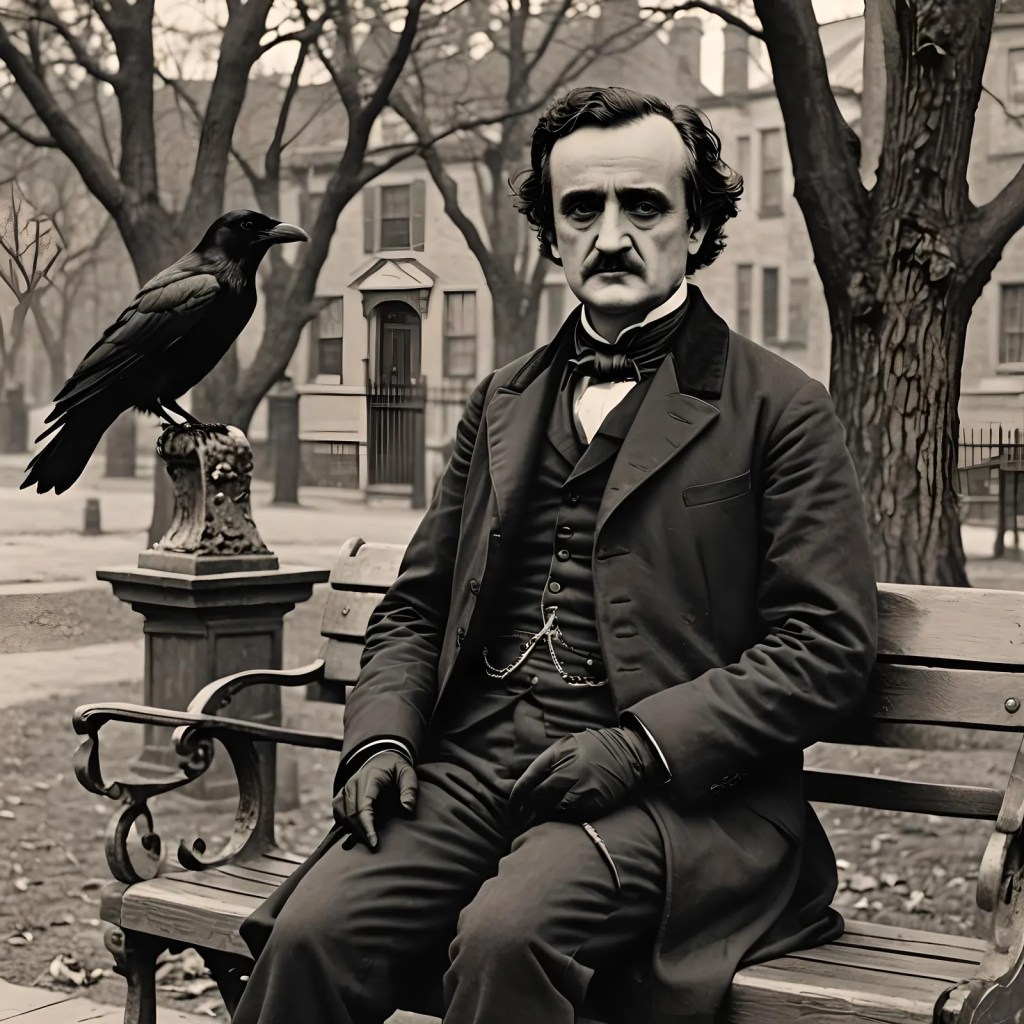
His first published collection, Tamerlane and Other Poems, was credited to “a Bostonian.” Only twelve copies of the original 1827 edition have survived. In December 2009, one copy sold at Christie’s auction in New York City for $662,500—a record price for a work of American literature.
During his lifetime, Poe worked for various literary journals and periodicals, developing a distinctive style of literary criticism. His often caustic reviews earned him the reputation of being a “tomahawk man,” a term used to describe his fierce criticism of fellow writers. A favorite target of his ire was Boston’s acclaimed poet Henry Wadsworth Longfellow.
Poe’s best-known works are classified as Gothic horror, a genre that appeals to the public’s taste for the terrifying and psychologically intimidating. His recurrent themes deal with death, as seen in The Tell-Tale Heart and The Masque of the Red Death. Beyond horror, Poe also wrote satires, humor tales, and hoaxes, showcasing his masterful use of sarcasm in pieces like The Narrative of Arthur Gordon Pym.
The exact cause of Edgar Allan Poe’s death remains shrouded in mystery, with theories ranging from various diseases to alcoholism, substance abuse, or even suicide. Tragically, he was not coherent long enough to explain how he ended up in such dire circumstances or why he was found wearing clothes that did not belong to him. His attending physician reported that Poe’s final words were, “Lord help my poor soul,” a haunting reflection of the despair that marked his final moments. After being taken to Washington Medical College, he died on Sunday, October 7, 1849, at 5:00 a.m. Unfortunately, all relevant medical records, including Poe’s death certificate, have been lost to history, leaving countless questions unanswered.
In the wake of his death, his literary rival, Rufus Wilmot Griswold, seized the opportunity to tarnish Poe’s name. Griswold wrote a slanted obituary under a pseudonym, filled with falsehoods that portrayed Poe as a lunatic. The obituary began, “Edgar Allan Poe is dead.”
Poe’s influence extends beyond his own era, inspiring numerous writers and filmmakers, including H.P. Lovecraft, Ray Bradbury, Stephen King, Alfred Hitchcock, and beat poet Allen Ginsberg. He sold the rights to Annabel Lee while still alive; it was published on October 9, 1849, just two days after his death. Poe was only forty years old.

As we reflect on Poe’s life and work, it becomes clear that his exploration of love, loss, and the human condition remains relevant today. His legacy invites us to confront our own fears and desires, encouraging us to seek beauty even in the darkest corners of existence. The Edgar Allan Poe National Historical Site, one of four residences he occupied between 1838 and 1844, is the only surviving Philadelphia home and is currently closed for utility improvements. I hope it reopens soon, allowing future generations to connect with the haunting allure of Poe’s world—and perhaps find their own reflections of love and loss within his timeless works.

 Keystone Wayfarer
Leave a reply to Kathy Kolb Cancel reply