Dinner time was a cherished family ritual during my childhood. Despite her busy work schedule, my mom would come home and immediately start preparing the meal, while my younger brother and I set the table. After dinner, we’d clear the table and wash the dishes together. I still smile when I recall our conversations about getting a dishwasher, to which my mom would humorously reply, “I already have two.”
I have a tendency to dive into details, which often leads me down a rabbit hole of endless questions that can overwhelm those around me–just ask my husband. Recently, this curiosity led me to the Mennonite Heritage Center in Franconia.
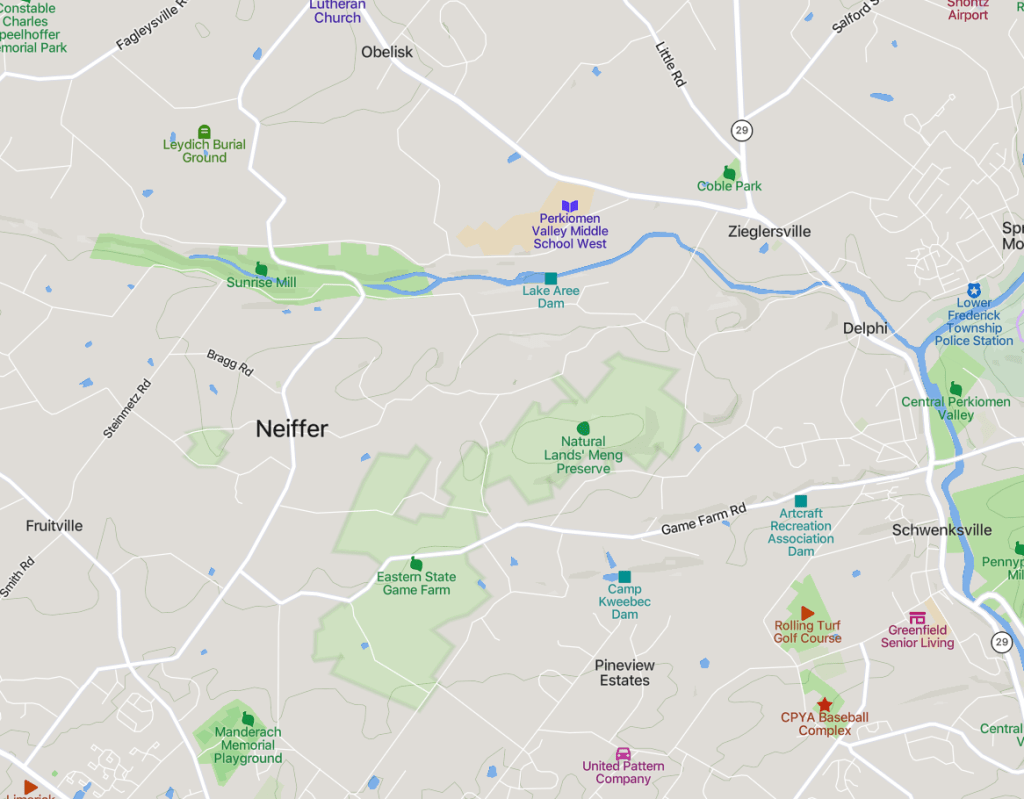
While researching what seemed like an unrelated topic, I was intrigued by a question from the archivist: “I never understood why people lived out there,” referring to the land behind what locals call Stone Hill. “They must have been potters.” And indeed, they were.
Pottery is a deeply rooted craft in Montgomery County. When Germans arrived in the eighteenth century, they brought their traditional techniques with them. The local clay, rich in iron oxide, turns red after firing in the kiln, giving rise to the term “redware.”
Jacob Medinger (1856-1932) was one of Pennsylvania’s last early folk potters, renowned for his Neiffer pottery, which is now highly sought after by collectors. He learned the craft from his German-born father, William Ferdinand Medinger (1826-1902), who travelled to Philadelphia in 1854. After relocating to Limerick Township, William worked at Samuel Neiffer Pottery for seventeen years before starting his own business in 1872. He ran this business with the help of his sons Jacob, Albert, Wilson, and William, managing all aspects from clay extraction to firing. Around the turn of the century, William passed the business on to Jacob.
Pennsylvania Germans transformed redware from basic household items to artistic creations through techniques like slipware and sgraffito. Slipware involved applying colored clay, or “slip,” to pottery surfaces. Slip, a watered-down clay, comes in various hues, such as cream, red, or dark brown. A slip cup with hollow quills was used to quickly apply linear designs, which were then embedded with a rolling pin.
Sgraffito, a technique meaning “scratch,” involved scratching through a layer of white or yellowish slip to reveal the red clay beneath. After decoration, the piece was coated with a clear lead glaze, which added a glossy finish and made the pottery waterproof. A signature Medinger design featured two wavy lines repeated three times with round dots between the sets.
Medinger primarily produced utilitarian ware such as pie plates, apple butter crocks, and pitchers. He also collaborated with local woodcarver William J. McAllister (1879-1956) to produce highly prized graffiti-decorated plates.
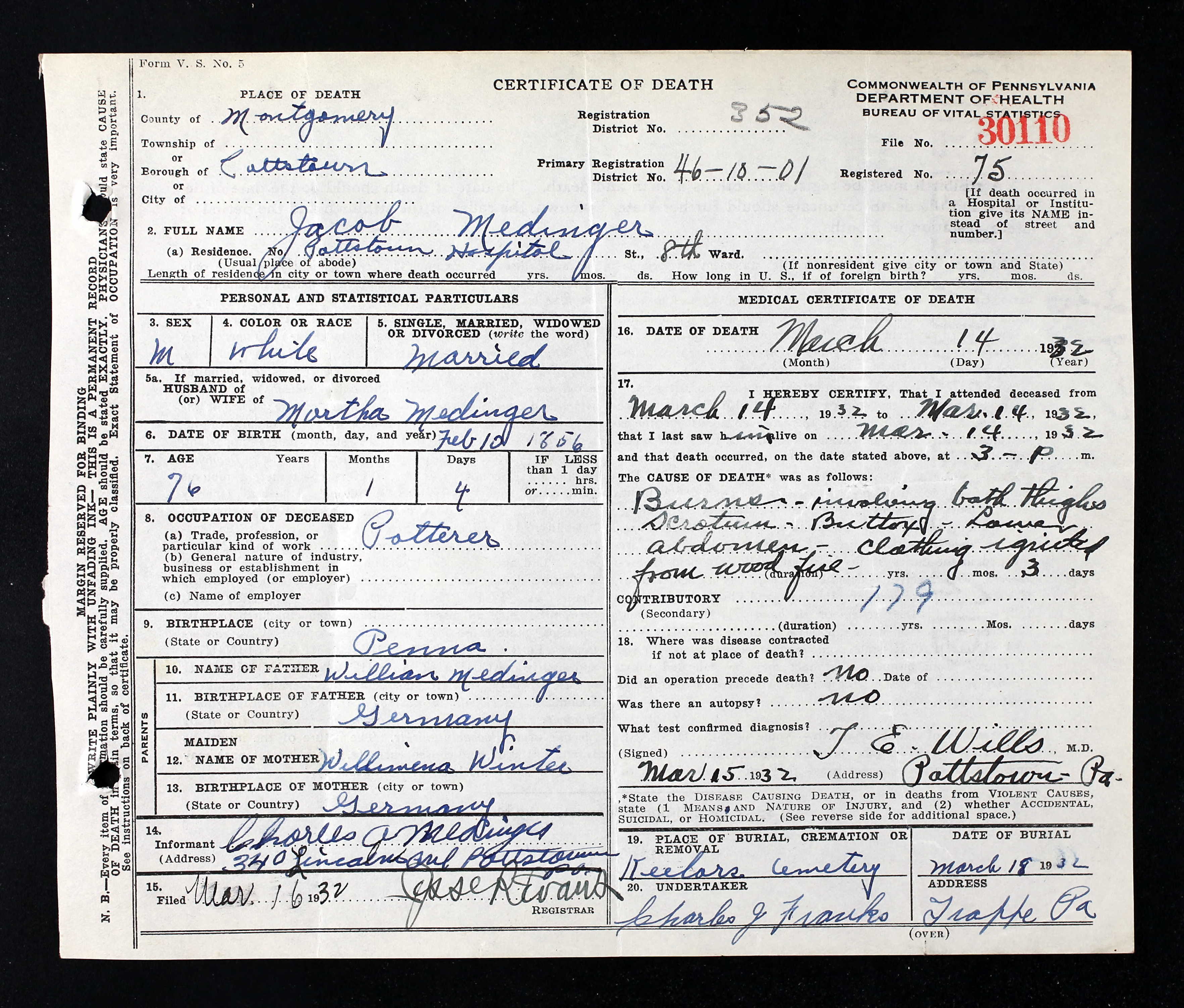
Tragically, Jacob Medinger died on March 14, 1932, when his clothes caught fire from his kiln, leading to his death at Pottstown Hospital. He is buried at Keelor’s Cemetery, now known as St. Luke’s Lutheran Church Cemetery, alongside his wife Martha (1858-1937) and three daughters.
The Limerick Historical Society houses a significant collection of original Medinger pottery and a Medinger cider press. They are open each Wednesday from 10am to 3pm and the second Sunday of each month from 1pm to 4pm. For more information, visit their website at www.limerickpahistory.org.
Local artisan Denise Wilz, a master potter with the Pennsylvania Guild of Craftsmen, regularly exhibits her work at the Mennonite Heritage Center and offers workshops. I’ve taken two of her workshops, one of which was a gift for my mom featuring a light print of my hand on the back. You can explore her crafts at www.wilzpottery.com.


 Keystone Wayfarer
Leave your thoughts