
Growing up in a northern suburb of Boston, my family cherished the daily ritual of reading newspapers. The Boston Globe was our go-to for comprehensive coverage of national and international news, while the Melrose Evening News kept us informed about the latest happenings in our own small community. Like clockwork, these papers would land on our front steps, delivered by a diligent young cyclist.
Looking back, I am struck by the profound impact those newspapers had sparking my curiosity about the world. Those black and white smudged pages weren’t just ink on paper; they were portals to diverse perspectives and narratives, making connections to the broader world beyond my doorstep.
In today’s ever-evolving media landscape, the once-familiar rustle of newsprint has been replaced by the relentless clatter of keys. The rise of 24-hour news channels, notably with the launch of Cable News Network (CNN) in 1980, marked a seismic shift in how we consume information. Television and internet news have since supplanted the tactile experience of holding a newspaper, relegating them, in most cases, to the realm of nostalgia.
Pennsylvania holds a significant place in the early history of American newspapers. The American Weekly Mercury, founded in Philadelphia in 1719, predates Benjamin Franklin’s purchase of the iconic Pennsylvania Gazette in 1729. These publications not only chronicled the events of their time, but also played pivotal roles in shaping public opinion and fostering community identity.
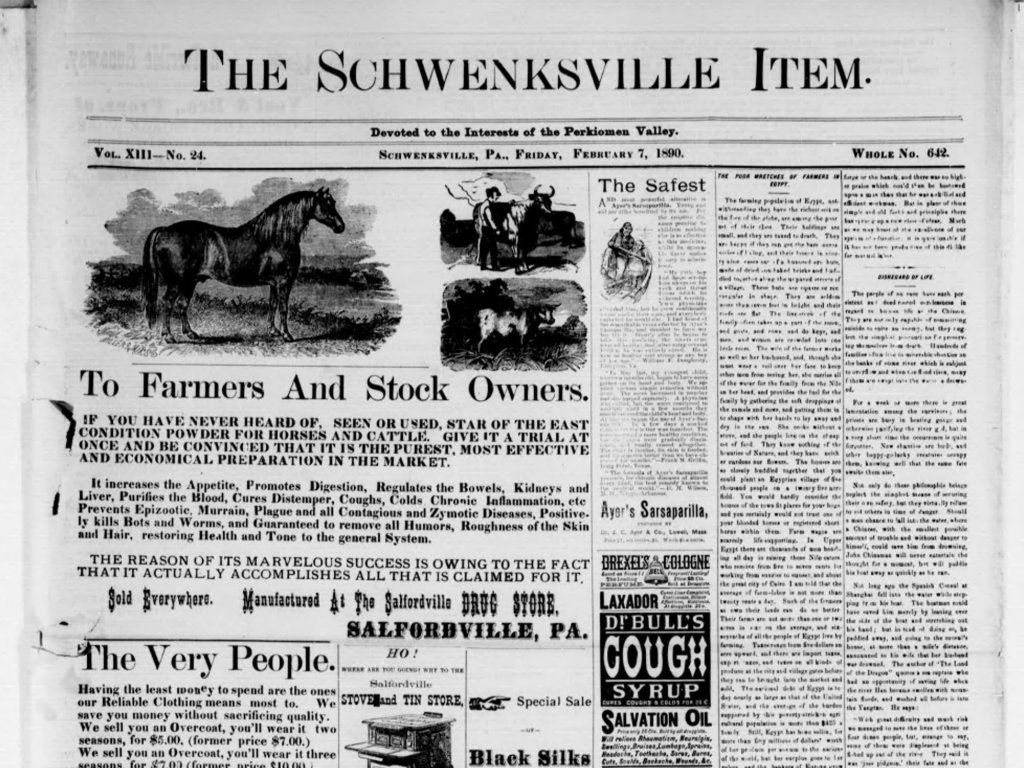
In my adopted hometown of Schwenksville, the local paper was The Schwenksville Item. Founded by Frederick Township native Rev. Nathaniel B. Grubb (1850-1938) in 1877, the four-column weekly publication began its circulation as a beacon of community information.
Under the leadership of its second publisher, Irvin H. Bardman (1858-1929), the paper played a central role in the town’s growth, even spearheading efforts for borough incorporation in 1903. Often referred to as Schwenksville’s guardian angel, Bardman, steered the newspaper until his retirement in 1929. Stanley H. Bardman, his son, took the helm until 1948.
Bruce MacBain (1924-2014) became The Item’s longest and final publisher, overseeing the paper until its last edition in 1990. During his tenure, MacBain transformed the publication from hot lead typesetting to offset and commemorated its 100th Anniversary. The newspaper became known for its comprehensive coverage of regional news, politics, and high school sports. MacBain was not only a journalistic innovator but also a community advocate. He was an early champion of The Philadelphia Folk Festival. Additionally, MacBain actively supported the Lower Frederick Regional Ambulance and was a member of the Patriotic Order of Sons of America, Washington Camp 387. Prior to his ownership of The Schwenksville Item, MacBain gained experience working at another local paper, The Hatboro Spirit.
The rapid decline of local newspapers in the United States has reached an alarming pace. Analysts predict that by the end of 2024, the country will have lost one-third of the newspapers it had in 2005. According to a report from the Brookings Institution in 2015, the number of newspapers per hundred million population dropped from twelve hundred in 1945 to just four hundred in 2014. This decline isn’t isolated to newspapers alone; traditional news media like television networks and radio have also suffered.
Today, roughly six thousand newspapers are left in America, down from nearly nine thousand in 2005. This means that roughly half of all U.S. counties are served by only one local news source. Despite these challenges, the legacy of local newspapers like The Schwenksville Item and Melrose Evening News live on, reminding us of the vital role newspapers play in shaping our lives.


Schwenksville Facts
A yearly subscription to The Schwenksville Item in 1877 cost seventy-five cents.
It was in the newspaper office that the first telephone in Schwenksville was installed.
Irvin H. Bardman is buried at Keely’s Church Cemetery.


 Keystone Wayfarer
Leave a reply to On The Siegfried Line – Keystone Wayfarer Cancel reply