Mysteries and controversy have a way of pulling us in, don’t they? And honestly, it’s not accidental. It’s almost never about what we already know—it’s the gaps that grab us. You see it in the stories that refuse to fade. Take Amelia Earhart. How is it that one disappearance can still spark debate all these years later? Or the Bermuda Triangle, that stretch of ocean where every explanation seems to leave something out? There’s an itch to it, a quiet curiosity that sneaks up on you and just won’t let go.
And when you add controversy into the mix, it only deepens the pull. People remember things differently. One person is certain it happened one way; someone else swears the opposite. Over time, those differences don’t fade—they expand. In the end, it’s not just the event that lingers—it’s the uncertainty, the not-quite-knowing, that keeps the story alive.
One such story sits in plain sight, just a short drive from Schwenksville. If you’ve ever walked the trails at Green Lane Park, you may have passed right by it without a second thought.
Just below Knight Road, on a gentle rise beside the trail, a single marble headstone stands alone. No fence, no other markers—just the quiet slope and the hum of passing cars and footsteps. An American flag moves softly in the breeze above a small Revolutionary War marker, the kind you see scattered across old cemeteries throughout Pennsylvania.
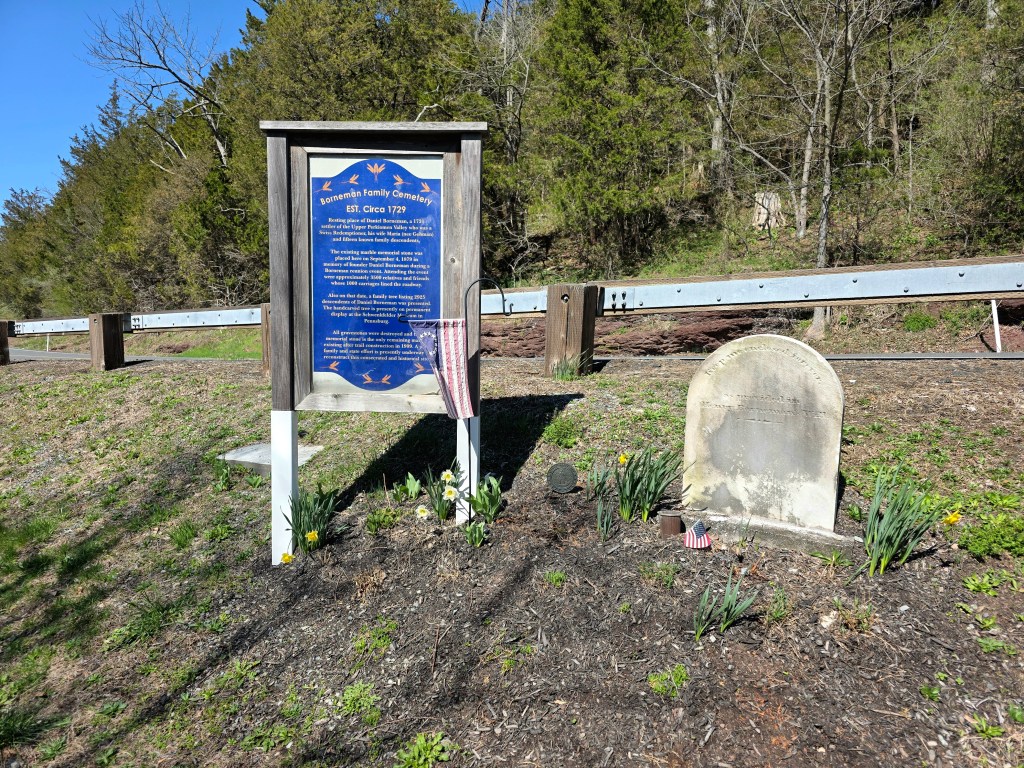
The stone marks the grave of Daniel Borneman—a man whose life began along the Rhine and ended here, in what were once dense, unsettled woods. And yet, standing there, with nothing else around him, it’s hard not to feel like there’s more to the story… something just beyond what we can see.
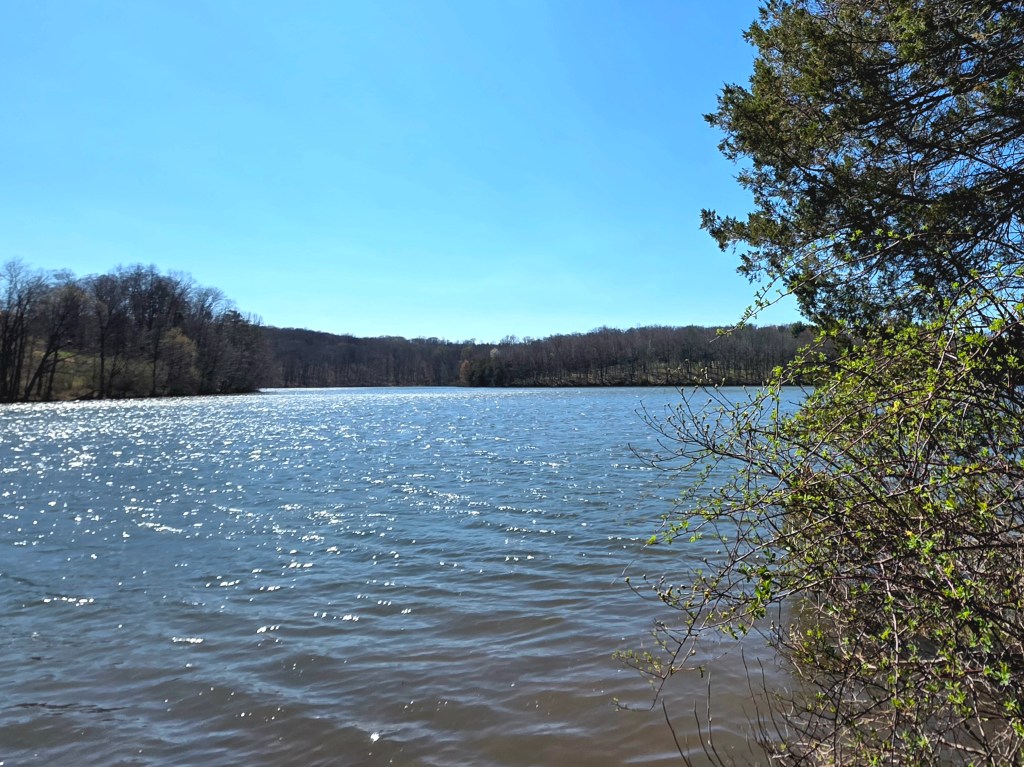
Once, this quiet spot was part of something larger. Located near what is now the Green Lane Reservoir, the Borneman Family Cemetery was established around 1729 to hold Daniel Borneman—one of the area’s earliest settlers—and roughly seventeen of his descendants. For generations, it stood undisturbed, a quiet testament to a family that had crossed an ocean in search of a new life.
But this patch of earth is more than a resting place—it’s memory made tangible. Here, law, family stories, and modern progress have all collided. When plans for Green Lane Park began to take shape, debates followed—over preservation, over access, over what it truly means to honor the past. Suddenly, this once-forgotten slope was alive again, caught between centuries, its story no longer settled. And the arguments it sparked say as much about us today as they do about the people buried here.
Daniel was born in 1703 in Ober Rhein Thal, in the Swiss canton of Graubunden. He grew up along the Rhine—a landscape of winding water, hillside villages, and terraced fields where farmers coaxed a living from the land. Life moved with the rhythm of the river: spring floods, autumn harvests, the steady toll of the church bell marking each day. Timber, grain, and wine traveled to distant markets. Merchants bargained in crowded squares. Children ran through vineyards under watchful eyes.
And yet, for all its beauty, it was a small world. Opportunities were limited, and for someone like Daniel, the familiar may have begun to feel confining—less like home, and more like a boundary he would one day have to cross.
In the spring of 1721, he left the Rhine for the uncertainty of the Atlantic. Like many Europeans of his time, Daniel Borneman became a “redemptioner,” agreeing to sell years of labor in the American colonies to pay for his passage. Unlike British indentured servants, continental Europeans like Daniel didn’t arrive with contracts already in place—their fate would be decided only after they reached shore.
The voyage itself was brutal. Ships were overcrowded, filthy, and often riddled with disease. Passengers were cheated, overcharged, or forced into desperate negotiations the moment they arrived. Some carried money that mysteriously disappeared along the way; others were “redeemed” by family members or sponsors already in America. Most, like Daniel, faced years of labor—on farms, in workshops, or as household servants—under strict and often unforgiving conditions.
And yet, even within that system, there was hope. Freedom waited at the end of those years, along with a small start—tools, clothing, just enough to begin again. For many, it was a gamble worth taking. Daniel took it.
Family stories remember the journey as something even more uncertain. One version says the ship’s captain tried to divert the passengers to Virginia, where harsher labor conditions awaited, instead of honoring their intended destination in Pennsylvania. The passengers resisted. What followed, according to the story, was a tense and wandering stretch along the coast, the ship drifting for days before finally running aground on a shoal near New Jersey.
From there, the story turns almost miraculous. Local settlers came to their aid, offering food, clothing, and direction. And because the voyage had violated the terms of their agreement, Daniel and the others arrived in Pennsylvania free—but with nothing. Penniless. Exhausted.
By 1724, Daniel had settled in the Upper Perkiomen Valley. Around 1729, he married Maria Gehman. Together, they had children—Susannah, Christian, Barbara, and Henry—who put down roots deeper into Montgomery County. Daniel worked hard, farming and doing household labor, carrying memories of the Rhine and hopes for a new life. He died in 1766, Maria in 1756, and both were laid to rest in what became the Borneman Family Cemetery.
Historical accounts indicate the cemetery followed Swiss-German traditions: graves arranged in orderly rows, marked with wood or stone, and inscriptions noting faith and family. Daniel, Maria, and their descendants rested here quietly, their lives woven into the land—long before the slope would one day see thousands return to honor them.
Then, in 1879, the cemetery came alive again. On September 4, more than 3,500 descendants and friends gathered, with a thousand wagons lining the roads. A marble marker was placed for Daniel, and a hand-carved family tree listing 2,925 descendants was presented. That tree still exists today at the Schwenkfelder Museum—a tangible reminder of a family whose roots run deep in the region.
Centuries later, Daniel’s story lived on—not just in records or headstones, but in the lives of his descendants. The Borneman farm in Limerick Township carried forward the labor and resilience of the family. Harvey Moyer Borneman and his father, Daniel, ran a bustling farm supplying meat, poultry, fruits, and produce to the Philadelphia Farmers’ Market. Eggs traveled in wooden crates stamped “Harvey Borneman,” calves were kept in ice-cooled barn caves, and chickens were processed on Wednesday mornings. Every detail of daily farm life was carefully recorded in family memoirs.
In 1999, a trail expansion at Green Lane Park cut through the cemetery, destroying the original headstones and leaving only the 1879 memorial marker. County officials reported that surveys found no remains and said proper procedures—including historical review and oversight—were followed. Contractors were instructed to watch for graves, and visual inspections revealed nothing.
Even so, that quiet slope beside the Borneman Trail remains at the center of debate. Green Lane Park brought visitors, playgrounds, and attention—but also questions. How do we honor history while accommodating the public? Which parts of the trail should remain untouched, and which are fair game for new paths or park features? Opinions are sharply divided. Some argue that development disturbs the dignity of Borneman’s resting place; others see it as a chance to connect more people with local history.
The Borneman family tells a different story—one rooted not just in records, but in memory. They point to early 18th-century deeds, including one from Henry Borneman requiring the cemetery to be “kept enclosed forever,” as well as historical records and newspaper accounts affirming its existence. They maintain that graves were removed during construction and that federal approval should have been sought, since federal funds were used. Officials from the Pennsylvania Historical and Museum Commission criticized the project for failing to notify them. The family continues to search for proof, commissioning independent surveys to confirm the site.
County officials, however, insist that proper procedures were followed. Surveys and visual inspections reportedly revealed no graves—no markers, no disturbances, no trace of the cemetery. For the Bornemans, though, the question isn’t just about procedures or permits. It’s about whether history is measured only by paper and technology, or also by the memories and stories carried through generations.
Today, the slope beside the Borneman Trail remains quiet, yet the debate endures. The story that began along the Rhine, carried across the Atlantic, and took root in Montgomery County continues to spark questions—about family, memory, and how we honor the past in a world that keeps moving forward.
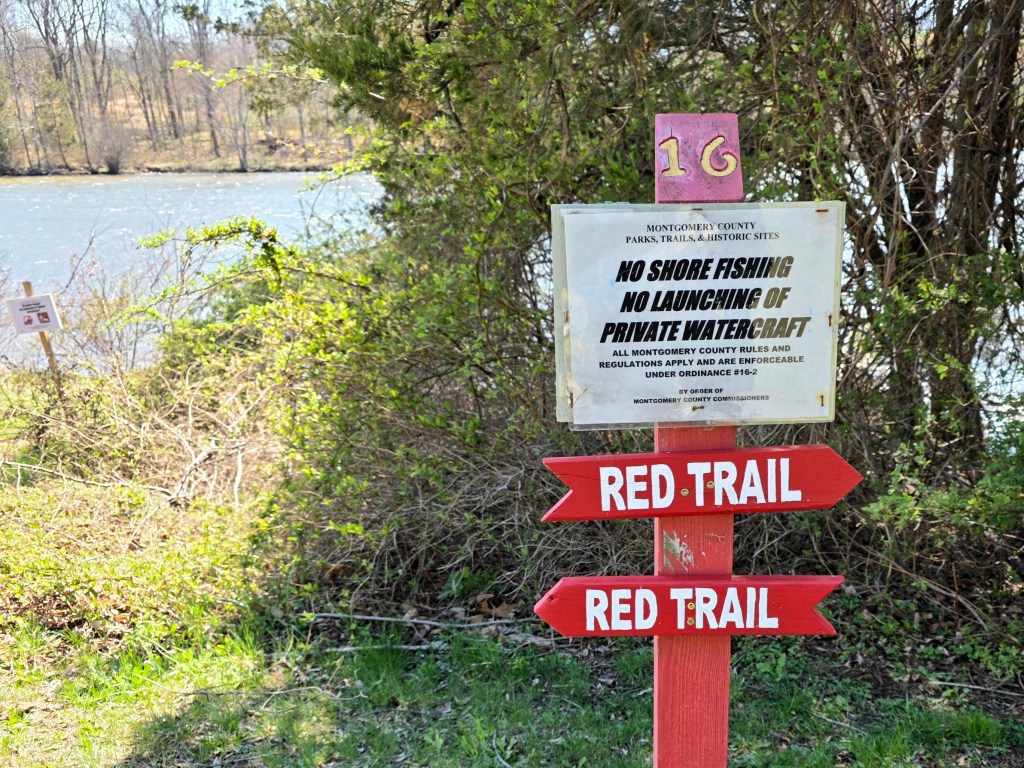
For visitors on Green Lane Park’s popular Red Trail, the Borneman cemetery is easy to miss. This small patch of earth is history made tangible. It is also a flashpoint, where family, history, law, and modern development collide. For the Borneman family, the question remains: can the traces of a past buried under asphalt and time still be recovered—or are they lost forever?
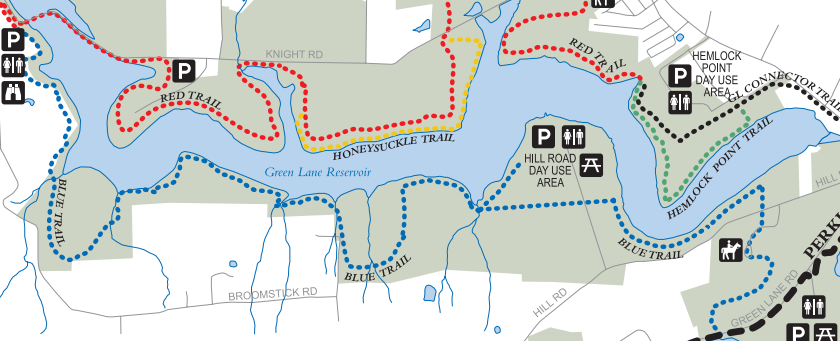
The Red Trail at Green Lane Park stretches about five miles along the eastern edge of the reservoir and is considered easy to moderate. Most of it winds through forest and along the water on natural surfaces, with gentle hills along the way, but a few sections are paved—including the part that crosses a bridge over a small inlet. It is along this paved section near the bridge that hikers will find the Borneman cemetery marker.
The Red Trail also links up with the Honeysuckle Trail, a 1.5-mile path that runs roughly parallel just below the Red Trail along the lake’s edge. Between the two, you can follow the water, duck into shaded forest, or loop back to parking at Hemlock Point or the Green Lane Connector. Watch your step on the paved sections near the water—they can get slippery—but the mix of surfaces makes the Red Trail both scenic and easy to explore.
Christian Borneman (1735–1809), son of Daniel, served as a Private in the Revolutionary War with the 4th Battalion, Philadelphia County Militia. He is buried at Limerick Church Burial Ground, which holds at least seventeen Revolutionary War soldiers and is believed to contain hundreds of additional unmarked graves from that conflict. The cemetery later became the resting place of Charles Breyer (1844–1914), a Civil War Medal of Honor recipient. Breyer served as a Sergeant in Company I of the 90th Pennsylvania Volunteer Infantry and was recognized for his bravery on August 23, 1862. His citation reads, “Voluntarily and at great personal risk, Breyer picked up an unexploded shell and threw it away, thus doubtless saving the life of a comrade whose arm had been taken off by the same shell.”
As the country begins the celebration of its 250th anniversary, it’s important to remember the sacrifices of those who fought for our independence and liberty.

 Keystone Wayfarer
Leave your thoughts