Several weeks ago, I arrived at Sellersville Theater in the early afternoon. I was there to work a show I’d been looking forward to for months—one I’d even circled in my calendar. You see, I still keep a large, neatly kept schedule book. Call me old-fashioned, but there’s something quietly satisfying about seeing plans set down in ink. The Tommy Dorsey Orchestra was, as expected, a well-sold performance. Even in the stillness before showtime, a ripple of elation moved through the empty space.
Whenever a classic orchestra performs on our stage, I know the day will carry a certain grace—a reverence that seems to linger in the air. The first note I heard came from a clarinet, the very instrument that had carried me through years of band concerts and parades in my youth. For a heartbeat, I was transported to a memory I hadn’t touched in years. Then, just as quickly, I returned to the present, listening as the rest of the ensemble joined in for soundcheck. Brass and rhythm wove together—bright, swinging, alive—the kind of music that stirred something deeper than nostalgia. In that moment, I was reminded of another kind of music, one that has quietly played through generations of the family I married into: a song of service, pride, and unforgettable loss.
Veterans Day is a moment of pause to honor the men and women who’ve worn the uniform of the United States Armed Forces. It’s a day that always makes me reflect not only on history but on the people behind it. The holiday began as Armistice Day, marking the moment the guns fell silent at the end of World War I— the 11th hour of the 11th day of the 11th month in 1918. Many countries still observe it as Armistice or Remembrance Day, but here in the U.S., the holiday evolved. Thanks to the efforts of veteran organizations, in 1954 it became Veterans Day — a tribute to all who have served, in peace or war.
As the theater doors opened and patrons filled the seats, I noticed him—moving slowly, yet with an unmistakable presence. He wore a baseball cap embroidered with: U.S. Veteran WWII. I knew I had to talk to him.
Ernest “Ernie” Mogor began sharing his story. He had wanted to join the U.S. Navy like his brother, but being colorblind changed that plan. Instead, he enlisted in the U.S. Army, training with the 76th Infantry Division, 417th Infantry Regiment, Company E. My colleagues and I listened, captivated. The realization that I was meeting a living hero, a link to history, was almost overwhelming.
During the orchestra’s first set, I did a quick bit of research on my soundbooth-based computer. It revealed that by early 1945, Mogor and the 76th were crossing the Sauer and Moselle Rivers near Echternach, Luxembourg, under heavy German fire. These movements were part of the Allied push through the Siegfried Line, and for a time, the 76th was assigned to the Third United States Army under General George S. Patton Jr. At intermission, Ernie described three months in combat, including a terrifying moment on the banks of the Rhine when a German sniper’s bullet passed through his friend before striking him. Remarkably, both survived.
Later, as the concert ended, my thoughts lingered on these stories of service and sacrifice. My husband’s family carries such a legacy. His father, Stewart Lerch, knows loss in a way few ever can. He never met his own father who was killed at age 23 while serving in the Southwest Pacific during World War II. Rusty — as he is known — was only seven months old.
Stewart E. Lerch served as a Technician Fifth Grade (Tec5), a specialist whose technical skills were vital to keeping his unit operating in the field. He was killed in action in New Guinea, leaving behind his young wife, Anna P. (Vogt) Lerch, his mother, and five brothers — among them George and Bruce, who also served in far-reaching parts of the world.

Earlier this year, Rusty shared his story before a Memorial Day audience. As I revisited his words, I couldn’t help but think of Ernie—and of the countless quiet sacrifices made by all who serve, and by the families they leave behind. Each sentence carried its own gravity, cutting straight to the heart of what it truly means to belong to a Gold Star family.
“I never knew my father,” he began, reading from his prepared speech. “I was told he visited me and my mother in the hospital after my birth and held me for about an hour. Later, he said his goodbyes to his family, shipped out for the Southwest Pacific, and never came home again.”
“During my teenage years, my mother began to break down and talk a little more about my dad. She gave me some of the items related to him: his ring, his Purple Heart, the 27th Engineer Combat Battalion — a tie clip, and cufflinks. The last thing she gave me was the dreaded telegram informing her of my father’s death.”

During an interview with the Reading Eagle, Rusty spoke of his mother and the day she received that dreaded telegram. The grief must have been unimaginable. Yet almost immediately, she returned to her factory job, producing munitions for the war effort. “She didn’t stop,” Rusty recalled. “She just kept going, because life had to go on.” It was an act of quiet courage and determination—one that mirrors the steadfast heroism of countless families left behind during wartime.
Married at 20, a mother at 21, and widowed at 22, Anna carried her grief with remarkable strength. She never remarried, instead dedicating her life to her son and to supporting the war effort. She first learned the precision skills needed to operate a drill press at Parish Press Steel in Reading and later worked at the Rosedale plant in Muhlenberg, helping produce munitions for the troops.
“She worked at Rosedale Ordnance during the war,” Rusty shared. “And just like all the other widows, they picked themselves up and went back to work because they knew they had to supply munitions for the troops.”
I had the pleasure of meeting Anna before her passing in 2014. She loved her grandson—my husband—and he loved her just as deeply. Their bond was evident in every glance, every word they shared. I remember her memorial service at Forest Hills Memorial Park in Reiffton, and how my husband was overcome with a sadness I had never seen before—or in the ten years since her death. It was a grief that, in its own way, mirrored the profound loss felt by every Gold Star family.
The number of Americans who know someone who has died in military service has grown over time, as the nation’s conflicts have taken their toll—through combat, accidents, illness, and even suicide. Throughout U.S. history, battle deaths alone have exceeded 1.1 million, with more than 500,000 additional non-combat losses. While it’s difficult to pinpoint an exact percentage of the population affected today, the impact is undeniable: nearly every family, community, and circle of friends has felt the weight of sacrifice in some way.
In his Memorial Day speech, Rusty shared even starker statistics. “Approximately 16 million Americans served in uniform during World War II. By war’s end, 405,399 had died, and another 78,000 were missing in action. My father was one of the 405,399.”
“Records from the Veterans Administration indicate there were roughly 183,000 children left fatherless after the war, designated as ‘war orphans,’” he continued. “I am one of them.”
Rusty traveled to the Philippine Islands to visit his father’s grave at the American Military Cemetery in Manila. The once-in-a-lifetime trip gave him a chance to connect with the father he never knew. “The first time I walked up to his grave, I said, ‘Hi, Dad, it’s been a while.’ I spent about three hours sitting there, just talking about anything that popped into my mind.”
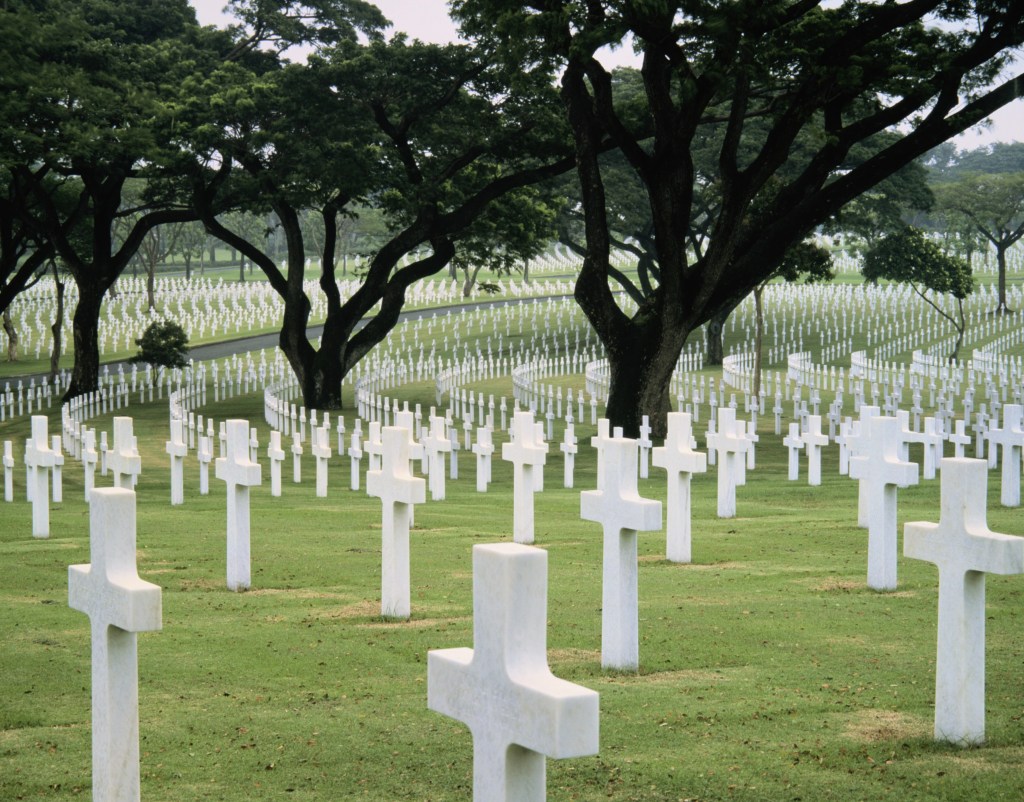
Perched on a plateau in Fort Bonifacio, Taguig, the Manila American Cemetery and Memorial rises quietly above the city, a place of reverence and remembrance. From the airport or the city, its marble headstones come into view. They are aligned in eleven plots, set amid tropical trees and shrubs. The cemetery spans 152 acres and holds 17,206 graves—the largest number of U.S. World War II casualties anywhere. It also contains the war dead from the Philippines and allied nations, many of whom fell in New Guinea or during the campaigns to defend and reclaim the islands. Maintained by the American Battle Monuments Commission, the Memorial serves as both a resting place and a solemn reminder of the sacrifices made in the fight for freedom.
During his trip, Rusty visited the graves of several men from his father’s outfit, paying respects to their sacrifice. He visited his father’s grave three times during his trip. On the last visit, his speech notes, “Dad I don’t think I’ll be coming back to the Philippines again, but I know I’ll be seeing you and talking to you again.”
Gold Star families carry a quiet courage that few can truly understand. Their lives are marked by the absence of a loved one who gave everything in service to their country, yet they carry on with remarkable strength and grace. Every memory, every story, every photograph becomes a way to honor the sacrifice and keep alive the legacy of those who never returned. They share a bond unlike any other—a blend of pride, grief, and resilience that connects them across generations. Rusty’s life reflects that interwoven legacy. He married Sandra Lerch, also from a Gold Star family, whose brother was killed during the Korean War—a rare union of two families shaped by the sacrifices of war.
Over the years, Rusty has walked the quiet rows of countless military cemeteries, laid a wreath at the Tomb of the Unknown Soldier, and shared breakfast at the White House with other Gold Star families.
Rusty’s Memorial Day speech reminds us that the price of freedom is paid far beyond the battlefield. It lives in the empty chairs at dinner tables, the quiet rooms of homes, and the hearts of families who have lost loved ones. The stories that remain—of courage, sacrifice, and love—reach across generations, connecting past and present.
As I walked away from Sellersville Theater that day, the music still echoed in my mind. Yet it was the stories shared by Ernie that stayed with me the longest. I remember his parting words — that he was lucky, that God was good. And I have to agree. That day, I met a hero.
Each day, through my husband, I am gifted a connection to Rusty’s memories, Anna’s devotion, and the unwavering courage of every Gold Star family. It is important to pause on the days when America honors its veterans.
Memorial Day, observed each year on the last Monday in May, remembers those who gave their lives in service. Veterans Day, held every November 11th, expresses gratitude for those who served and returned, carrying their stories, scars, and strength into the world beyond the battlefield. Together, these days honor sacrifice in all its forms.
To Ernie, Stewart, and every veteran past and present — thank you for the courage, sacrifice, and strength that define true service.

 Keystone Wayfarer
Leave your thoughts