
Moving to Schwenksville in late 2007 marked a significant turning point in my life. Following years of hopping around the country in pursuit of my career, buying a house meant putting down roots – a concept that had eluded me since college. The old farmhouse along the state road was number twenty-three on my exhaustive list of viewings. Throughout the journey, I couldn’t shake the feeling that my realtor was growing weary of my pickiness. But then it happened – I found it. My house.
Settlement day presented a mix of excitement and swirling nerves. I asked myself repeatedly, “what am I doing?” Gathering a handful of pens, hoping to appear adequately prepared for the occasion, I sat at the table surrounded by a mountain of paperwork. I signed my name over and over again, each stroke symbolizing a step into the unknown. In the end, a quiet sense of accomplishment settled over me.
Seventeen years have passed since that day, and my love for my house has only grown. But in those early years, as I settled into my new home, I stumbled upon an unexpected revelation. My beloved century-old, brick colonial lay less than five miles from another notable structure, one that most don’t ever want to visit.
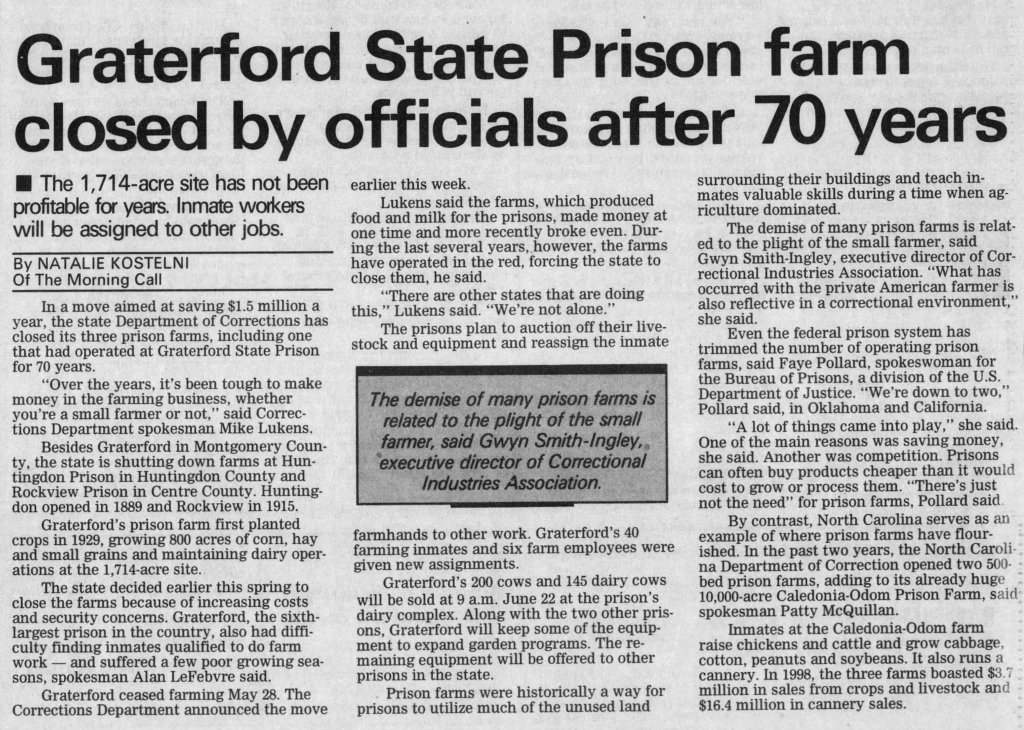
State Correctional Institution at Graterford (SCI Graterford), also known as Graterford Prison, Graterford Penitentiary, Eastern Correctional Institution and Graterford Prison Farm, holds a significant place in state history. Established during the Great Depression, it once stood as Pennsylvania’s largest maximum-security prison. Situated on what was once over seventeen hundred acres of sprawling farmland, SCI Graterford is located on Graterford Road off of Route 29. The original compound boasted a formidable presence, enclosed by a towering thirty-foot wall punctuated by nine guarded towers, symbolizing the institution’s strict security measures.
The original facility featured eight major cell blocks, each housing four hundred cells, following a concept known as the Pennsylvania System. In this design, prisoners endured solitary confinement within cells measuring sixteen feet high, twelve feet long, and nearly eight feet wide. Attached to the back of each cell was a completely enclosed exercise yard, intended to prevent any contact among inmates. Prisoners had minimal interaction, limited to institution officers and occasional visitors.
While incarceration was relatively uncommon in colonial America, its origins can be traced back to the legal innovations of William Penn (1644-1718). Penn’s 1682 body of laws, known as the “Great Law,” introduced a significant shift in the colonial legal landscape. Though it included relatively few capital offenses, the Great Law prescribed various forms of punishment for lawbreakers, including fines, restitution, or corporal punishments such as branding or whipping.
As the colonies expanded, the need for facilities to detain offenders became apparent. Officials repurposed forts and blockhouses to serve as rudimentary prisons for those awaiting trial or punishment.
In the years following the American Revolution, Pennsylvania emerged as a global leader in prison reform and criminal justice practices. The opening of Eastern State Penitentiary in 1829 marked a significant milestone, earning Pennsylvania the recognition as the birthplace of the penitentiary concept. However, by the late twentieth century, Philadelphia found itself at the forefront not of reform, but of incarceration rates.
Designed by architect John Haviland (1792-1852), Eastern State Penitentiary pioneered the concept of “penitence,” emphasizing true remorse as a guiding principle in incarceration. However, by 1913, the institution faced severe overcrowding, leading to a departure from this philosophy. Eight additional cell blocks were constructed, and multi-prisoner cells became the norm, altering the original approach to incarceration.
As a result of its outdated infrastructure and the increasing costs of operation, Eastern State Penitentiary was shuttered in 1970, with many inmates transferred to Graterford, in Montgomery County.
In 1978, Graterford Prison housed approximately sixteen hundred prisoners, with its main five cell blocks supplemented by an additional forty cells in a security unit known as Behavior Adjustment Unit (BAU) or Restricted Housing Unit (RHU). Notably, the RHU included a special section designated for death row inmates, though executions were never carried out at the prison.
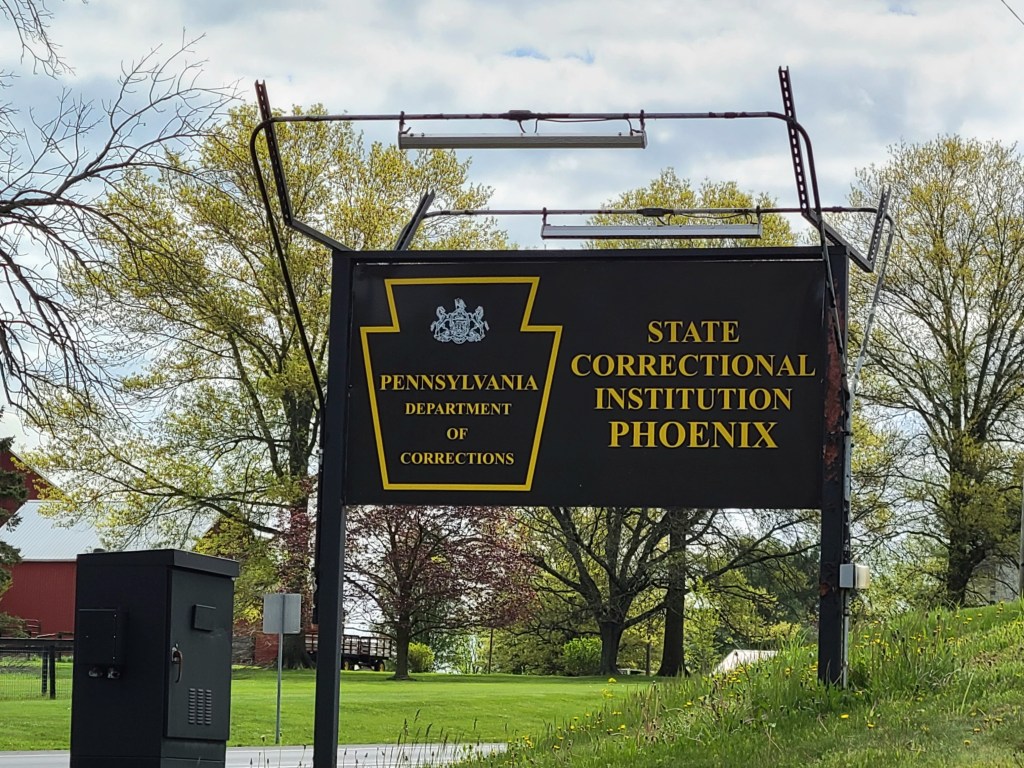
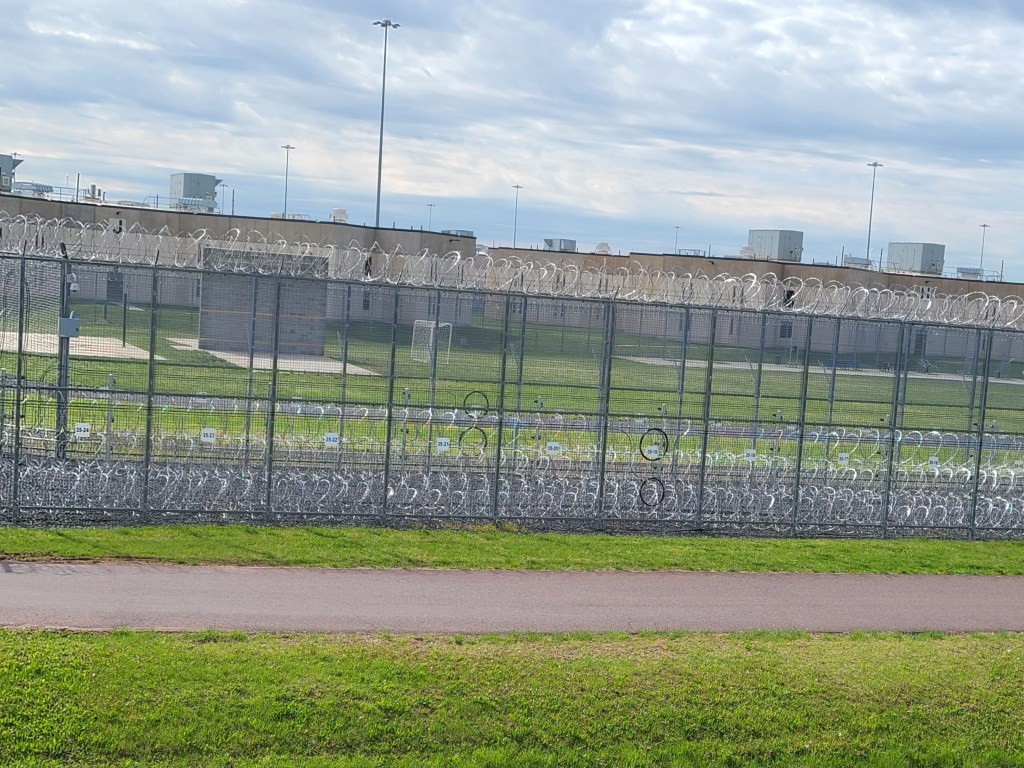
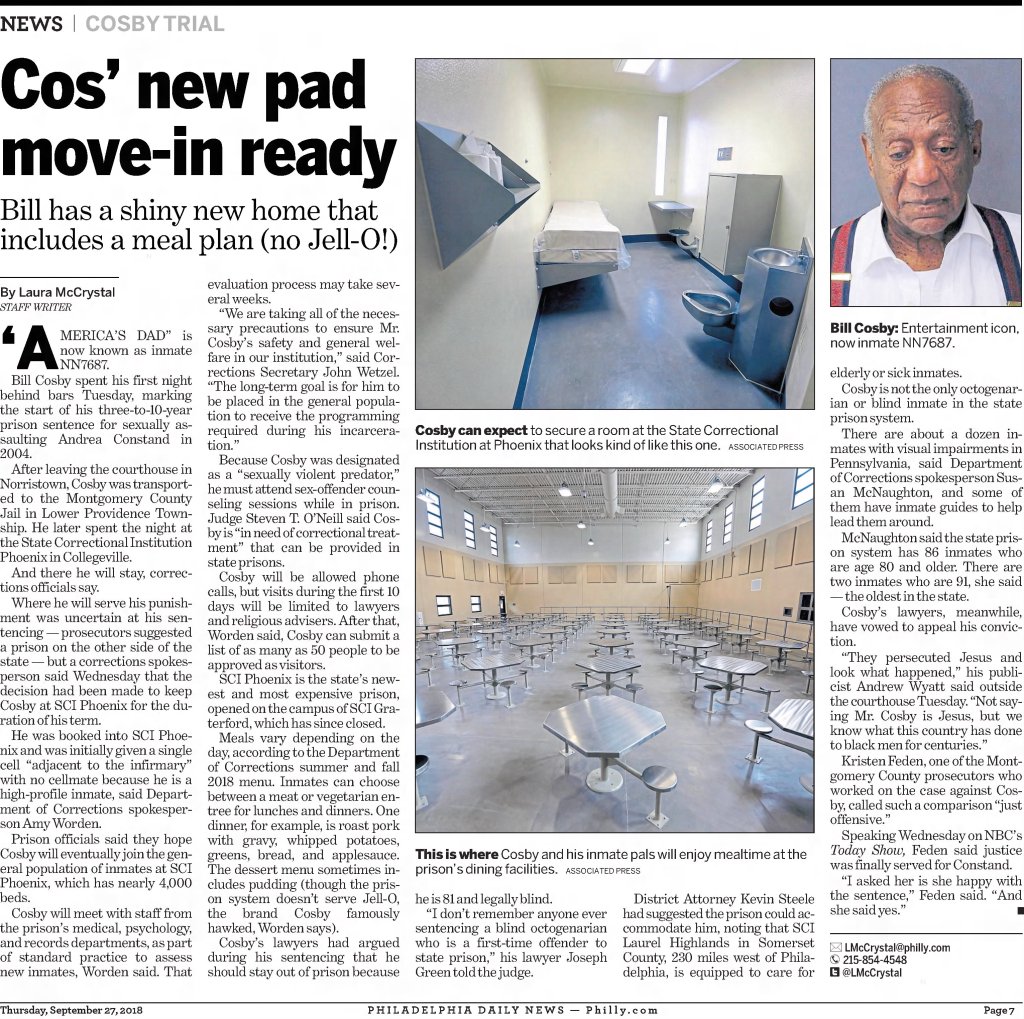
State Correctional Institution Phoenix (SCI Phoenix) replaced Graterford Penitentiary in 2018. It cost four hundred million to build, making it the most expensive state prison to be constructed in Pennsylvania history. The facility has a capacity of just over thirty-eight hundred prisoners and as of September 2018, its full time work force numbered twelve hundred. It is one of two prisons that share Pennsylvania’s death row.
SCI Phoenix buildings are built on Graterford Prison’s land area. The new and old buildings are a quarter of a mile apart, with SCI Phoenix fencing beginning about eleven hundred feet east of the original barricade.
During its history, Graterford Prison witnessed occasional escapes. In 1981, a group of inmates held thirty-eight hostages in the prison kitchen for six days. Nearly seven hundred state troopers raided the prison in 1995, collecting two hundred and fifty homemade weapons and over fifty packets of cocaine.
SCI-Phoenix is located 31 miles northwest of Philadelphia and 4.1 miles from my house.


Notable Inmates
George Feigley, a sex cult leader, served time at Graterford from 1979-1981 before being transferred to Western State Penitentiary following the discovery of his plans to escape by helicopter.
Before embarking on his boxing career, Bernard Hopkins spent several years at Graterford.
Ira Einhorn, known for his environmental activism, was convicted of murder. Upon his extradition from France in 2001, he spent a month at Graterford before transferring to SCI Houtzdale.
Philadelphia rapper Meek Mill was incarcerated at Graterford from 2017-2018.
Pep, the beloved labrador retriever of former Governor Gifford Pinchot, spent time at Graterford.
Gangster Al Capone served a 10-month sentence at Eastern State Penitentiary for a concealed weapons charge in 1929. In the days leading up to his 1930 release, concerns for his safety led to his transfer to Graterford.
Bill Cosby was found guilty of three counts of aggravated indecent assault on April 26, 2018. He was sentenced to three to ten years in prison and transferred to SCI-Phoenix, initially confined to a single cell before being moved into general population.
Additional Pennsylvania Prisons of Importance
Moyamensing Prison, inaugurated in 1835 as Philadelphia’s sole county facility, held a diverse array of inmates. Noteworthy individuals include the abolitionist Passmore Williamson, the anarchist Emma Goldman, the infamous serial killer H.H. Holmes, and the poet Charles Bukowski. The prison ceased operations in 1963 and was demolished in 1968.
Prior to Moyamensing, Walnut Street Jail, operational from 1776 to 1835, served as Philadelphia’s county jail. Used as a military prison until 1784, control reverted to the county after the withdrawal of British troops from the colonies. It held state prisoners until 1818, when Western State Penitentiary in Pittsburgh took over that role. Eastern State Penitentiary’s opening in 1829 marked the end of Walnut Street’s tenure. Upon its closure in 1835, Moyamensing Prison assumed its role as the county’s primary correctional facility.
Erected in 1896, Holmesburg Prison shared a design reminiscent of Eastern State Penitentiary’s radial layout. However, its history was marred by conflict, including multiple hunger strikes and clashes between inmates and officials. In a tragic event in 1938, four prisoners perished in their isolation cells due to extreme heat adjustments by authorities. Holmesburg gained notoriety for dermatological experiments conducted on inmates by Dr. Alberg Kligman during the mid-20th century. The prison’s tumultuous history culminated in 1973 when two wardens were killed by prisoners, marking a grim milestone in American prison history. Despite its closure in 1995, Holmesburg continued to be utilized for overflow prisoners as recently as 2013.

 Keystone Wayfarer
Leave your thoughts