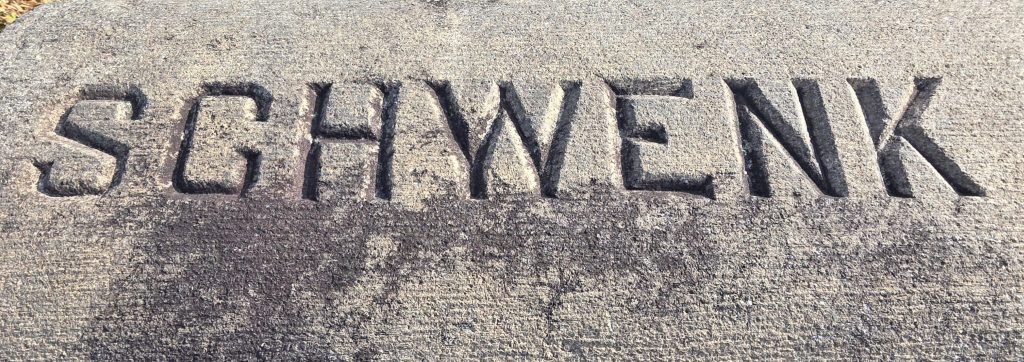
For nearly two years, I’ve poured much of my spare time into writing about history. Lately, though, I’ve turned that lens inward—wondering about my own story and the ripples I might leave behind. With my birthday quickly approaching, the thought feels sharper than usual. What will people say when I’m gone? What was she like? What drove her? And why on earth did she do that?
Maybe it’s my never-ending curiosity or just a subtle need to understand a life still unfolding. Either way, writing lets me sift through the moments that matter, separating the fleeting from the lasting. When I write about the past, time doesn’t just shift—it slows. In that stillness, memory stretches across generations, weaving the choices of those who came before into everything I see and touch.
Though my roots trace back to Massachusetts, it’s here in Schwenksville—my adopted hometown—where one family’s name stands tall, marking both the map and my own continuing story. History feels tangible here. It’s in the streets I walk and the homes I pass. The very air feels heavy with the labor, hopes, and dreams of people I’ll never meet, still echoing across centuries.

And that’s the real power of legacy. It’s not just what we leave behind, but the thread quietly linking one generation to the next. These are the connections I keep returning to in my writing—especially here, in a town so deeply shaped by one family.
Earlier this year, Keystone Wayfarer traced the roots of the Schwenk family in Pennsylvania, beginning with Hans Michael and his son George. George’s marriage to Veronica Markley in the late 1700s set in motion a lineage that still defines this town.
Their story may seem distant, but here, the Schwenk name is more than a historical footnote. It’s a living presence—a reminder that heritage isn’t buried; it’s something we move through every day.
When George died in 1803, he left behind more than land or livestock. Among his belongings were a well-worn sermon book and a large German Bible. On paper, these held little monetary value, but their significance ran deep. The softened corners and faded ink spoke of faith passed down—anchors for the generations to come.
Through his children, the Schwenk story stretched far beyond the borders of this little town. Each forged their own path, carrying a piece of their father’s spirit with them. Abraham, a skilled tanner and Revolutionary War veteran wounded at Germantown, helped sustain the early local economy and later donated land for churches that still stand today. Daniel’s life was rooted in family and community. He strengthened ties across Montgomery County through his marriages and children. And Elizabeth bridged rural life and a growing business world when she married into Norristown’s entrepreneurial scene, carrying forward the family’s values in the process.


As I trace these lives—of faith, sacrifice, and entrepreneurship—I circle back to my walks through town. The streets are lined with echoes of their footsteps: Abraham’s steady stride after a long day of work, Elizabeth’s contemplative gaze from a second-story window, Daniel’s laughter mingling with rhythms of farm life and Sunday gatherings. Their lives were quiet, often unnoticed, but they endured. They mattered. They shaped the landscape I now call home.
Before Schwenksville was officially a town, the land was part of the old Pennypacker Estate. Then in 1816, Jacob Bauer Schwenk—George’s grandson—built a house that would eventually become the Schwenksville Inn. Around that time, he also opened the town’s first general store, which later doubled as the post office starting in 1838, with Jacob himself serving as postmaster.
Around 1845, he expanded his home into the Farmers and Mechanics Hotel—where Liberty Ministries now stands—to shelter travelers stranded by floods. By his death in 1852, Jacob had laid more than foundations; he’d shaped the borough’s future.

His children each carried that work forward in their own way. Jacob G. Schwenk took over the family store, keeping the town’s heart beating. His brother, Abraham G. Schwenk, inherited the hotel along with 76 acres of land—and he’s the one who ended up designing much of Schwenksville’s layout as we know it today. Their sister Elizabeth received a stretch of land running from Maple Street to where Routes 29 and 73 now meet. She married Reuben Strassburger, who started a coal and lumber business on the site now being redeveloped as Trailside on Main.
“Looking back on the legacy of my family, I am proud of my ancestors who settled the Perkiomen region,” says Melissa Schwenk Weinstein, a local descendant. “They farmed, served our country, and became successful tradesmen, entrepreneurs, and community members. Their blood, sweat, and tears were literally shed on this land.”
Melissa’s reflections bring the story into the present. “I feel very lucky to live in the same area where my ancestors settled in the 1700s. Driving through Schwenksville, I can imagine their lives and even see some of the same buildings and geographic features: the Perkiomen Creek, the Scioto Creek, Goshenhoppen Creek, the farmlands, and houses where Schwenks once lived and worked. Not everyone can do this, and I feel fortunate to walk some of the same roads my ancestors probably traveled.”
George Schwenk is Melissa’s sixth great-grandfather. Born in 1963, she still lives near where it all began. Her father, Frederick Gehris Schwenk, carried forward a proud family line stretching back through George’s son John, then John Stetler Schwenk, Nathan Borneman Schwenk, and Frederick Renninger Schwenk. This remarkable lineage of farmers, tradesmen, and community builders is more than history. It’s a living connection that Melissa embodies every day—and one I deeply respect.
Her father, a Civil War enthusiast, especially admired Samuel Klinger Schwenk, a long-serving soldier whose life exemplified resilience and dedication to duty. Several of Samuel’s brothers also answered the call: Milton, a U.S. Navy officer, and Aaron, a soldier with the 50th Pennsylvania Infantry. “I come from a very accomplished and successful family,” she adds with pride.
By the late 1800s, Schwenksville had grown into a bustling town of about 450 residents. It boasted a national bank, churches, a school, and a vital link to the outside world via the Perkiomen Railroad. Livestock trading—a key community industry—thrived once again with a Schwenk at its heart. Frank Schwenk and his son ran a busy cattle yard near the tracks, drawing buyers from across the region. On market days, the lowing of cattle echoed through the streets, herds moving past storefronts and homes to the delight—and occasional groans—of townspeople. Local kids scrambled along the sidewalks, earning pocket money by guiding animals or holding gates. Their laughter mingled with the clatter of hooves.
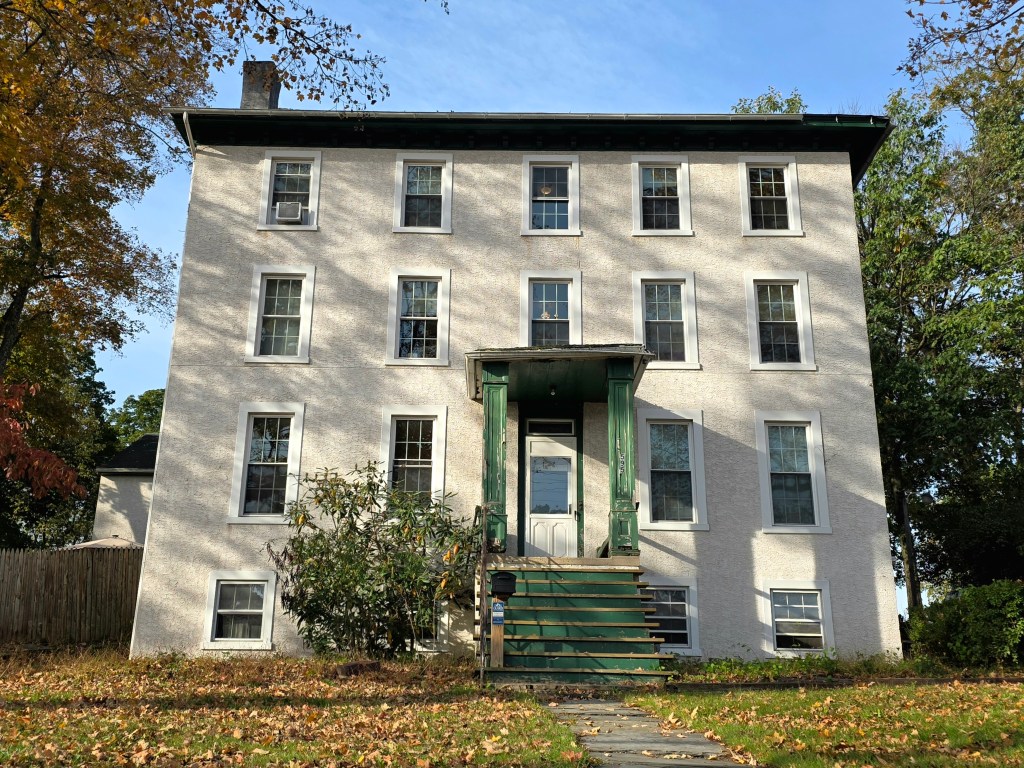
Several family homes and buildings still stand as tangible links to the past, quietly telling stories to those who pause to notice. The red brick house at the corner of Maple and Route 73 once belonged to Elizabeth Schwenk and Reuben Strassburger. Just up the road, the impressive “Schwenk Mansion” at 595 Main Street—built by Abraham Schwenk in 1856—is a familiar landmark. With its white facade and green-trimmed windows, it welcomes travelers entering town en route to Collegeville, standing tall as a testament to the generations who came before. The Weldon House, now home to Engage Art Studio, was originally built by Jacob Schwenk and once described in an 1879 newspaper article as “a delightful retreat.” Walking past these buildings feels like stepping into chapters of a living story—one woven with history, family, and the quiet endurance of those who built this place.
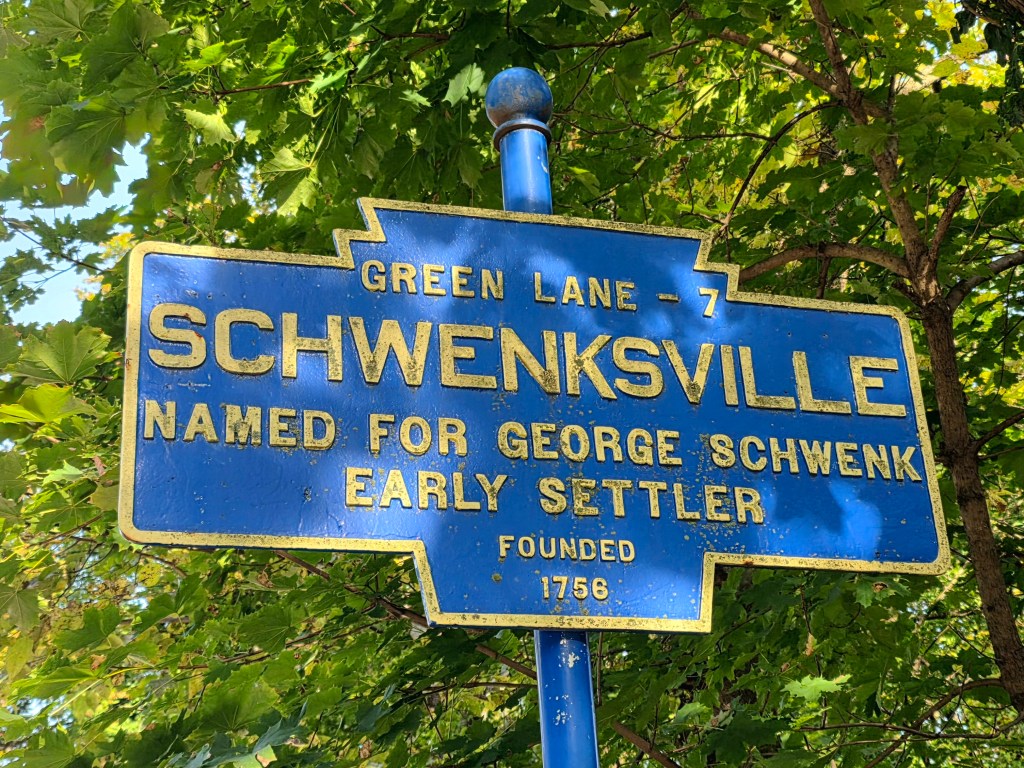
Today, as you enter town, you might spot a modest blue historical marker dedicated to the Schwenk family. It’s one of many dotting Pennsylvania’s roadsides, each honoring a pioneer, builder, or visionary. Yet this one resonates with me in a way the others don’t. Every time I pass it, I think of the generations of Schwenks whose lives shaped this place, and whose footprints I now quietly follow.
And then I find myself returning to the same questions: What will people say when I’m gone? What small traces of me will linger in the places I once walked?
Perhaps legacy isn’t carved in monuments or measured in accolades, but in being remembered as part of something larger—to have mattered, to have loved and labored in ways that leave a trace. Maybe it’s only a name in a church record, a Bible worn smooth from generations of hands, or a great-great-granddaughter walking familiar roads on an October afternoon, feeling that pull of connection and wondering—after all this time—how the story continues.
As my birthday approaches, I hope my story, too, might one day resonate—not in statues or markers, but in moments, memories, and quiet connections.
And maybe, just maybe, that’s enough.
This is the second in a three-part series exploring the legacy of the Schwenk family.


 Keystone Wayfarer
Leave your thoughts