My fascination with political cartoons began nearly twenty years ago when I stumbled upon a piece at a local flea market. It was a serendipitous discovery—an 1874 Harper’s Weekly cartoon by Thomas Nast. The glass had bubbled with age, but the old wooden frame still held firm, preserving the printed image inside. Politicians, dressed in dark suits, were depicted as hollow skeletons, a stark representation of political decay and corruption for which Nast was famous. Struck by its vivid imagery, I purchased it on the spot, convinced I’d uncovered a rare treasure. Despite years of searching online archives, I’ve never found another copy of that exact cartoon, which has only reaffirmed my belief in its rarity.
That accidental find of Nast’s work sparked my curiosity, leading me to explore not only his cartoons but also the legacy of political cartoonists who shaped early America’s social and political discourse. One of the earliest and most iconic examples of the genre is Benjamin Franklin’s “Join or Die.” First published in a 1754 issue of The Pennsylvania Gazette, the wood engraving depicted a severed snake, symbolizing the urgent need for unity among the American colonies in the face of the French threat. Though Franklin’s goal of uniting the colonies under a single government wasn’t immediately realized, the image was later repurposed during the Revolutionary War as a rallying cry against British rule.
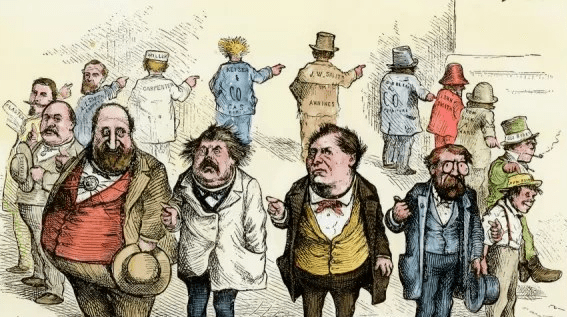
German-born Thomas Nast, often called the “Father of the American Cartoon,” is best known for his satirical depictions of William “Boss” Tweed and the Tammany Hall political machine. Nast’s work vividly captured the corruption and cronyism of the era, shaping the public’s negative perception of the Tammany Ring. His cartoons were more than artistic expression—they were a powerful vehicle for social and political change.
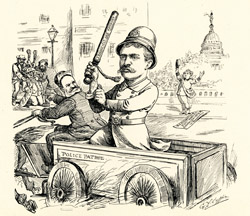
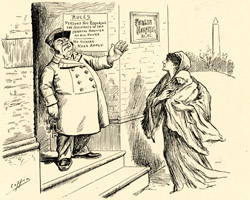
That chance discovery years ago sparked an exploration of other political cartoonists, including the lesser-known yet significant George Yost Coffin. Born in Pottstown on March 30, 1850, Coffin moved with his family to Washington, D.C., in 1858. As a youth, he exhibited a keen interest in sports, reading, and art. He went on to study at Columbian College (now George Washington University), earning an Bachelor of Arts degree in 1869 and a Bachelor of Laws degree in 1871. While pursuing his law studies, Coffin honed his artistic skills, working as an art tutor before securing his first professional position as a clerk in the Revenue Marine division of the Department of the Treasury.
Coffin’s career as a political cartoonist began in the early 1870s, when he contributed to The Washington Chronicle, Washington D.C.’s first illustrated newspaper. After the paper’s demise, Coffin worked for several political and humorous journals, including Harper’s Weekly, The Judge, and Puck—a magazine founded by Austrian cartoonist Joseph Keppler. By the mid-1880s, his work had been featured in a variety of publications, including The Washington Star, The Critic, The National Republican, The Washington Post, and The National Tribune. One of his most notable works was a 1895 cartoon titled Exit! Income Taxes, which depicted Benton McMillin, a proponent of the federal income tax, illustrating the tensions surrounding the issue—a debate that would not be resolved until the 1913 passage of the 16th Amendment.

The earliest notable American cartoonists, like James Akin in Massachusetts and William Charles in Philadelphia, played crucial roles in the medium’s development. While Akin was the better draftsman, Charles was more prolific, especially during the War of 1812. In the 1820s, lithographic printing made political cartoons more affordable and easier to produce. The Civil War era saw a surge in cartoon production, with nearly two hundred lithographs published between 1860 and 1865. Prominent artists included Philadelphia’s David Claypoole Johnston, E. W. Clay, and German-born Louis Maurer.
In the 1840s, illustrated comic periodicals began to emerge in the U.S., inspired by the success of Punch, a London-based humor and satire publication. Publishers like Joseph Pulitzer and William Randolph Hearst quickly saw their readers’ increasing appetite for political cartoons and began incorporating them into their newspapers. Harper’s Weekly, in particular, rose to prominence, largely due to Thomas Nast’s ability to emotionally appeal to Northern patriotism, making it the leading outlet for artistic satire.
By the late 19th century, over one thousand political cartoonists were active in the U.S., including George Yost Coffin. Known for his nonpartisan stance, Coffin once explained, “Every political situation has half a dozen comical sides to it, depending on the viewpoint.” He avoided offensive caricatures, believing that “You need not make a man odious or repulsive in order to caricature him.” His most frequent targets included Grover Cleveland, William McKinley, Theodore Roosevelt, and Alexander “Boss” Shepherd.
Coffin’s final years were marked by illness, attributed to locomotor ataxia, caused by syphilis of the spinal cord. He died in his Washington D.C. apartment on November 28, 1896. He was only forty-six years old. Despite his early death, his contributions to American political commentary continue to resonate, and his works, which helped shape the medium, are preserved in several archives at George Washington University.
Coffin, a nephew of Democratic Pennsylvania Congressman Jacob S. Yost (1801-1872), is buried alongside his mother, Sarah, at Edgewood Cemetery in Pottstown. In 2014, a historic marker was placed at the site of his birth, the Yost Mansion. The marker commemorates the location of the former Bahr Arcade, which replaced the razed mansion in 1901.
The Internal Revenue Service started accepting income tax returns on January 27. The deadline to file your return is April 15.

 Keystone Wayfarer
Leave your thoughts