
On countless Sunday mornings, my husband Tim and I have enjoyed eating breakfast together on Schwenksville’s high street. We could easily walk there, but most often we drive the short distance, parking on the bumpy, stone lot that is nestled around Snoozy’s Café.
As we routinely savor our order of mid-morning scrambled eggs and toast, not forgetting the customary sides of smoky bacon and sausage for the hubby, our eyes inevitably wander to the myriad of vintage railroad signs that adorn nearly every interior wall. Each unique item serves as a silent reminder of the building’s historical past.
Once upon a time, the popular café’s rectangular brick building served as the bustling ticket office on a picturesque stretch of the now-defunct Philadelphia and Reading Railroad. The arrival of trains in 1869 ignited commercial opportunity in the small town, and almost immediately, Schwenksville began to welcome legions of newcomers eager to enjoy the growing promise of prosperity.
Albert Bromer (1837-1906), who chose Schwenksville as a home in 1864, was one such visitor. His entrepreneurial spirit remade the very look of Main Street, evident in the many buildings that continue to thrive as a result of his vision today.
Historical accounts reveal that after arriving from Germany in 1862, Albert and his wife Catherine (1841-1909) started a modest gentlemen’s clothing business in their Schwenksville home. At the time, they had only one employee.
As the business flourished, Bromer recognized the need for expansion. He enlisted local carpenter Peter Scholl, the very same person who grew up in (and later owned) my house, to build a dedicated structure that would serve as headquarters for Bromer’s burgeoning enterprise.
Once completed, daily operations inside the impressive three-story building began with the cutting of fabrics. From there, materials were distributed to the homes of area women, where they diligently sewed the garments together. Once completed, finished clothing was carefully pressed, packed, and transported by horse-drawn wagons, and later by train, to be sold in bustling Philadelphia.
Bromer’s giant building came to be known as Industrial Hall. Constructed in 1874, it stood as the crown jewel of local commerce. The building, currently housing the state liquor store, functioned as a vibrant hub of community life with its upper floors hosting public gatherings and serving as the regular meetinghouse for The Improved Order of Red Men, one of America’s oldest fraternal organizations.
The now storied landmark, which was added to the historic register in 1975, played a pivotal role in the illustrious Pennypacker Family Reunion of 1877. As torrential rains poured down, over 1200 individuals sought refuge inside the building; their mingled voices masking the raindrops that fell most of the day. Samuel Pennypacker, elected governor of Pennsylvania in 1903, gave one of many keynote speeches on this memorable and ill-fated day.
In a heartbreaking turn of events, tragedy struck late in the afternoon as many attendees were making their way home. A train carrying 130 party guests derailed from the rain-soaked tracks on which it traveled. Seven passengers were killed, among them Nathan Pennypacker. Over one hundred were injured.
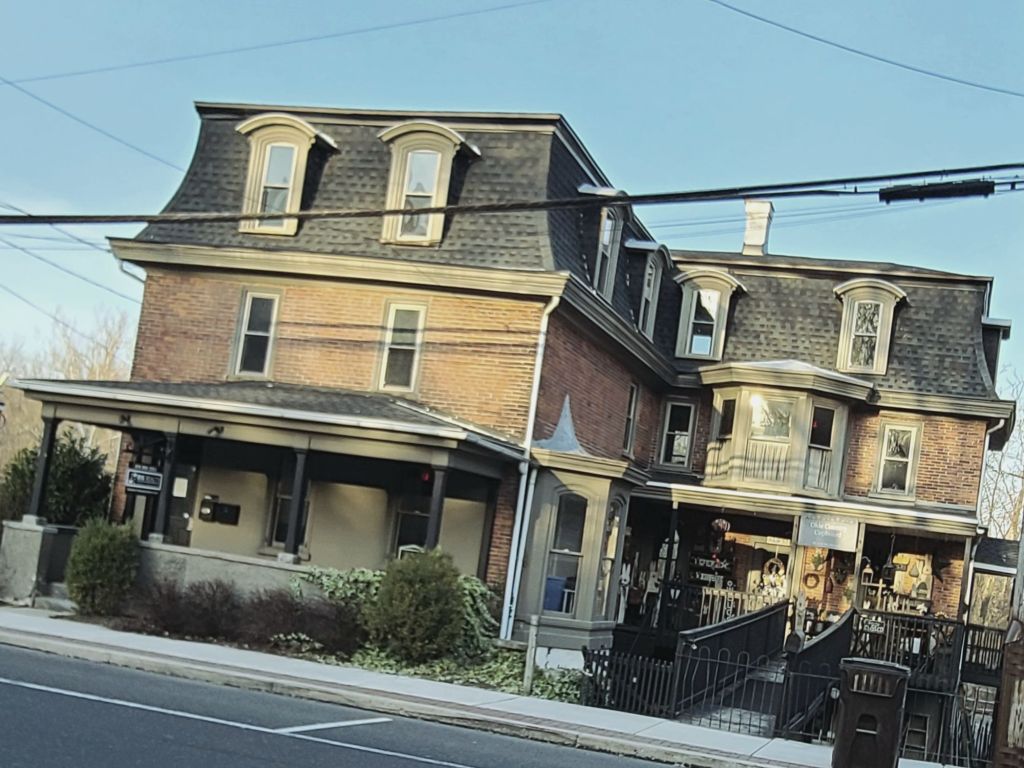
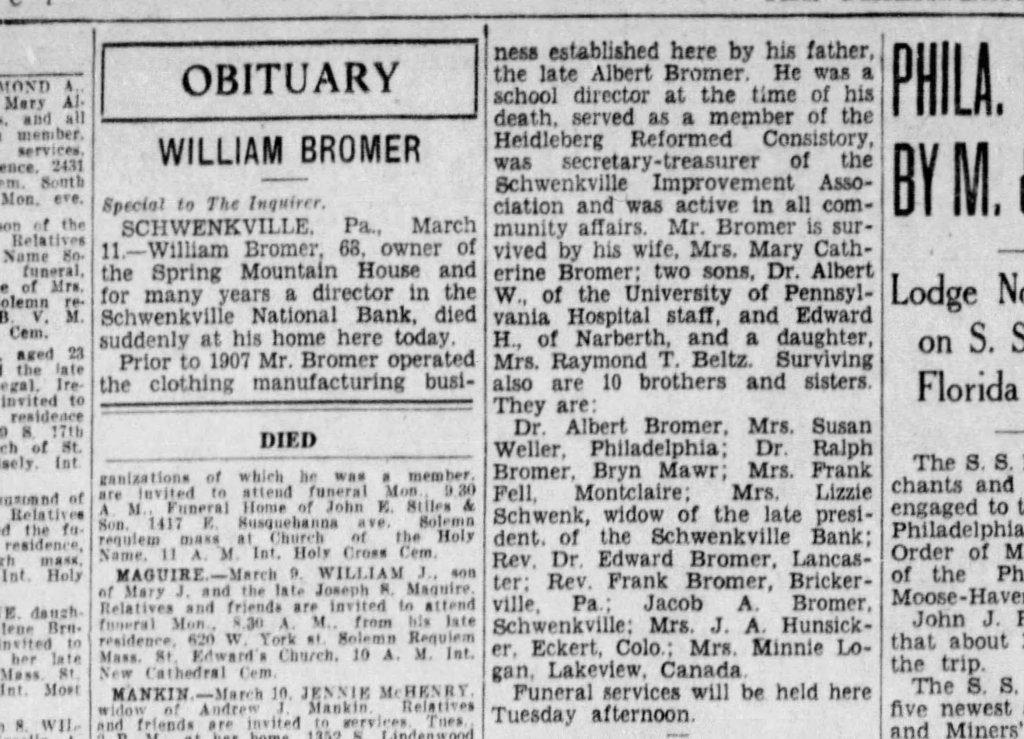
Additional properties on Schwenksville’s Main Street can be attributed to the Bromer family. Gracefully standing atop the hill that lies across from Perkiomen Bicycles is a majestic mansion believed to be the home of Albert’s eldest son, William. Its architectural splendor continues to catch the eye of most passersby.
Some accounts suggest the small frame building, long serving as borough hall, may have been used by the Bromer family as a buttonhole shop. Jacob, one of the Bromer sons, erected a garage on the former site of the Perkiomen Hotel; a business he operated until his death in 1936.
Albert Bromer retired from business in 1890. His farewell marked the end of a legendary era. William took the reins of the garment empire until it was sold in 1924. At that time, Bromer’s Clothing Company boasted an impressive workforce of nearly 600, churning out over 8,000 garments per week.
Albert and Catherine Bromer are buried, alongside several of their eleven children, at Keelys Church Cemetery. Their imprint on this small town is a testament to their unwavering resilience and ingenuity. Together, they enjoy eternal peace on the hillside of the snoozy town I love.




 Keystone Wayfarer
Leave your thoughts