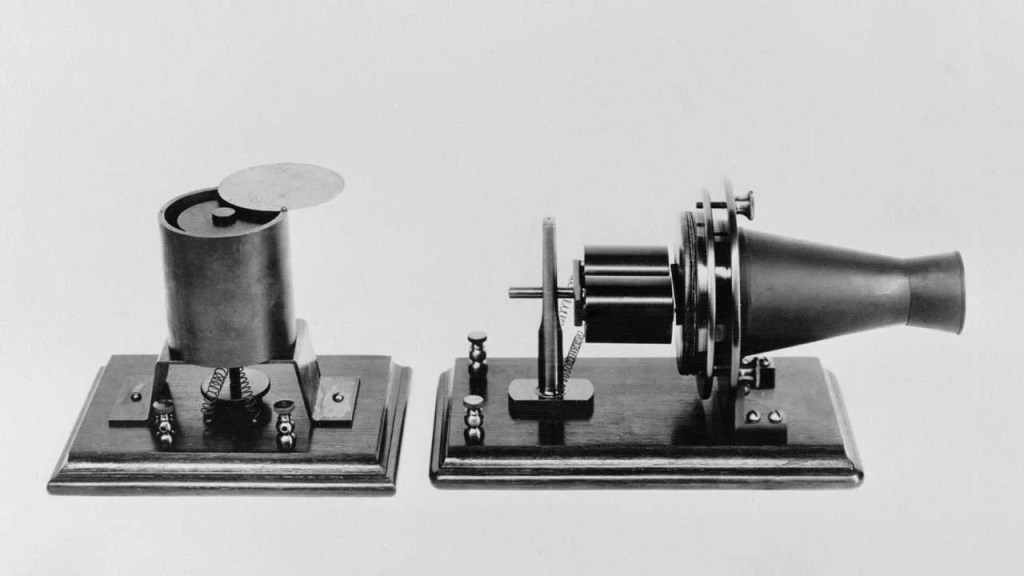
There was a time when I could look at a phone number and know exactly where it belonged. In the early ’90s, I worked for an international record label as a radio promoter, calling college stations across the country. Computers were precious then, so my work lived in binders I carried everywhere. Inside were meticulously compiled handwritten pages, one for each station. Across them, a number connected a DJ, a scene, and a time zone.
The week I scored my first number one on the College Music Journal—the weekly bible of college radio—it felt like magic. The Boston-based metalcore band Only Living Witness had climbed to the top with their debut album, Prone Mortal Form. Being from Boston, being directly involved with a local band achieving that milestone—it was personal.
Back then, the map was simpler. The North American Numbering Plan began in 1947 with just 86 area codes, each a neat pin on a continent-wide grid marking a city, a town, a neighborhood. The largest cities received the quickest combinations—New York City’s 212, Los Angeles’s 213.
Today there are well over 300, and the spread of cell phones and VoIP lines has fractured the geography. I sometimes wonder when I stopped recognizing the numbers, when the map became too large to hold in my hands. Long before I studied maps of codes, someone else was experimenting with how sound itself could travel.
Alexander Graham Bell was born on March 3, 1847, in Edinburgh, into a family obsessed with speech. His father, grandfather, and brother were authorities on elocution, devoted to the mechanics of voice and articulation. His mother—and later his wife—were deaf. Bell’s world was half sound, half silence, and from that tension grew a lifelong fascination with the fragile boundary between the two.
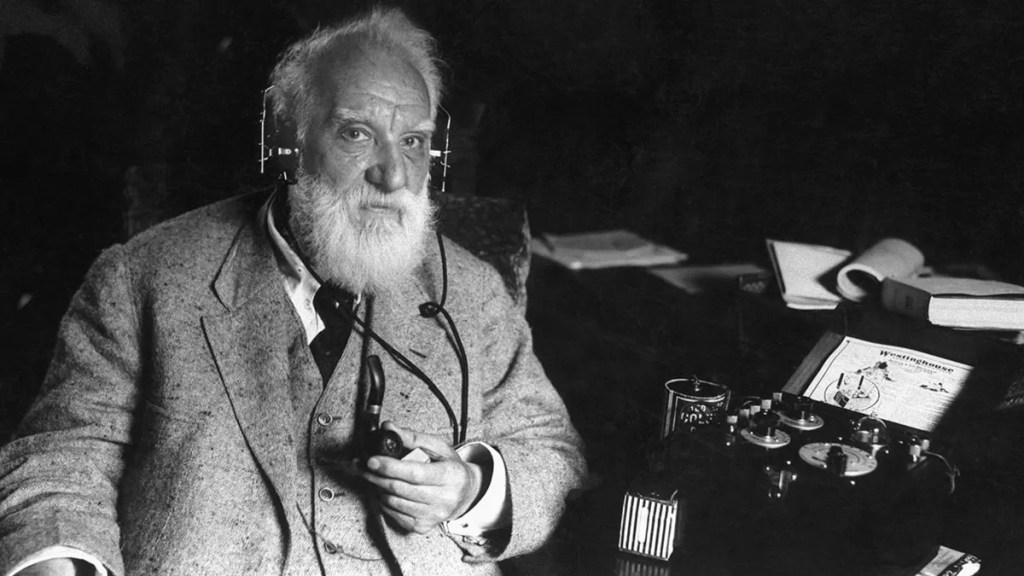
In 1865, the Bell family moved to London. Alexander took positions that paid the bills but left him enough spare hours to pursue his real obsession: sound. Armed with little more than wire, reeds, and stubborn curiosity, he strung telegraph lines from room to room. He tapped, he listened, studying how a simple vibration might one day carry a voice. When his older brother Edward died of tuberculosis in 1867, the experiments took on a heavier, more urgent significance.
Boston became Bell’s new laboratory when he arrived in 1871. As a professor at Boston University, he spent mornings teaching and afternoons tinkering. Two students would leave a lasting mark on his work. Six-year-old George Sanders had a family willing to give him room to experiment. Fifteen-year-old Mabel Hubbard, deaf from scarlet fever, had a sharp, inquisitive mind—one that would later make her his wife and lifelong partner.
Bell needed hands to build what his mind imagined. He found them in Thomas Watson, a skilled mechanic. Together, they wrestled with the rudiments of electricity and vibration, assembling devices that captured the faint tremors of sound. Their small laboratory was part workshop, part alchemy. In each faint tremor of wire and membrane, there was the thrill of possibility.
By 1874, Bell’s experiments were taking shape. He used a curious device called the phonautograph, invented in 1857 by the French printer Édouard-Léon Scott de Martinville. The machine couldn’t play back sound—it only made it visible. Imagine sound waves as ripples in the air. On the phonautograph, these ripples left marks as vibrations shook a thin membrane, moving a stylus that traced patterns onto soot-covered paper or glass. Up and down, back and forth, the lines captured the rhythm of a note, a whisper, a pulse.
Then, in a serendipitous moment, a single vibrating reed revealed that sound could do more than be seen—it could travel along a wire. Seizing this insight, Bell and Watson built the first acoustic telegraph and experimented with harmonic telegraphs—wires capable of carrying multiple messages at once. It was a glimpse of the network of voices Bell had imagined for the future. Visualizing it was one thing; securing it on paper was another.
The race to secure a patent was intense. Inventors scrambled, each hoping to be first to claim the idea of transmitting the human voice. On February 14, 1876, Chicago-based Elisha Gray made a cautious move, filing a caveat—a formal notice to the patent office that he had an invention and intended to submit a full patent later. But Bell was faster. Hours afterward, his lawyer submitted a complete patent application from Boston. In a single day, the stage was set for one of the most famous battles in the history of invention.
The patent would officially be granted on March 7, just three days before Bell spoke the words that would echo through history. On March 10, in a Boston workshop, Bell called out to his assistant Thomas Watson: “Mr. Watson, come here—I want to see you.” Crackly, indistinct, yet unmistakably human, the voice traveled along the wire. Bell and Watson had just achieved what no one else had: a voice carried over a wire. It was a small, private triumph—but its significance was enormous.
That summer, Bell demonstrated his new invention—the telephone—at the Philadelphia Centennial Exposition, the first official international world’s fair held in the United States. The fair took up roughly 285 of the 450 acres of West Fairmount Park, bounded by Girard Avenue to the north and the Schuylkill River to the south. The park itself was part of Philadelphia’s sprawling Fairmount Park, which covered more than 2,000 acres—making it one of the largest urban parks in the United States at the time. From these open fields, the exposition spread outward into vast exhibition grounds filled with iron-and-glass halls and other monumental buildings constructed for the fair.
Machinery Hall trembled under pistons and belts, while Horticultural Hall bloomed beneath its arched glass roof. Nearby, the Woman’s Pavilion showcased dozens of patented inventions, highlighting contributions women had made to society. At the center stood the Main Exhibition Building, massive and gleaming, where visitors marveled at steam engines, looms, and machines that clattered, hissed, and roared.
Bell set up his telephone on a small table in a quiet corner of the Main Exhibition Building. It sat unassuming, easy to overlook. And then it spoke. Visitors in a neighboring pavilion listened as Bell recited Shakespeare, their faces reflecting astonishment. Dignitaries from around the globe leaned in, including Emperor Dom Pedro II of Brazil, who reportedly exclaimed, “My God! It talks!”
The judges—an international panel of scientists, engineers, and educators appointed by the exposition—awarded Bell a gold medal for the invention and a second for his display of Visible Speech. The telephone had stepped out of the workshop and into the imagination of the world.
Pennsylvania quickly became part of the unfolding story when a telephone exchange opened in Pittsburgh in 1878, only months after the first exchanges appeared in the United States. The following year, a Bell company was organized in Philadelphia, beginning the network that would later become the Bell Telephone Company of Pennsylvania. Local accounts note that the first telephone in Schwenksville was installed in the office of the Schwenksville Item.
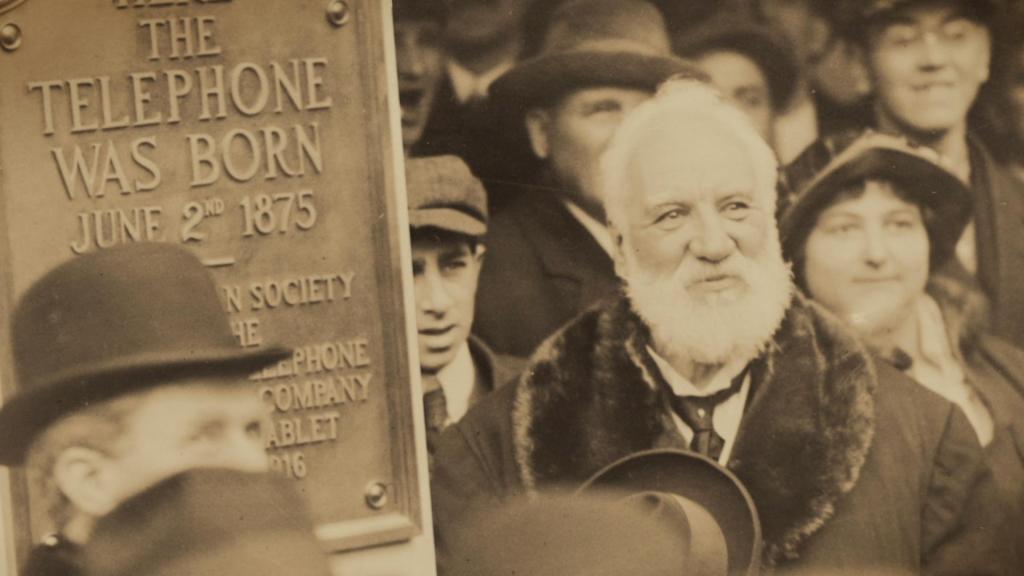
As the network expanded, the telephone quickly moved beyond curiosity and became infrastructure. Wires stretched across rivers and rail lines, while switchboards and operators multiplied. A voice was no longer confined to the room it occupied; it could leap across counties, across states—across the continent.
Bell’s life didn’t stop at the telephone. He founded the Volta Laboratory, where he refined sound recording and developed the graphophone. He also explored the photophone, transmitting sound on beams of light. He experimented with hydrofoils and man-lifting kites to push the boundaries of transportation. In a dramatic turn, he built an early metal detector to try to locate the bullet in President James Garfield after the 1881 assassination attempt. As president of the National Geographic Society, he shaped the use of photography and mapping to illuminate the world. He wrote, lectured, and championed scientific progress across disciplines. When he died on August 2, 1922, in Nova Scotia, he left a legacy as vast and resonant as the voice he had carried across wires.
More than a century after the telephone’s introduction, I tapped into its legacy, dialing numbers across the nation with my binders in hand. Each ring, each click a reminder that the human voice—carried over wires, across cities, through time—still held its magic.
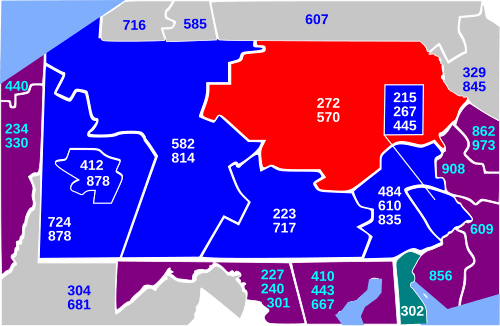
In 1947, the North American Numbering Plan reshaped how we connected across distance. Instead of relying on local operator switches and memorized exchanges, each region received a simple, unique area code—a numerical key to a wider world. The plan began with just 86 area codes covering the entire continent, turning sprawling cities, towns, and rural communities into easily reachable points on a continent-wide grid.
For Pennsylvania, the rollout initially meant just four area codes: 215 for the southeast, 412 for Pittsburgh and the west, 717 for the central counties, and 814 for the north. As population and telephone use grew, the map began to change. Area codes split and overlaid. 610 carved out of 215, later joined by 484. 724 peeled from 412. Countless others reshaped the geography. Where once a local phone number was just seven digits, the introduction of area codes expanded dialing across regions to ten.
Only Living Witness formed in 1989 when drummer Eric Stevenson teamed up with singer Jonah Jenkins. Within two years, bassist Chris Crowley and guitarist Craig Silverman joined, solidifying the lineup that would record the band’s two pivotal albums. In 1993, they recorded their debut, Prone Mortal Form, at the original Fort Apache Studios in Cambridge, Massachusetts. The album was produced by Tim O’Heir, who would later work with influential indie rock bands Sebadoh, Dinosaur Jr., and Folk Implosion. Fort Apache became a hub of the Boston-area indie and alternative scene before moving to Bellows Falls, Vermont, and later to a private farm in New Hampshire in 2007. Decibel Magazine hailed Only Living Witness as one of the great overlooked bands of their era. Drummer Eric Stevenson passed away on August 9, 2011, at 43 after a battle with melanoma.

 Keystone Wayfarer
Leave your thoughts