
October is almost here, and with it comes the season of witches, ghosts, and all the spooky things I love. But sometimes, the scariest stories aren’t supernatural—they come from real life.
One of my favorite books, Arthur Miller’s The Crucible, is a perfect example. Though dramatized, it tells the chilling story of 1692 Salem, where fear spread faster than reason, and a single false accusation could ruin a life. Sadly, it’s an example of a dynamic we still see today—public panic, moral judgment, and reputational destruction. Some even call it an early form of cancel culture—though that term is hotly debated.

Three centuries later, fear took a different form during the McCarthy era. Like Miller, other artists explored its human toll—Irwin Shaw’s The Troubled Air, the 1976 film The Front, and George Clooney’s Good Night, and Good Luck, which portrays journalist Edward R. Murrow’s stand against Senator Joseph McCarthy. Nominated for six Academy Awards, Clooney’s film reminds us that suspicion, scapegoating, and abuse of power aren’t just history—they’re patterns that can resurface anywhere, anytime.
So let’s dig in.
In the 1950s, fear of communism ran so high in the U.S. that suspicion alone could destroy lives. Teachers, government workers, and Hollywood actors were all targeted in an atmosphere of national paranoia.
The term “McCarthyism” comes from Senator McCarthy, who made headlines by claiming he had a list of Communists inside the State Department. But the movement actually began before McCarthy’s rise. In 1947, President Truman signed an executive order requiring federal employees to be screened for “loyalty,” a vague standard that flagged thousands with even loose ties to so-called subversive groups.
By the dawn of the 1950s, the U.S. had seen the Communist takeover in Czechoslovakia, a Soviet nuclear test, and the outbreak of the Korean War. Fear became policy.

Public hearings by Senator McCarthy and the House Un-American Activities Committee (HUAC) dominated headlines. Formed in 1938, the controversial panel investigated suspected communist influence. Its Cold War–era hearings targeted individuals and organizations in ways widely criticized as violations of civil liberties. Though many reprisals were later overturned, the damage was already done.
And while many think of this as a Hollywood or Washington story, McCarthyism reached into small towns too—including one just outside Philadelphia.
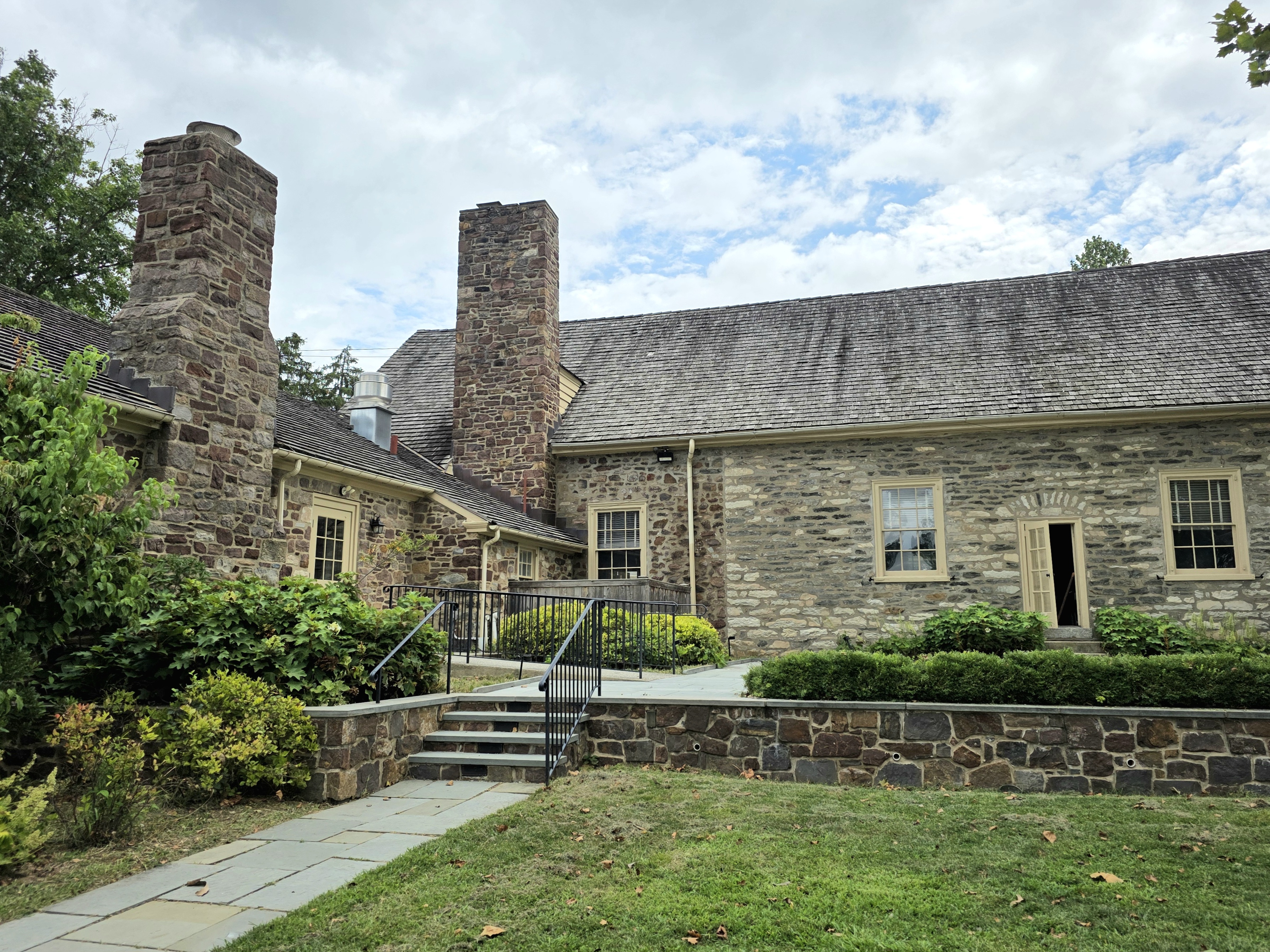
Before I bought my farmhouse on Game Farm Road, I lived in Whitemarsh Township, a quiet suburb near Plymouth Meeting. A short walk from my old rental took me to two historic sites: Plymouth Friends Meeting House and Abolition Hall. It was at the corner of Germantown and Butler Pikes that I first learned about Mary Gardner Knowles, a local librarian caught in the storm of McCarthyism.

Mary was born in Watertown, a suburb just west of Boston and about ten miles from my childhood home. Throughout high school and her college years at Bates, she worked in both school and public libraries. In the mid-1940s, she became a secretary at the Samuel Adams School for Social Studies in Boston. The school, affiliated with the U.S. Communist Party, offered classes in art, literature, history, and politics. Her husband, Clive, along with several of their friends, also taught there.
In May 1953, as Cold War tensions escalated, the Senate Internal Security Subcommittee summoned Mary to testify. Established under the 1950 Internal Security Act—better known as the McCarran Act—the subcommittee targeted individuals suspected of Communist ties. President Truman rejected the legislation, warning that it posed “the greatest danger to freedom of speech, press, and assembly since the Alien and Sedition Acts.” Although he vetoed the bill, Congress ultimately overrode him.
Mary refused to answer the committee’s questions, citing her Fifth Amendment rights. While invoking the Fifth was a legal protection, it was often viewed as an admission of guilt. The committee didn’t press charges, but her employer at the time—a small library in Northwood, Massachusetts—fired her anyway.
With her reputation tarnished, Mary moved with her son Jonathan to Philadelphia. She had divorced in 1951, a change that only added to the challenges she faced. She eventually landed a temporary job at the William Jeanes Memorial Library, located right on the grounds of the Plymouth Friends Meeting House. Founded in 1926 by Mary Rich Jeanes Miller in memory of her first husband, the library was overseen by a board appointed by the local Quaker meeting. By 1953, however, it relied heavily on public funding. Mary was hired to fill in for librarian Edith Sawyer, who had broken her hip.


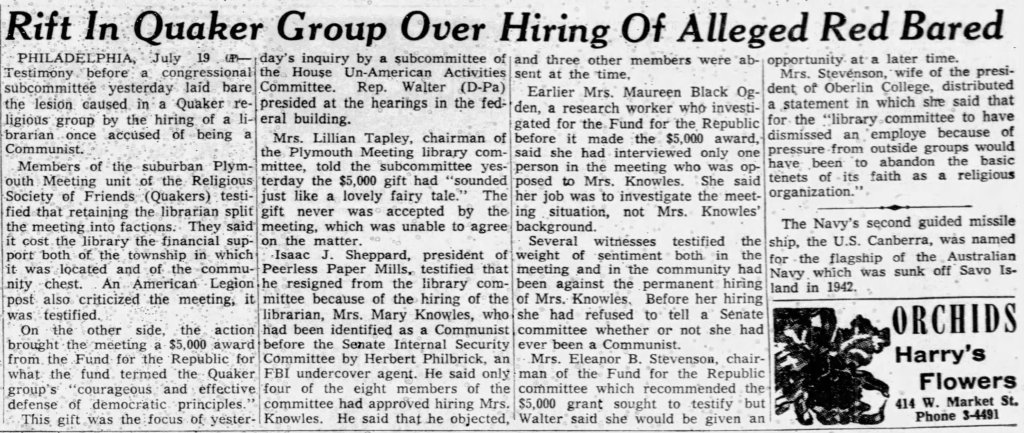
Mary was upfront about her past: her job at the Adams School, her firing, and her refusal to testify. She insisted she was not a Communist. The board, satisfied with her qualifications, hired her for six months in October 1953.
It’s said that under her leadership, the library thrived. Circulation increased, and the space became more welcoming to local children. By early 1954, the board was considering making her position permanent. Even though the library was privately run, one local commissioner asked her to sign a state loyalty oath. But the board, true to its Quaker roots—and its long-standing refusal to sign any kind of oath—backed her. On September 1, 1954, she officially became a full-time employee.
Two commissioners immediately resigned in protest.
Local anti-Communists demanded Mary’s removal, sparking a firestorm of controversy. But the library board stood firm. In retaliation, the township cut off public funding. Then things escalated: the FBI stepped in. Mary was subpoenaed once more—and suddenly, her story was everywhere. Her name appeared in national headlines.

Despite the mounting pressure, Mary stayed put. In May 1955, the Fund for the Republic—a civil liberties organization—awarded Plymouth Friends Meeting House $5,000 for its “principled stand” in keeping her on. The Fund’s president, educator and former university chancellor Robert Maynard Hutchins, called the board’s action a model for anyone resisting “self-appointed censors and amateur loyalty experts.”
Instead of quieting her critics, the award only made them angrier. When Mary appeared before the Senate Internal Security Subcommittee a second time, things were different—she actually testified. She was clear: she wasn’t a Communist, didn’t belong to any banned groups, and had no clue about any spying or subversion. She spoke about her work as a librarian and her role in a private religious community. But still, on April 17, 1956, the Senate voted to hold her in contempt of Congress.
Mary was convicted on 52 counts of contempt. But in 1960, the U.S. Court of Appeals overturned the verdict, ruling that the committee’s questions had exceeded its authority. A year later, the U.S. Supreme Court delivered the final word—overturning Mary’s conviction and clearing her of all charges. It was a major victory, ending years of legal battles and finally vindicating her stand.
During its reign, McCarthyism targeted universities, public schools, and law firms—it even reached maritime workers. Hollywood, however, took the brunt of the attention. Some of the era’s most famous targets included Lucille Ball, Leonard Bernstein, Charlie Chaplin, Albert Einstein, Lena Horne, Gypsy Rose Lee, Burgess Meredith, Dorothy Parker, Pete Seeger, Artie Shaw, and Arthur Miller, author of The Crucible.
Mary Knowles never set out to be a symbol—she just wanted to do her job. But by standing firm, and with a community willing to stand with her, she became part of a larger story: one about civil liberties, local integrity, and the importance of refusing to let fear dictate public life.
Mary stayed at the small library outside Philadelphia until retiring in 1979. She later moved to Alameda, California, where she passed away on November 22, 1997.

 Keystone Wayfarer
Leave your thoughts