
History rarely arrives with fanfare. More often, it slips in quietly—catching us off guard in everyday moments: a stack of old books forgotten in a basement, a handwritten note in the margin of a worn cookbook, a song your mother hummed without knowing why. These are the ways history whispers. For me, the past rarely shows up in neat, straight lines. It drifts in through detours—sparked by curiosity, a fleeting emotion, or the itch of something just out of reach. I don’t usually start with flashy events. Instead, I begin with fragments. And I follow them backward.
When most people think of Pennsylvania’s history, names like Benjamin Franklin or symbols like the Liberty Bell often come to mind. But one of the state’s most enduring and quietly powerful legacies is the 28th Infantry Division. Known as the “Keystone,” it’s the oldest continuously serving division in the U.S. Army.
Its roots stretch back more than 275 years, to when Franklin himself helped organize the Pennsylvania Associators—a volunteer militia formed to protect the colony from outside threats. These weren’t professional soldiers, but neighbors, shopkeepers, and farmers—ordinary people stepping forward out of a deep sense of duty. Their choice planted the seed of a military tradition that continues to this day.
The division’s formal shape began to emerge in 1879, when Pennsylvania’s Governor Henry Hoyt appointed Major General John F. Hartranft to lead what would become the Pennsylvania National Guard. At the time, no one could have predicted how far this unit would go.

It was during World War I that the division found its identity. On the battlefields of Europe, under relentless pressure, their grit and determination caught the eye of General John J. Pershing, commander of the American Expeditionary Forces, who gave them a name that stuck: the “Iron Division.” This wasn’t just a nickname—it was a tribute to their unbreakable resolve amid some of the war’s most brutal fighting. That courage, however, came at a steep price. By the war’s end, the division had lost over 14,000 soldiers, and two of its members—Sergeant James I. Mestrovitch and Major Joseph H. Thompson—earned the Medal of Honor for extraordinary bravery.
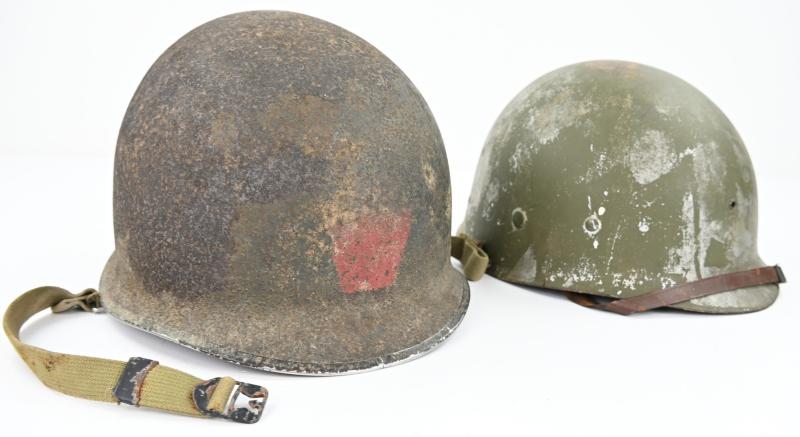
World War II tested the division once again, especially during the Battle of the Bulge—one of the largest and bloodiest battles ever fought by the U.S. Army. As the troops pushed across Europe, they helped liberate France. It was then they earned another name—this time from their enemy. The Germans called them the “Bloody Bucket,” a grim reference to the red keystone patch on their uniforms and the ferocity of their resistance. That patch wasn’t just a symbol—it was a warning. The U.S. Army never officially adopted the name, but for the men of the 28th, it became a powerful badge of honor.
In the decades following World War II, the 28th Infantry Division wasn’t called up for Vietnam or deployed during Desert Storm. But everything changed after 9/11, when the division was once again called to serve in a new era of warfare. Thousands of its soldiers deployed on missions for Operation Enduring Freedom, Noble Eagle, and Iraqi Freedom. In 2004, Company A of the 28th Signal Battalion, along with elements of the 103rd Armor Regiment and 107th Field Artillery, deployed to Iraq. The following year, the 2nd Brigade Combat Team spent a year in theater, followed by the 56th Stryker Brigade in 2008—the first National Guard Stryker brigade to enter a combat zone.
Today, the 28th Infantry Division remains strong, with units across Pennsylvania, Maryland, Ohio, and New Jersey. Its soldiers continue the tradition of service—whether responding to floods at home or deploying to support global missions. A lasting tribute to that legacy stands in Boalsburg, where a shrine honors the division on land once owned by Colonel Theodore Davis Boal. Back in 1916, Boal started a horse-mounted machine gun unit—the Boal Troop—which later became part of the Guard. Since 1919, members of the 28th have gathered there every third Sunday in May for a memorial service. The road leading to the site is named the Pennsylvania 28th Division Highway.

The division’s legacy even shows up in popular culture. The HBO film When Trumpets Fade (1998) tells their story during the Battle of Hürtgen Forest. In The Subject Was Roses (1968), Martin Sheen’s character quietly wears the 28th’s insignia. Their red keystone patch appears in the opening of Dawn of the Dead (1978), and they’re mentioned in Band of Brothers (Episode 5), grounding their presence in the broader WWII narrative.
From humble beginnings in Philadelphia, the 28th Infantry Division has grown into a symbol of what ordinary people can do when united by a common cause. Time and again throughout American history, it has proven that courage, resilience, and service can shape the future.
Like the quiet traces of history I chase, the 28th’s story reminds us that the past isn’t distant or frozen in time. It’s woven into our lives—carried forward by ordinary people who choose to step forward. To me, history isn’t just about dates or monuments. It’s about connection. It lives in our habits, in our silences, and in the way we move through the world. I’m not chasing statues. I’m chasing those whispers—and they’re everywhere, waiting for someone to listen.
The 28th Infantry Division Association Scholarship Fund helps soldiers offset the cost of higher education, covering expenses like books, room and board, lab fees, and more. Each year, the fund awards four $500 scholarships through the Pennsylvania National Guard Scholarship Program, honoring service with meaningful support. Click here to make a contribution.

 Keystone Wayfarer
Leave your thoughts