
Some years, it feels like we completely skip spring. One minute it’s flurries and frostbite, and the next—bam!—we’re baking in full-on summer heat. In fact, a 2025 analysis by Climate Central found that 98% of the U.S. has seen more warmer-than-normal spring days since 1970. For many places, that’s seven extra warm days each spring. No wonder it feels like this early growing season seems to be in a rush to skip town.
Climate Central, an independent group of scientists, focuses on researching climate and its impact on daily life. NOAA (National Oceanic and Atmospheric Administration) backs them up, noting that temperatures are creeping up earlier every year, as if the seasons themselves are racing to catch up with the calendar.
I won’t wade into the “why” of it all because that conversation tends to spiral into a political hot tub faster than you can say “climate crisis.” But if we’re barreling into summer anyway, why not lean in? And what better way to do that than with an overflowing root beer float?
Root beer is one of those quintessential American things that feels like it’s always been around—like baseball, fireworks, or arguing about pizza toppings. But it didn’t start out as the sweet, fizzy treat we know today. Back in the late 1700s, it was more of a hot herbal tea, brewed from roots and herbs like sarsaparilla, wintergreen, and juniper. Native American and European communities enjoyed these earthy concoctions not just for their taste, but for their supposed medicinal magic. You could call it the 18th-century equivalent of a wellness shot.
One man would change all that.
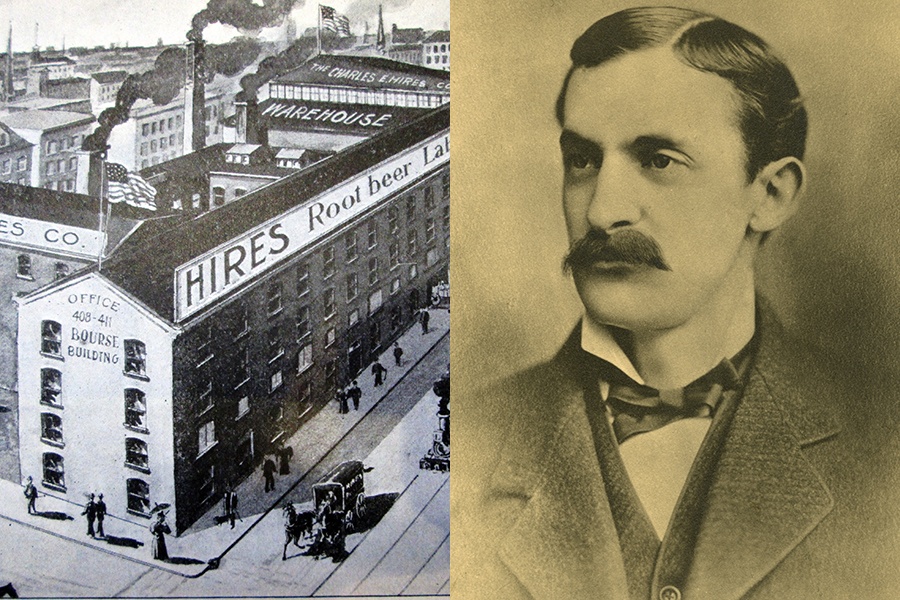
Charles Elmer Hires wasn’t just a pharmacist; he was a visionary. Born in New Jersey in 1851, Hires was mixing potions by age twelve as a drugstore apprentice. By sixteen, he was in Philadelphia, honing his skills and eventually invested four hundred dollars–a small fortune then–in a pharmacy owned by his soon-to-be brother-in-law. It was the first step toward building what would become a legendary American brand.
Then came the honeymoon that changed everything.
In 1875, while travelling with his wife, Clara Kate Smith, Hires was served a rustic herbal tea at a country inn. Curious and enterprising, he got the recipe, took it back to Philadelphia, and—alongside two professors from the College of Pharmacy—refined it into a complex blend of sixteen roots, herbs, and berries.
At the time, several Philadelphia companies were already selling herbal extracts and tonics. But Charles wasn’t interested in blending in. He saw an opportunity to elevate this humble tradition. He initially called it “Hires’ Root Tea,” but a savvy friend, Russell Conwell, suggested “Root Beer” to appeal to the hardworking, beer-loving Pennsylvania coal miners. And just like that, root beer was born.

The big break came at the 1876 Centennial Exhibition in Philadelphia. Hires gave out free samples and sold packets of his drink mix, winning over visitors from across the country. Soon, he opened a factory at 117-119 Arch Street and, in 1890, incorporated the Charles E. Hires Company. Before long, Hires introduced a syrup version of his root beer, making it even more convenient for shops to serve. Soda fountains started buying his extract by the gallon, and the humble homebrew was well on its way to becoming a national favorite.
Hires was more than just a root beer innovator—he was a marketing trailblazer. Before Coca-Cola was a household name, Hires was running full-page newspaper ads and distributing Victorian trading cards. These were miniature artistic masterpieces, created by some of the most talented lithographers and artists of the time. The cards were collectible and helped build a national brand identity before the concept even existed.
His ads featured rosy-cheeked children sipping frothy mugs of root beer, promising a guilt-free, good-for-you soda. Hires knew that building a strong brand was key, so he made sure his product was associated with quality and purity. His slogan? “Join health and refreshment—drink Hires Root Beer.”


By 1894, Hires had sold over three million packages, which brewed more than three hundred million glasses—five for every person in the U.S. The Charles E. Hires Co. was booming, with a massive plant along the Delaware River. Between 1904 and 1909, his company grew nearly thirty percent a year.
While his focus remained on root beer, Charles had other ventures up his sleeve. In 1896, he began experimenting with condensed milk, and over the next decade, he pioneered several new processes to ensure the product was safer and longer-lasting. By 1918, he sold his condensed milk interests to Nestlé.
Of course, not everyone was thrilled. When the Woman’s Christian Temperance Union questioned its alcohol content, Hires fired back with lab results showing it contained no more alcohol than a loaf of bread. Famously a non-drinker, he proved his “beer” was a safe, virtuous drink. Take that, Francis Willard.

Charles remained in charge of his company until 1925, when his two sons took over. Charles died from a stroke at his home in Haverford on August 1, 1937. He was 85 years old.
Despite the company’s success, competition crept in. The 20th century brought cola wars, changing tastes, and brands like A&W and Barq’s. Though sales remained steady, rising material and labor costs saw the Hires family sell their majority stake to Consolidated Foods Corp. By 2008, after Cadbury Schweppes spun off Dr Pepper Snapple Group, Hires was largely phased out in favor of the more popular A&W brand. Though you could still find Hires Root Beer online as late as 2016, it had become a rare and nostalgic product, mostly relegated to online retailers.
While root beer may have taken a bit of a backseat to cola and other sodas after the 1950s, it never truly disappeared from the City of Brotherly Love. The city’s craft beverage boom sparked a root beer renaissance, with small producers like Yards Brewing Company and Hank’s Gourmet Beverages keeping the fizzy flame alive. And in a way, they’re carrying on a legacy that started in the heart of Philadelphia.
So, if summer really is jumping the line this year, find yourself a shady spot, grab a frosty mug, and sip on a little piece of history. Root beer might have started in a teacup, but thanks to one curious pharmacist and a good honeymoon, it found its way into our summers for good.
The Root Beer Float

If root beer is a nostalgic throwback, then the root beer float is its crown jewel. It’s dessert at its most chaotic and charming. Vanilla ice cream plus root beer—two ingredients and boom, you’ve got a fizzy, frothy spectacle that tastes like summer in a glass. It’s less of a recipe and more of a performance. Kids are mesmerized. Adults pretend it’s “for the kids.” Everyone wins.
While soda fountains date back to the 1800s, the float’s true origin story is delightfully quirky. In 1893, Frank J. Wisner of Cripple Creek, Colorado, was gazing at a snowy mountain and had a sudden thought: What if I plopped ice cream into root beer? Thus, the “Black Cow” was born—later known simply as the root beer float.
By the 1950s, drive-ins like A&W helped make floats a national obsession. Today, they’re a summertime classic, still beloved for their chaotic blend of bubbles and cream.

 Keystone Wayfarer
Leave your thoughts