
Ah, yes, the classics. “Wash your hands!” “Clean up your room!” “Eat with your mouth closed!” Every adult has surely heard these commands so many times they’ve practically become a part of our DNA. It was like having a personal parental DJ, remixing the same tunes on an endless loop. And, of course, when you forgot? Cue the familiar sound of your parents’ voices, reminding you again—because, let’s face it, they had the magical ability to repeat those instructions until they were precisely drilled into your head.
But the ones that really stand out in my memory? “Turn off the light!” and the ever-popular “Were you raised in a barn?” That one came with a particular flair, usually after an exterior door was left wide open, as if my brother and I were trying to heat or air-condition the entire neighborhood. As a kid, it seemed like just another annoying reminder. But now, as a homeowner, oh, do I get it. There’s something about those monthly energy bills that really brings the lessons home. Suddenly, I’m that person—shutting doors and flipping off lights like I’m trying to save the world, one room at a time.
Turns out, those little reminders weren’t just about teaching manners; some were survival skills for adulthood. When I moved to Schwenksville, I suddenly found myself living next door to one of the region’s most iconic landmarks—though I didn’t realize it at first. Shortly after purchasing my home on Game Farm Road, I received a brochure in my mailbox. It highlighted what are arguably the tallest architectural features in the area. Most people around here can easily spot the towering twin stacks or see the puffy white clouds billowing from their symmetrical edges every day. Welcome to Limerick Generating Station, whose iconic steam stacks have become as much a part of the local landscape as the occasional deer wandering through my backyard.
Living next door to such a powerful presence, I quickly realized that Limerick Generating Station wasn’t just a feature of the skyline—it was like a new neighbor, quietly doing its thing, mostly in the background. Growing up, the closest nuclear plant to me was Seabrook Station, which began operations just before I moved to New York City in 1990 to pursue my dream career. So, I wasn’t around to pay much attention, but now that I live near Limerick, it feels like they’re my unofficial neighbors. Like those parental reminders we all got growing up–a little mysterious, sometimes overwhelming, but always there.

Limerick Generating Station spans six hundred acres, much of which was acquired through eminent domain, including most of historic Frick’s Lock Village. It’s a vast space dedicated to generating a significant amount of energy. One key feature that helps keep the reactors cool is water drawn from the nearby Schuylkill River. This water regulates the temperature, ensuring the reactors operate at optimal levels while producing massive amounts of energy. The plant’s 500-foot-tall twin natural draft cooling towers are its most striking features. They rise above the landscape like silent sentinels, overseeing the land, while the plant itself hums away quietly, providing 2,317 net megawatts of clean, carbon-free energy—enough to power thousands of homes or keep the coffee brewing for early risers and late-night workers like me.
Planning for the site began in 1969, but construction didn’t get underway until 1974. The process of bringing the two reactors online took over a decade, with the original owner, Bechtel Power Corporation, overcoming various challenges typical of large-scale energy projects. Unit 1 began operations on February 1, 1986, and continues to operate reliably, licensed through 2044. Unit 2 came online on January 8, 1990, and is set to continue its operations through 2049. For decades, these reactors have served as consistent powerhouses, much like the parental reminders we all grew up with—they’ve endured the test of time and show no signs of slowing down.
When it comes to nuclear energy, the United States is the undisputed leader. As of 2024, the country is home to ninety-four commercial nuclear reactors, generating nearly nineteen percent of the nation’s electricity. The journey toward peaceful uses of nuclear materials in the U.S. began with the creation of the Atomic Energy Commission (AEC) under the Atomic Energy Act of 1946. At that time, medical scientists were investigating how radiation could target the fast-growing cells of cancer, and they were granted access to nuclear materials for their research. Looking back, it’s striking how something as powerful—and potentially destructive—as nuclear energy has been harnessed for healing. Meanwhile, the military also explored other peaceful applications of atomic technology.
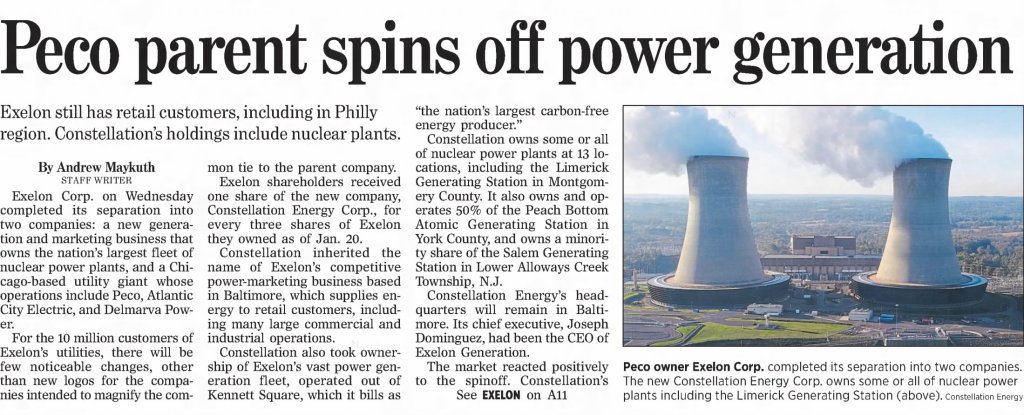
Limerick Generating Station, now owned by Constellation Energy following its spin-off from Exelon Corporation in 2022, is a “black start” plant, meaning it doesn’t rely on external grid power to start up. This is crucial for grid reliability—when other plants go offline, Limerick can step in and help restore power. To ensure it can do so when needed, the station is equipped with eight Fairbanks Morse diesel engine generator sets, each capable of delivering 3,000 kilowatts of power and reaching full speed within ten seconds of startup. The plant operates at 100% power except during scheduled refueling outages, ensuring it remains reliable and ready in case of emergency.
And speaking of emergencies, Limerick Generating Station has had its share of incidents over the years. In 1994, an F3 tornado came dangerously close to the plant, causing significant damage to a nearby housing development but narrowly missing the facility. In 2015, a malfunction on a control card released excess energy that caused an odor in the control room. In 2016, Unit 2 was shut down due to an electrical fault, but the issue was quickly resolved. Then, in 2021, the emergency cooling system failed during a routine test, but it was swiftly repaired and brought back online. Despite these incidents, the plant has operated safely, providing reliable power to the region.

The Montgomery County Department of Public Safety, Division of Emergency Management, plays a crucial role in ensuring the safety of the twenty-one municipalities within the ten-mile Emergency Planning Zone (EPZ) around Limerick Generating Station, including my home in Schwenksville. Residents within the EPZ are regularly updated on emergency plans and notifications for potential nuclear incidents. Additionally, every municipality in Pennsylvania is required by law to have an Emergency Operations Plan (EOP) outlining responses to various emergencies. For those within the EPZ of a nuclear plant like Limerick, there’s an added requirement: a Radiological Emergency Response Plan (RERP). This specific playbook ensures that everyone knows exactly what to do in the event of a nuclear incident. The RERP is regularly updated, and all first responders participate in annual training and biannual drills to stay prepared.
To ensure that everyone knows how to act in an emergency, Limerick has installed a system of public alert sirens throughout the EPZ. These sirens are regularly tested, so when they sound during an actual emergency, you’ll know it’s time to take action. And when they are tested, you’ll definitely know it. The sound is deafening.
It’s easy to forget that behind the energy we use every day, there’s a whole system working to keep us safe and prepared. Limerick Generating Station, along with local municipalities, is committed to ensuring the community is ready, so we can all live our lives knowing that safety is a top priority. So, the next time you recall those key life lessons from your parents all those years ago—like turning off the lights or shutting the door behind you—remember, they weren’t all just about manners. They were preparing us for the world ahead, one reminder at a time.

Pennsylvania is home to three additional nuclear power plants—Beaver Valley Power Station, Peach Bottom Atomic Power Station, and Susquehanna Steam Electric Station. In an intriguing turn of events, a report from NPR on September 20, 2024, revealed that Three Mile Island in Middletown, PA—site of the worst commercial nuclear accident in U.S. history—is set to reopen to power Microsoft’s data centers. These data centers are essential to running the tech giant’s cloud computing and artificial intelligence operations. This agreement between Constellation and Microsoft is expected to create more than three thousand regional jobs and generate over three billion dollars in state and federal taxes. The project’s anticipated launch is in 2028.

 Keystone Wayfarer
Leave your thoughts