
I was living in Astoria, a vibrant neighborhood in Queens, when I first discovered Roosevelt Island. Nestled along the East River, the slender island offered a stunning view of the iconic New York City skyline. At one end, an aged lighthouse stood stoically, while at the other, a castle-like structure lay hidden behind a fence, its decay a silent testament to a past both eerie and forgotten. The stark contrast between these frozen remnants of history and the bustling city that dwarfed it fascinated me. Intrigued, I spent the following weeks at the New York Public Library, scribbling in notebooks, eager to uncover the island’s unusual legacy.
Roosevelt Island has undergone many transformations over the centuries. Originally inhabited by the Lenape people, who called it Minnehanonck—thought to mean “long” or “nice island”—it was later settled by the Dutch and English as part of the growing New Amsterdam colony. By the 19th century, the island became known as Blackwell’s Island, serving as a site for hospitals, almshouses, and even a prison. It was here that the island became inextricably tied to the extraordinary work of journalist Nellie Bly. Her work marked a pivotal moment in both the island’s history and the broader American social reform movement. Her remarkable story serves as a fitting introduction to my monthly focus on key women in Pennsylvania history.
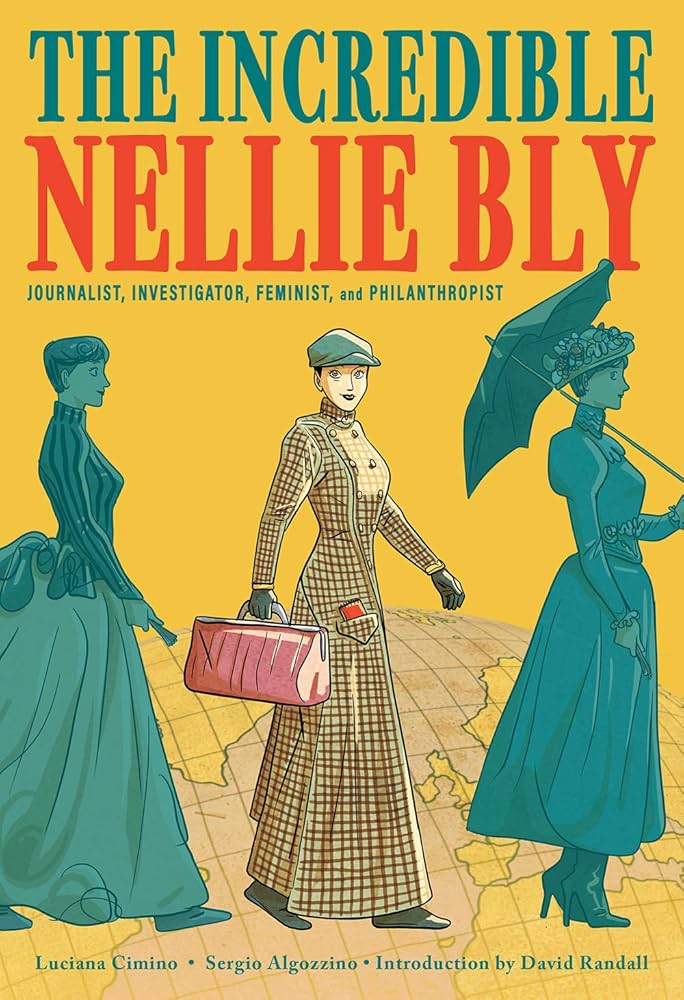
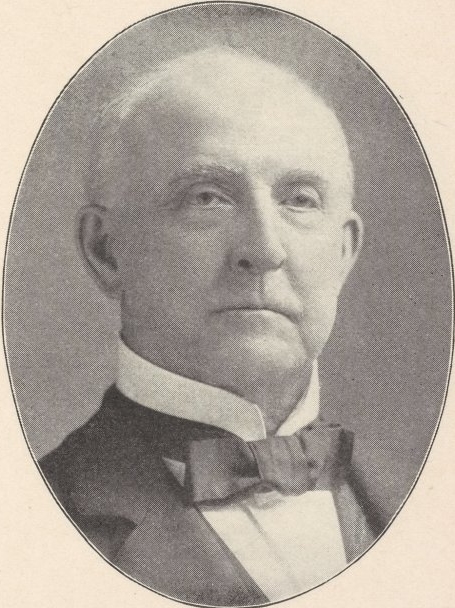
Born Elizabeth Jane Cochran in 1864 near Pittsburgh, she defied societal expectations from an early age. As the daughter of a well-respected businessman, she was expected to follow conventional paths, but instead, she displayed an insatiable thirst for knowledge and a deep desire to forge her own way. After briefly attending Indiana Normal School—today known as Indiana University of Pennsylvania—Elizabeth’s writing career took flight when a letter she sent to the Pittsburgh Dispatch reached the desk of its managing editor. Impressed by her boldness, George A. Madden offered her a position at the paper, opening the door to a rare opportunity for a woman at the time.
In 1887, Elizabeth followed her aspirations to New York City, where months of rejections and dwindling funds failed to dampen her ambition. Her perseverance eventually paid off when she walked into Joseph Pulitzer’s office at The New York World. There, she was assigned a groundbreaking undercover investigation that would instantly make her pen name famous.
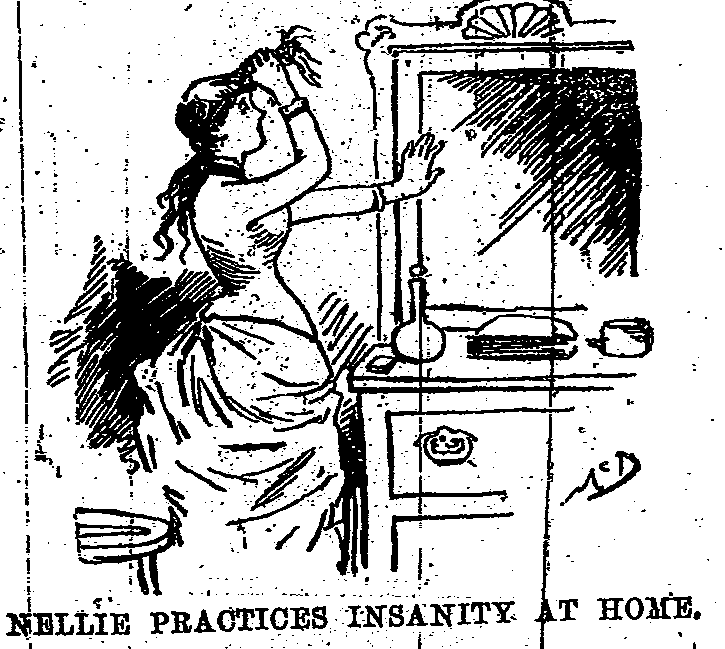
Of all the buildings on Roosevelt Island, I was immediately drawn to the ruins of the Octagon Tower—a once-grand structure that had served as the center hall to the Women’s Lunatic Asylum. Standing before its crumbling, graffiti-streaked exterior walls, I couldn’t help but think of Nellie Bly. How much courage it must have taken to enter this foreboding building, knowing she would face the unknown behind its massive facade. Gaining access to the asylum was no easy feat. Bly feigned insanity, first checking herself into a city-operated women’s boarding house where she adopted the demeanor of a disturbed woman. By making false claims that the other boarders were insane, she was quickly sent to Bellevue Hospital and later transported by boat to Blackwell’s Island.
Once there, Bly witnessed unspeakable horrors. The facility was infested with vermin. Patients were deprived of intellectual stimulation, subjected to icy, unsanitary baths, given nightly doses of opium, and fed rotten food. Even more alarming, patients’ cells were locked with keys that would have prevented nurses from rescuing them in the event of a fire. After ten days, Bly’s explosive two-part report—filled with detailed illustrations—was published. Her exposé sparked national outrage, leading to government intervention and a grand jury’s allocation of nearly one million dollars to improve conditions.

At the time, the term “lunatic” was a blanket classification used to describe anyone with mental health issues, leading to the institutionalization of people with conditions ranging from autism to depression to anger issues. Bly’s investigation illuminated these abuses and spurred lasting reforms in mental health care across the country, influencing change for decades. Her work was a precursor to the eventual uncovering of similar conditions at institutions like Pennhurst State Hospital, which was founded and operated well after the 1894 closure of the Women’s Lunatic Asylum on Blackwell’s Island.
Perhaps the peak of Bly’s fame came when she embarked on a solo, record-breaking trip around the world. Inspired by Jules Verne’s fictional character Phileas Fogg, she completed her 25,000-mile journey in just seventy-two days, six hours, and eleven minutes. While her record was eventually surpassed by George Francis Train, who completed the trip in 67 days, Bly’s adventure captured the world’s imagination and turned her into a global celebrity.
After the fanfare of her world trip, Bly shifted her focus to writing serial novels for Norman Munro’s New York Family Story Paper. In 1893, she returned to reporting for The New York World. She married Robert Seaman, a millionaire businessman forty-two years her senior. After his death in 1904, she took over his company, Iron Clad Manufacturing Co., but the business eventually went bankrupt due to mismanagement and embezzlement. Bly returned to journalism in 1911, covering national stories like the Woman Suffrage Parade of 1913. During World War I, she became the first woman to report from the front lines in Europe.
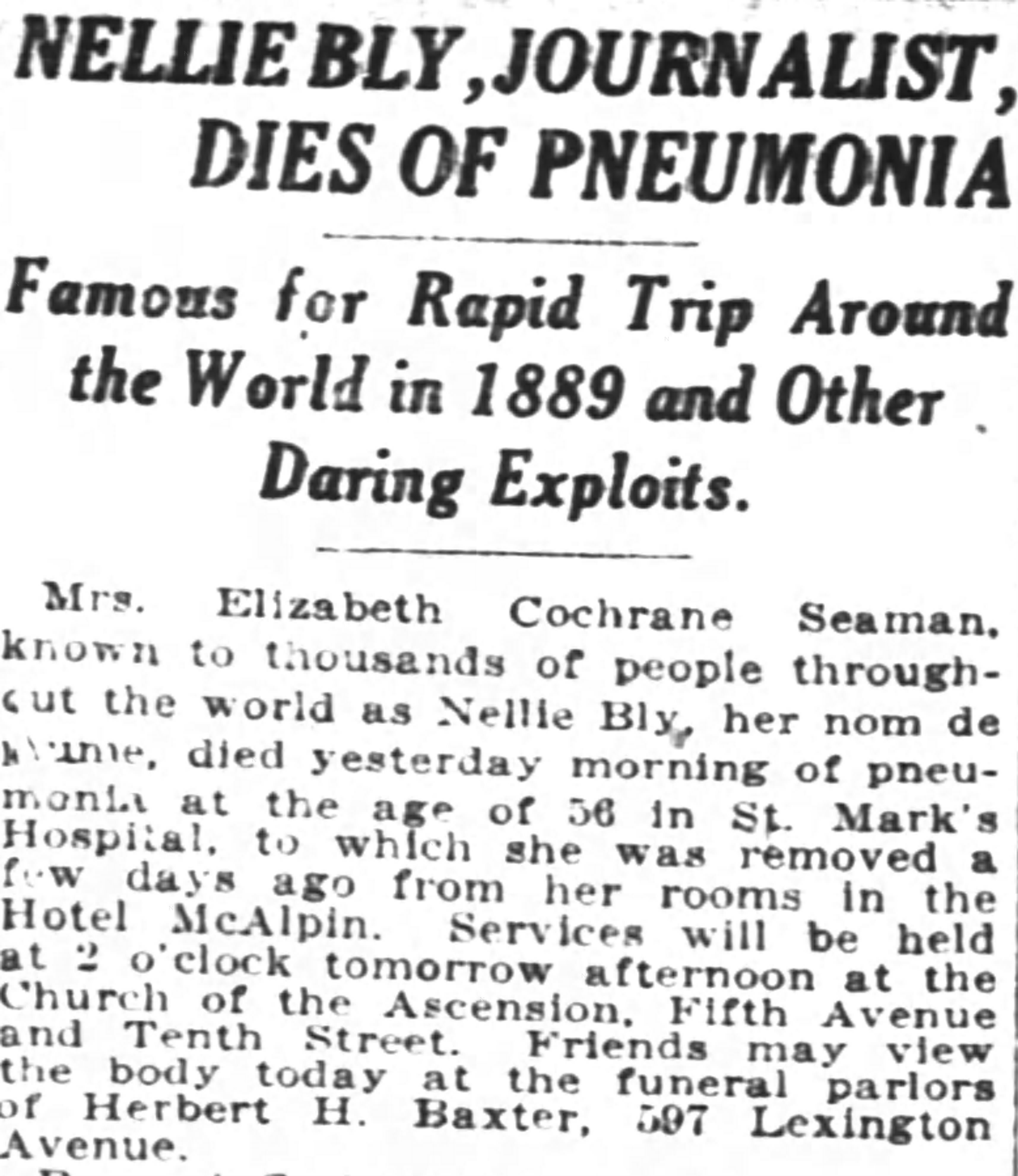
Elizabeth Cochran passed away on January 27, 1922, at the age of 57 from pneumonia and was buried at Woodlawn Cemetery in The Bronx. In 1998, she was inducted into the National Women’s Hall of Fame. Bly’s legacy endures, inspiring adaptations in media—from a 1946 Broadway musical to a 2019 opera. Today, her work continues to shape journalism, with her influence celebrated annually through the Nellie Bly Cub Reporter Journalism Award, which recognizes exceptional work by early-career journalists. The 2024 recipient was Maya Rosen.
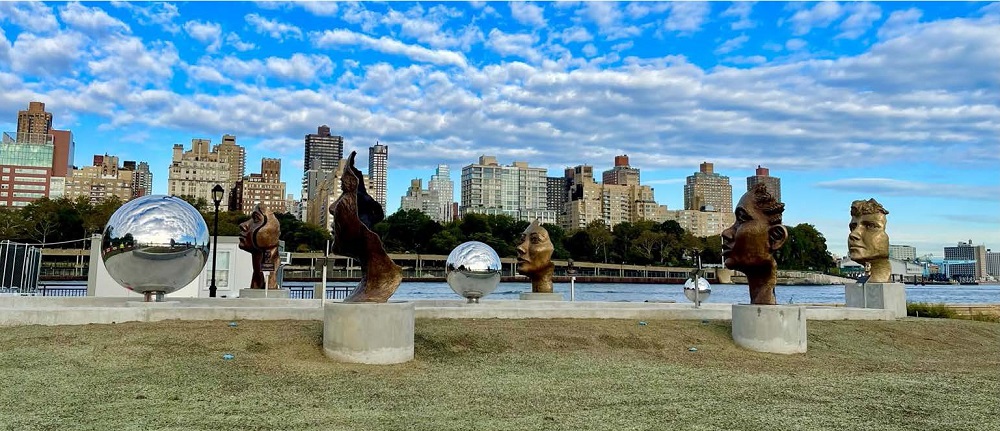
It’s been twenty years since I last set foot on Roosevelt Island. Today, The Octagon is a luxury apartment complex located at the center of the now bustling island, nestled between Queens and Manhattan. Though the original Alexander Jackson Davis design has been altered and renovated countless times, the stories embedded within its walls remain. In late 2021, a monument honoring Nellie Bly was unveiled on Roosevelt Island. Designed by artist Amanda Matthews, the installation—situated in front of the island’s historic lighthouse—features five towering bronze faces. Titled The Girl Puzzle, each face is inscribed with words written by Bly, representing the spirit and complexity of women’s stories.

 Keystone Wayfarer
Leave your thoughts