
Some stories last a lifetime, tales that dig deep and never let go. Growing up north of Boston, I have always been captivated by the Salem Witch Trials, a tragedy that has gripped my imagination and has remained a constant throughout my numerous decades circling the sun. Now, in my adopted home in Pennsylvania, I’ve found another local legend that rivals the intrigue of Salem.
Throughout Bucks County, the Doan Gang remains a powerful symbol of Loyalist resistance during the Revolutionary War. This notorious group of outlaws, both feared and reviled, has left an indelible mark on local—and now national—history. Their criminal enterprise has cemented their legend in history books and folklore, captivating generations, both new and old.
Recently, Discovery Channel aired a compelling feature on the enduring legacy of The Doan Gang, often called America’s first outlaws. The episode was eagerly anticipated by Bucks County residents, especially Mercer Museum Exhibit Specialist Clint Flack. Featured prominently throughout the episode, Flack guided viewers through the gang’s history and his exploration of the now-famous cave in Buckingham Township.
“I was eight years old when I first heard the story,” Flack writes from his Doylestown home. “At the time, I was constantly checking out the same books about dinosaurs and pirates from my school library. Then one day, my librarian introduced me to the Bucks County ‘land pirates.’ I was fascinated. Here were people who seemed like pirates, full of adventure and mystery, and they lived here, where I grew up! I’ve been hooked ever since.”
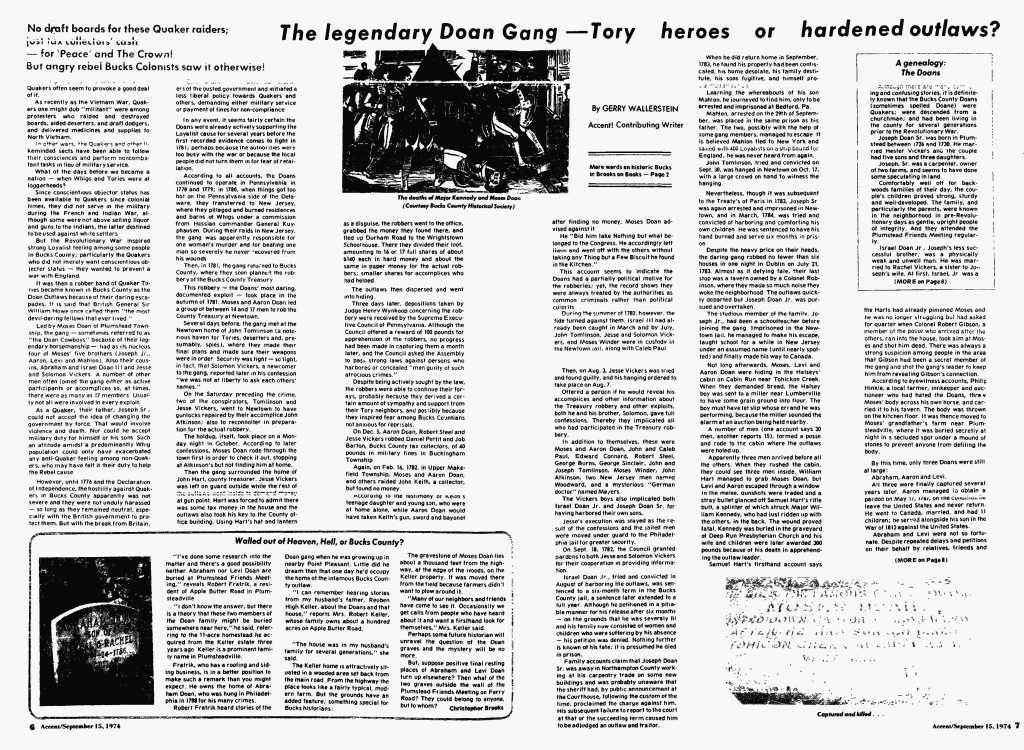
It is said the Doan family arrived in America in 1629, settling in Sandwich, Massachusetts, before moving to Pennsylvania around 1696. In Bucks County, they would come to play a significant role in local history. Joseph Doan, Sr. lived on a farm south of Plumsteadville with his wife, Hester. Their sons—Joseph Jr., Moses, Aaron, Levi, and Mahlon—and cousin Abraham were instrumental in shaping the Doan legend.
“Joseph Doan, Jr. was a principal member of the gang and may have even led it at times,” Flack explains. “His life from adolescence to his nineties is a fascinating study of complexity and intrigue. He suffered a bullet wound that left him with a distinctive scar, which was remembered decades later by Henry Mercer’s grandfather.”
“Joseph was a figure of contradictions,” continues Flack. “Though he was involved in many of the gang’s robberies, he was also a school teacher, and people petitioned to save him from execution, though he escaped from prison, making the petition moot. He later lived in Canada and had many descendants.”

From a base about thirty miles from my home in Schwenksville, The Doan Gang reportedly stole over two hundred horses and sold them to British troops stationed in Philadelphia and Baltimore. Over the course of their decade-plus-long reign, the gang included upwards of sixty members. One notable member mentioned by Flack is Gideon Vernon.
“Gideon was essentially a spy working under British spymaster John Andre,” Flack shares. “He delivered messages between British General Howe and his brother, Admiral Howe. Gideon also claimed to have spied on George Washington at Valley Forge and faced charges of kidnapping before being read out of the Quaker Meeting in Chester County.”
“After the war, he moved to Canada and petitioned the British government for compensation,” Flack adds. “His detailed revelations about his life, corroborated by other sources, offer significant insights into the broader story of The Doan Gang.”
A secret cave in an area noted as a quarry, believed to have been used by the outlaws, was a focal point of the Discovery documentary. Flack, along with property owner Frank Lamitina, began excavating the limestone-filled hillside in 2019, reaching a depth of nearly eighteen feet.
“My elementary school librarian, the same one who introduced me to The Doan Gang, also helped me locate the Buckingham cave property,” reveals Flack. “I had my dad drive me there, and I knocked on the door asking to see the cave. The property owner was not amused, and told me to leave. It wasn’t until decades later, by pure chance, that I met the current owner of the property while working at my friend’s business. He was much more receptive to investigating the cave. We’ve been digging ever since.”
“We’ve made several more exciting discoveries since the filming,” an excited Flack declares. “We located part of the ‘1775 M.DOAN’ inscription mentioned by county school superintendent Joseph Fell in his 1859 article about the cave’s discovery. Mind-blowing!”
“We also uncovered remnants of a large colonial glass bottle, suggesting the cave was in use during The Doan Gang’s time,” Flack confides. “We’re still searching and hope to find even more evidence of the eighteenth-century occupation.”
Though some romanticize the Doans as Revolutionary-era Robin Hoods, targeting the wealthy, their actions largely benefited themselves. They made only occasional gestures towards helping others, primarily focusing on their own gain.
“It is mostly fiction that they stole from the rich to give to the poor,” confirms Flack. “The only story close to this ideal is Moses Doan giving his father money after the Gang’s robbery of the Bucks County Treasury in 1781. This money may have come from his share of the treasure. Some new evidence from Canadian petitions after the war suggests that Moses’ father was involved in the Gang’s activities.”
Extending beyond the Revolution, the Doans were noted threats to the governments of Pennsylvania, New Jersey, Maryland, and as far west as the Ohio Valley. In 1783, the Pennsylvania General Assembly labeled the Doans as robbers, felons, burglars, and traitors. Authorities revived a medieval English practice of outlawry, sanctioning the execution of accused criminals without a trial. While most of the gang fled to Canada, several were captured and executed, with Moses Doan meeting his end in a dramatic shootout.
“The two best-known people who had to deal with the Doans specifically were Benjamin Franklin and John Dickinson, who were both presidents of Pennsylvania’s Supreme Executive Council during and after the Revolution,” Flack notes. “Franklin and Dickinson managed the petitions for and against executing Aaron, Levi and Abraham Doan, trying to figure out where Loyalists who robbed people would fit into the post-Revolutionary world.”
“Locally, the Doans frightened anyone involved in the Revolution,” Flack acknowledged. “George Wall, Jr., agent of forfeited estates, wrote about being scared to go about in the night during the Gang’s active years. The Gang also threatened Revolutionary figure Capt. William McCalla. Imagine how he felt about them.”
Regarding the reported threat against Speaker of the House Frederick Muhlenberg, Flack says, “There was no detailed plan, as far as we know, other than what was mentioned in the note. The note threatened to kidnap Muhlenberg and murder him if demands weren’t met. Muhlenberg hired a bodyguard after learning about the note, and no kidnapping or murder ever occurred. However, Muhlenberg’s store was robbed, and his horse stolen—suspected to be the work of The Doan Gang.”
The grave markers of Abraham and Levi stand just outside the Plumstead Friends Meeting Burial Ground in Doylestown, along Point Pleasant Pike. However, there is some speculation that these tablets might not mark the Doans’ graves but rather those of unmarked soldiers. During a recent visit to this historic site, I discovered the markers as expected—situated just beyond the well-kept burial ground and adjacent to a carefully preserved stacked stone wall.

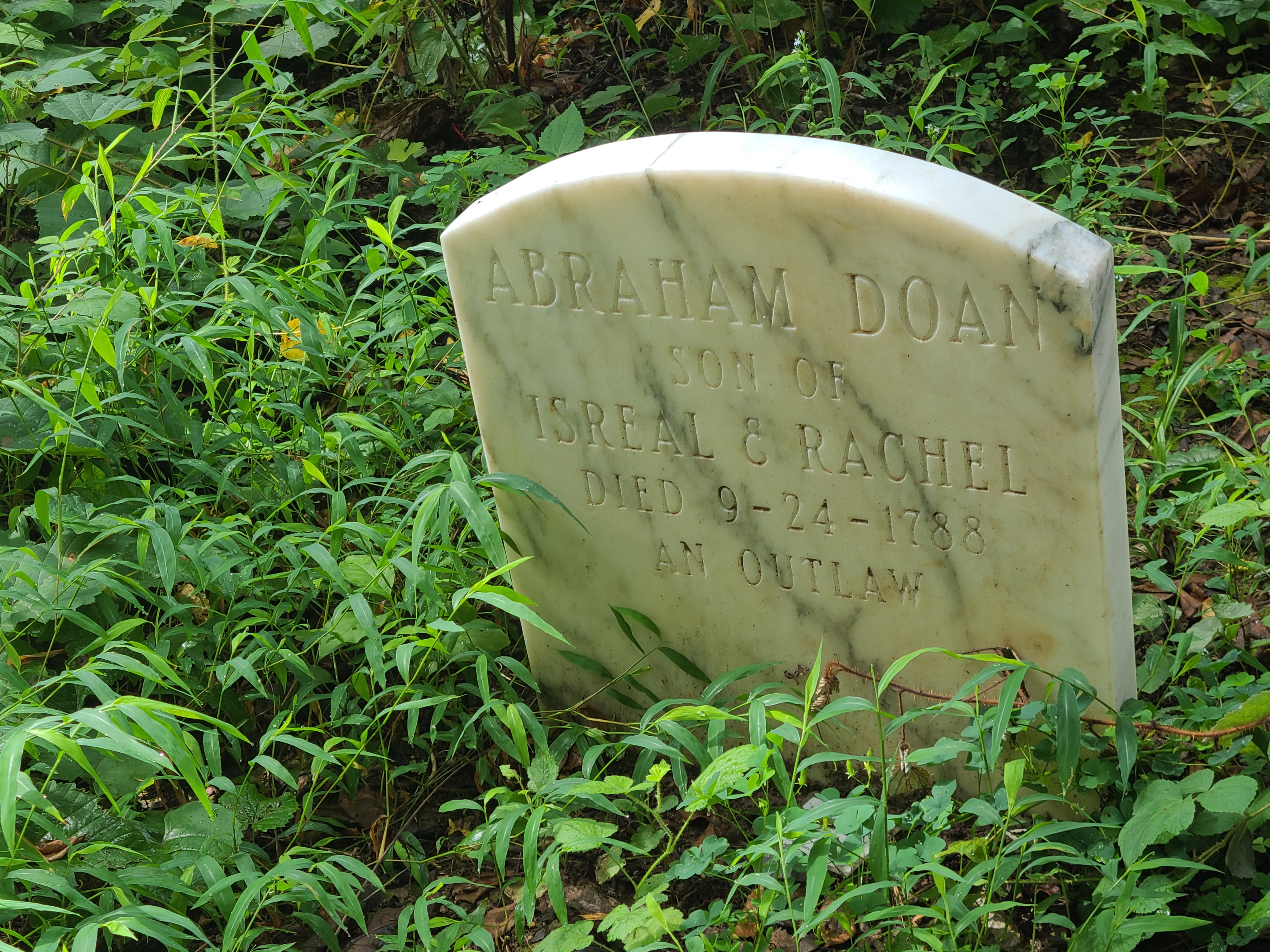
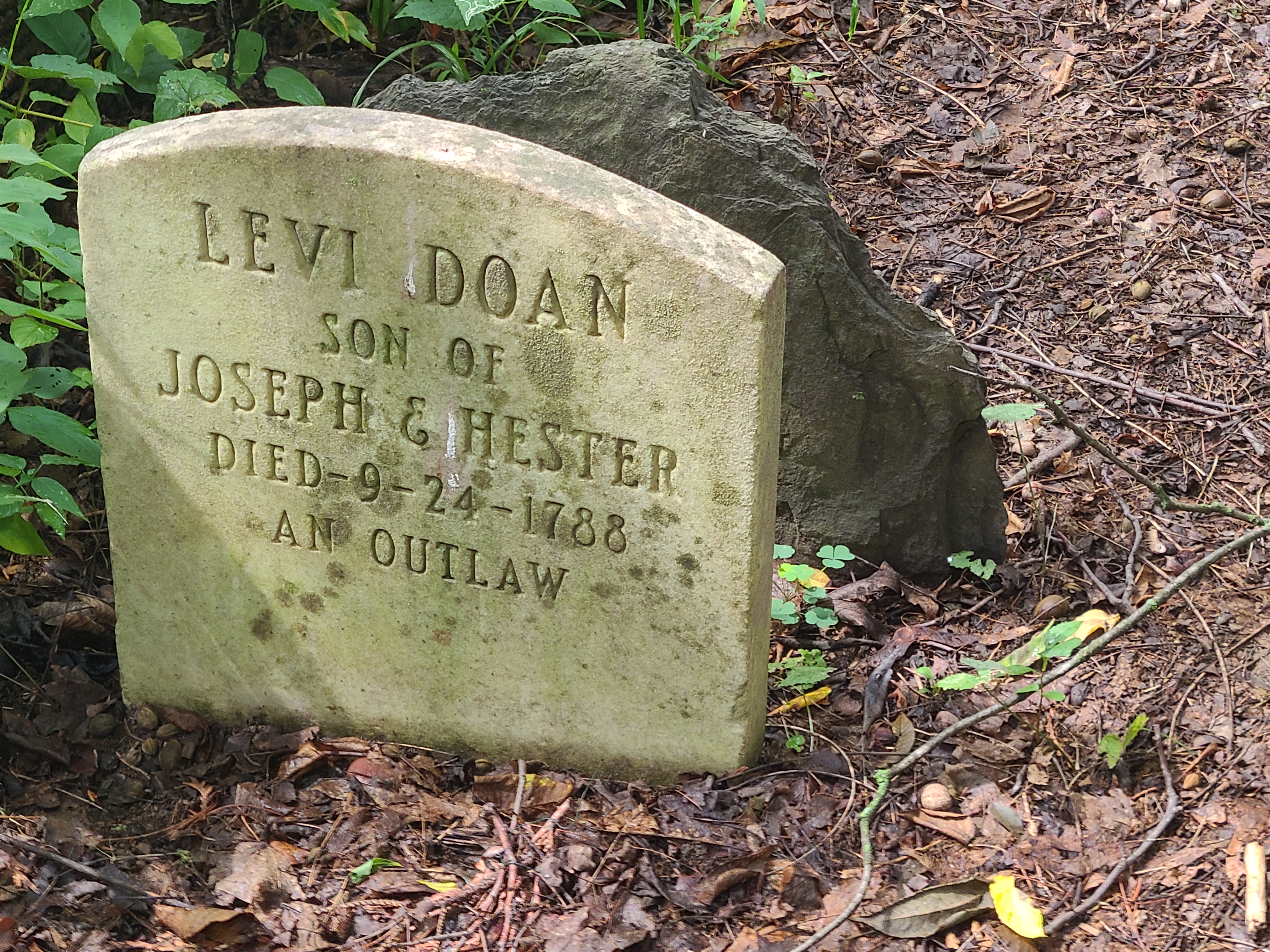
“Unfortunately, we will probably never know for sure,” Flack said. “The earliest accounts of Abraham and Levi’s burial come from the 1850s. One account by Gen. W.W.H. Davis describes a woman who, as a child, witnessed the outlaws’ burials in a piece of woods across the street, also owned by the Meeting. A similar account appears in another Doan history from this time.”
“Abraham and Levy were not active Quakers and had participated in violence, directly opposing Quakers’ ideals,” Flack continues. “But their mothers were active Quakers and may have pleaded for them. They may have been buried by the Meeting, but outside the cemetery itself, which aligns with the 1850s accounts.”
When asked about the Doan legacy in American history, Flack remarked, “Ultimately, their actions were futile. The rebels won, and the Doans lost everything. Those who were fortunate enough to survive had to move to Canada or England, forfeiting most, if not all, of their property.”
“Their story serves as a reminder that American colonists during the Revolution were not uniformly united behind the rebels. Many wanted no part in the conflict or wished to remain under British rule. This part of history is often overlooked, but it is crucial because it reflects the truth.”
“The best part of the Doan story today is that it inspires curiosity about local history,” Flack notes surely with a smile. “It shows that history isn’t just in textbooks; it was lived by real, complicated people—like the Doans.”

The Doan Gang’s most notorious crime was the theft of tax money from the Bucks County Treasury on October 22, 1781. To this day, the treasure from that heist and others remains unrecovered. According to Flack, “Evidence suggests that the treasure was spent long ago. Historical documents indicate that the treasure from the robberies was divided among the Gang members. They were fugitives after all, wanted men who couldn’t hold regular jobs and needed the cash for daily expenses.”
Flack adds, “The Doan Gang members believed they were fighting for a cause. They didn’t see themselves as random robbers but as participants in a civil war. While we might disagree with their methods and motives today, their story is a testament to the complex nature of historical conflicts.”
For the curious exploring parts of Bucks County with metal detectors in hand, will any part of The Doan Gang treasure be found? Flack reveals, “Joseph Doan, Jr. returned to Bucks County from Canada decades later to collect inheritance money. If there was buried treasure, he probably would have dug it then. But history is full of surprises. Goonies never say die! There’s still much we don’t know about the past. That is why we keep investigating.”
The Mercer Museum’s exhibit, The Doan Gang: Outlaws of the Revolution, opened on May 4, 2024, and will run through December 31, 2026. Look for rebroadcasts of Discovery Channel’s Expedition Unknown. The Doan Gang episode is titled Traitors’ Treasure of 1776.


 Keystone Wayfarer
Leave your thoughts