
Confession time – I’m a gardening nerd. As soon as spring breathes new life into Mother Earth, I willingly immerse myself in my spacious garden. I find there is an inexplicable exhilaration in getting my hands dirty, engaging in the rhythm of weeding, dividing, replanting, and mulching. These passions oddly run deep within me. And truthfully, that’s one of the reasons I chose a home in Schwenksville. Here, nature isn’t something distant; it’s right at your front door.
A quick five-minute drive up the road from my aging two-story brick colonial lies a hidden gem. Despite its sprawling size, it seems few are aware of its existence. Perhaps that’s about to change.
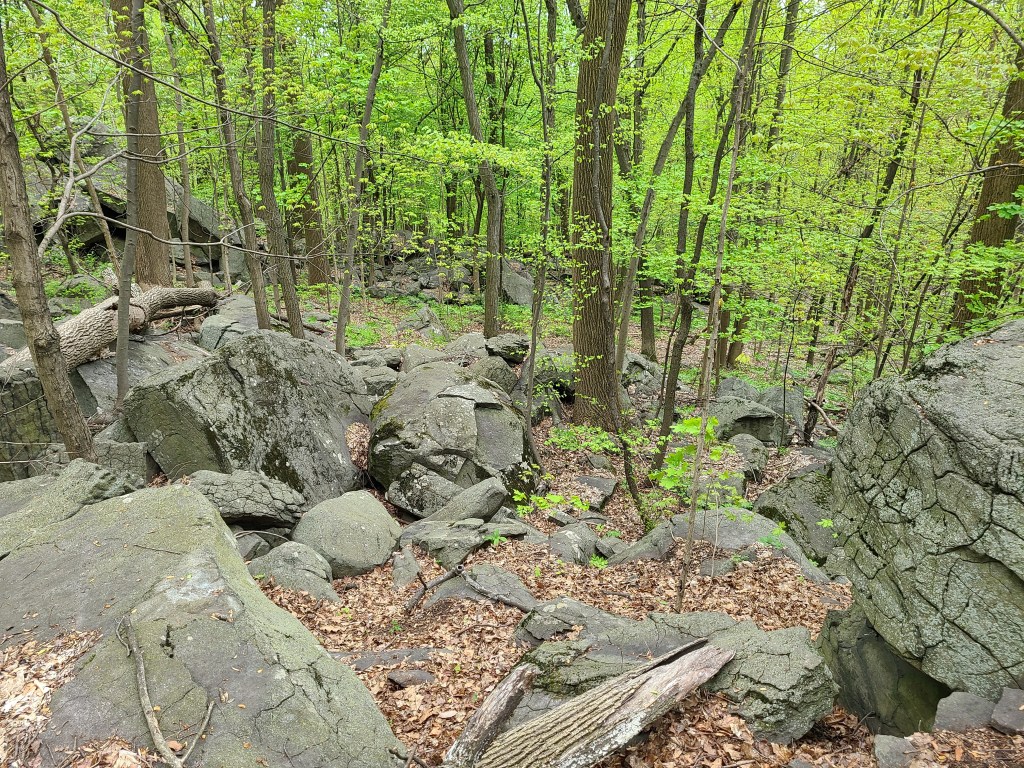
Meng Preserve stands as a living testament to the legacy of sisters Eve and Edna Meng. Located a stone’s throw from the intersection of Mine Hill and Meng Roads, this steeply sloped forest spans nearly one hundred acres and boasts an impressive outcrop of heathered diabase rock and enchanting vernal pools. The land is part of a much larger landscape known as Stone Hill Greenway.
Once the home of Eva, the terrain also served as a sanctuary for Hanna Keely (1864-1952) and her Girl Scout Troop. It was a way to engage young minds with the natural world in the early 1900s. And expanding young minds was important to the sisters, both instrumental in the creation of Schwenksville’s first library.
What is now known as the Perkiomen Valley Library was started in 1934. Originally located in the basement of Albert Bromer’s house on Main Street, the free public library served the townships of Lower Frederick, Skippack, Schwenksville, and surrounding areas. It moved into Alfred Panepinto’s designed building on Second and Church Streets in January 1957. Construction was supervised by Wayne Meng and cost over seventy thousand dollars to erect. The library was initially supported entirely by volunteer contributions, including that of head librarian Eva Meng. Today, the library houses more than twelve thousand volumes and continues to offer citizens a quiet place to read and learn.
Upon Eva’s passing in 1994, the property was gifted to the Valley Forge Audubon Society. The unbroken stretch of forest provides essential habitat for wildlife; documented sightings include over fifty-eight bird species, among them the elusive Kentucky Warbler, the enchanting Northern Parula, the vibrant Scarlet Tanager, and the beloved Wood Thrush, cherished by none other than Henry David Thoreau.
Meng Preserve is scattered with mature hardwoods including tuliptree, red and white oak, sugar maple, hornbeam and shagbark hickory. Shrubs include flowering dogwoods, black cherry, spicebush, and low-lying skunk cabbage.
Four color-coded and well-marked hiking trails, including routes named in honor of both Meng sisters, are enclosed within the Preserve’s natural canopy. The trails can be accessed from parking areas off Delphi Road and Ryanford Road. The Wetlands Trail (blue) is a one-mile loop with an elevation of 85 feet. From Mine Hill Road, follow the Stone Hill Trail (yellow) as it rises to an impressive elevation of 285 feet. Circle back to your car on the challenging, downhill Edna’s Trail (purple).
Eva Meng (1901-1994) and Edna Meng (1908-1987) were born to fruit farmer Abraham Lincoln Meng (1865-1939) and homemaker Annie Hallman Reinhold Meng (1876-1949). Their younger brother, Wayne Meng (1918-1998) served in the army during World War II. All are buried at Keelys Church Cemetery.
Valley Forge Audubon Society donated a conservation easement to the Montgomery County Lands Trust in 2004 to protect Meng Preserve from development.




 Keystone Wayfarer
Leave your thoughts