
A few weeks ago, a work colleague caught me off guard with a curious question. “Aren’t you the girl that can be found wandering around cemeteries?,” he asked, with a hint of amusement and a curious smile. “Why yes, that’s me,” I replied, matching his grin. Little did I know then, there’s a term for it – I’m a tombstone tourist!
I’m not drawn to famous rock stars or actors, mind you. Instead, I find solace among the older stones; their intricate engravings and cryptic symbols. Many of these markers are weathered to the point of being hard to read or altogether illegible, and that only adds to their charm. It sparks a quest within me to unravel the mysteries of those who rest beneath. What was their story? How did they live?
As a resident of Schwenksville, an area surrounded by history, it is pretty easy to find sites to explore. I began chronicling my adventures with this blog, starting with one of the larger local cemeteries, Keelys Church Cemetery. But there are many others, smaller ones, that are just as fascinating. Some boast only a handful of headstones, others just one. By taking the time to look around, some remarkable tales can be found.
Now, it is important to recognize the distinction between a cemetery and a graveyard. While most tend to use the words interchangeably, they differ with respect to space, location, religious affiliation, and stone requirements.
A graveyard primarily refers to a burial site almost always on church grounds. The compound word originates from the German “graban,” meaning to dig. Often, people buried in graveyards were members of a church, and their burial place had a spiritual meaning. Looking beyond the religious aspect, many graveyards typically have older stones that are arranged somewhat disorderly in manner and, in many cases unfortunately, are not particularly well maintained.
In contrast, a cemetery is generally not associated with a church. The first modern American cemetery is located in Cambridge, Massachusetts. Dedicated in 1831, Mount Auburn Cemetery is a garden cemetery, and its design further served as inspiration to others, including the expansive Laurel Hill Cemetery in Philadelphia. Its serene, park-like terrain broke with the harsh colonial views on death. In fact, the word “cemetery,” derived from the Greek, translates to “sleeping place,” emphasizing the purposeful design of the grounds as a final resting place for the dead.
The family plot often serves as a unique testament to the endurance of a family through generations. The arrangement of markers within can show the dynamics of the family as gravely proximity can indicate the interconnectedness of individuals. For example, a husband and wife side-by-side, child-sized markers near an adult suggesting a heartbreaking loss. These locations can often be in the most ordinary of places, often on ancestral property. The closest family plot to visit from Main Street Schwenksville is that of the Underkoffler Family.
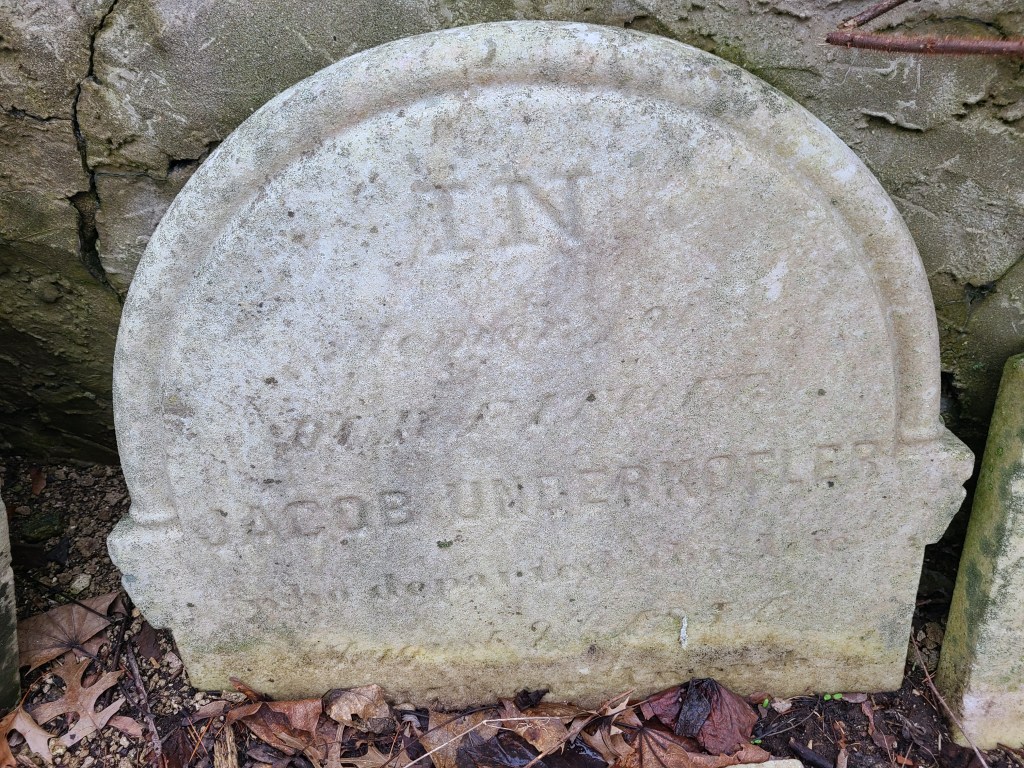
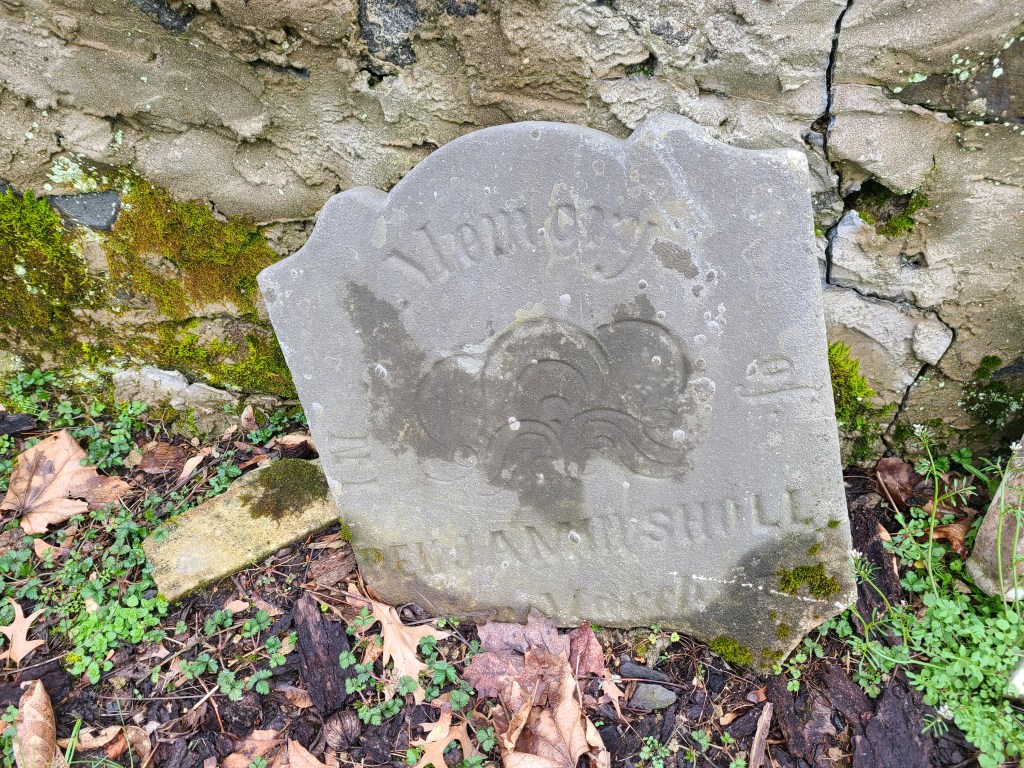
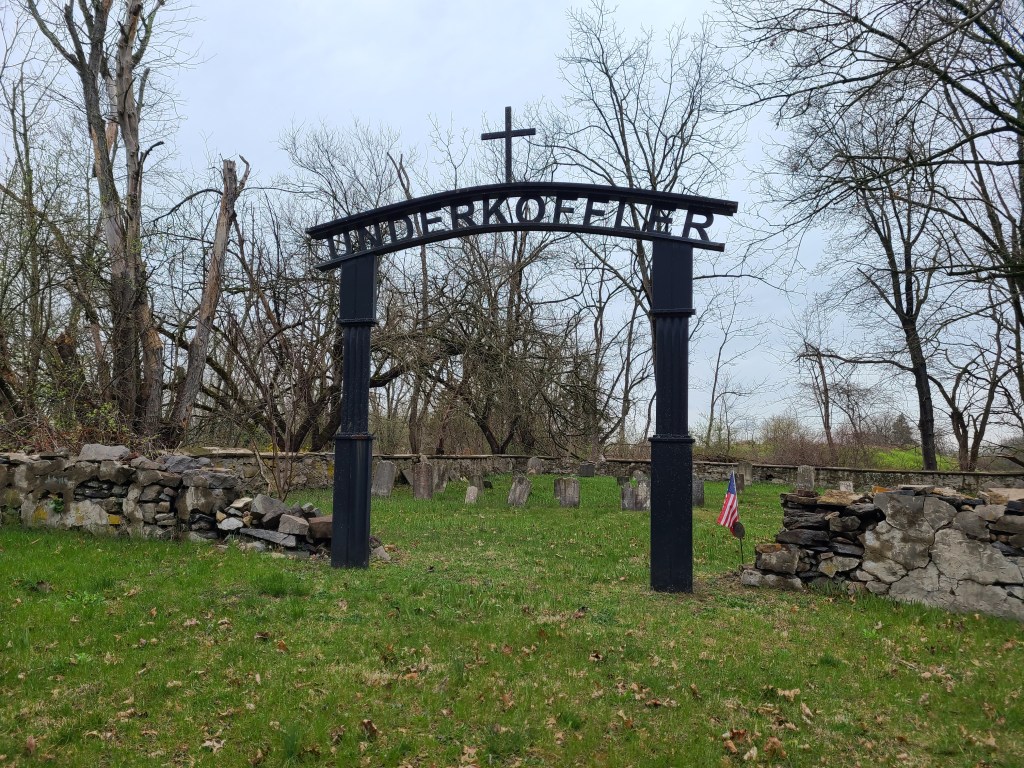
Published in 1884, History of Montgomery County, Pennsylvania, Volume II cites the burying place of the Underkofflers, “the first settlers here,” as a few steps from North Gravel Pike in Zieglerville. The surnames of those resting here include Cressman, Dreisbach, Long, Sholl, Schlotterer, and of course Underkoffler. The name is an Americanized form of Austrian German meaning “under the mountain.” There are roughly forty headstones enclosed by a decaying stone wall. A handful of damaged stones, lost to time, use the wall as support. Here are some of their stories.
Jacob Underkoffler Jr (1747-1826) is buried along with his wife Magdalena Weidner Underkoffler (1753-1826). He was a soldier in the American Revolution, serving under Captain Henry Boyer of the Philadelphia County Militia. His father owned a great deal of land in the area of Frederick Township that was deeded to his sons prior to his death. Jacob and Magdalena are believed to have had twelve children. Magdalena’s father, also a recognized patriot, arrived in Philadelphia aboard the ship Alexander and Ann in 1730 from Rotterdam.
Flora Allebach (1874-1901) was the wife of Moses G. Allebach. She died of pneumonia at the young age of twenty-seven. She had four children; the youngest was four days old at the time of death. Her father, Nathan H. Yorgey (1849-1920) is buried at Keelys Church Cemetery. His wife, Catherine, died of cancer in 1905. Her son, Glenn Allebach (1897-1969) is a World War II veteran, Army/Private First Class.
George Schlotterer (1790-1865) married Susanna Underkoffler Schlotterer (1793-1882). The two are buried together at Underkoffler-Schlotterer Burial Ground. They had two sons – Jesse Underkoffler Schlotterer (1820-1905) and Samuel (1837-1895), the latter a member of the 119th Infantry in the Civil War. Her parents are Jacob and Magdalena Underkoffler.
Elizabeth Underkoffler Treisbach (1787-1868) married Johannes “John” Treisbach (1791-1867). They had at least four children – Susanna Treisbach (1825-1829), Elizabeth Karwer (1822-1897) and Hilary, who in 1885 grew a pumpkin weighing eighty-five pounds. Their son, Reuben Underkoffler Treisbach (1829-1898), served in the Civil War.
Magdalena Sechler Underkoffler (1779-1832) is the wife of George. They had seven children, including daughter Magdalena (1802-1822) who is buried with her mother at Underkoffler-Schlotterer Burial Ground. Her grandson, Amos S. Underkoffler, served in the 51st Infantry out of Wisconsin in the Civil War.
Katherine Ziegler (1812-1901) is the granddaughter of David Schmidt Underkoffler (1735-1831) who is buried at Underkoffler-Schlotterer Burial Ground. She married Abraham Ziegler (1813-1905) and moved to the Midwest. An article from the Clinton Daily Democrat in Clinton, Missouri dated 1901 noted that the couple were the smallest people in the state – four feet and four feet two . They had twelve children.
Rinhard Groff Keeler (1822-1897) is the husband of Sarah Keeler. An article from the Lancaster Intelligencer from 1860 noted that he killed a three-foot long horned snake in a meadow on his property in Zieglerville. It was confirmed by the Montgomery Ledger that the snake is rare in this part of the country. The poisonous snake features horns near its tail. Sarah was the daughter of Benjamin Sholl (1791-1868) and Elizabeth Keeler Sholl (1791-1868), both of whom are buried at Underkoffler-Schlotterer Burial Ground.
The Underkoffler site is on land currently owned by the Christ Evangelical Congregational Church. James Underkoffler, a descendant, had the beautiful arch that graces the cemetery entrance erected in 2003. When visiting, please be mindful.





Additional Local Sites of Interest
The Pawling Cemetery is a private burying ground used by Pawling, Reiff, and Hauff families. It is located near the intersection of Perkiomen River Road and Deer Run Road. According to local tradition, a few slaves and Native Americans are buried here in unmarked graves. Some gravestones have been moved to Augustus Lutheran Cemetery in Trappe. There are thirteen memorials; the oldest dates to 1726.
Lederach Burial Ground is a family graveyard located on the Lederach Farm in Lower Salford Township. During the 1980s, there were six tombstones. By 1999, only two markers remained.
Haman Cemetery is the resting place for Walter P. Haman and wife Charlotte. Haman was a presidential bodyguard who founded New Life Boys Ranch in 1954. The location borders the campus of New Life Youth and Family Services on Freeman School Road.
The Kempfer-Markley Cemetery is on the north side of Route 73 in Skippack. Also known as Markley Association Cemetery, it is badly neglected and now has only one memorial inscribed, “In memory of Johannes Kempfer and Philip Markley, their families and descendants buried here 1760-1845.” The actual gravestones were relocated in 1975 to the Museum of the Trappe Historical Society.
Leydich or Leidich’s Burial Ground is located in the southwestern part of Frederick Township east of Swamp Creek. It is the largest private burying ground in the area. The spot was chosen at the junction of four family farms. There are one hundred forty-two memorials; the oldest dates to 1759.
The original location of Reiff’s Church Cemetery is noted at the southwest corner of Upper Mainland Road and Old Morris Road in Lower Salford Township. It existed until about 1850 when gravestones once on the site of Jacob Reiff’s Farm were removed by a later owner. Graves reportedly numbered in excess of one hundred.
Hollowbush Burial Ground reportedly has one large stone remaining that was erected in 1902. It reads, “in memory of Mother Hollowbush and sons Peter and Christian. Emigrated from Palatine 1730. Settled on this tract where they and relatives are buried.” The family has been the subject of extensive genealogical study since 1890.

 Keystone Wayfarer
Leave your thoughts